Lead magnets generate many requests, but no sales: what to do
Let’s imagine a familiar situation. Marketing launches new lead magnets, the number of requests skyrockets, and the cost per lead (CPL) drops. In the ad account metrics, everything looks perfect. But managers can’t keep up with callbacks, the CRM gets filled with “raw” contacts, and the number of real deals isn’t growing.
Sales sounds the alarm and complains that the inbound leads are completely unqualified. In reality, the problem isn’t the leads themselves. The main reason for low conversion lies in the lack of a clear processing system between the initial request and the actual sale.
The market has changed: cheap funnel entries are the new normal
Users increasingly prefer self-serve product exploration. Content has become the first touchpoint with a company, and lead magnets, guides, and calculators have turned into a B2B marketing standard. This gives businesses more requests and a cheaper entry into the sales funnel, but simply downloading a checklist doesn’t mean readiness to buy.
According to Forrester, by 2025, over half of major B2B deals will go through digital self-serve channels. This means the first contact increasingly starts with content, not a live conversation with a sales rep. The inbound flow is becoming more accessible, which is a result of normal market evolution.
But if cheap leads are the new normal, why do they so often fail to bring sales?
The illusion of efficiency: when marketing “wins” only in metrics
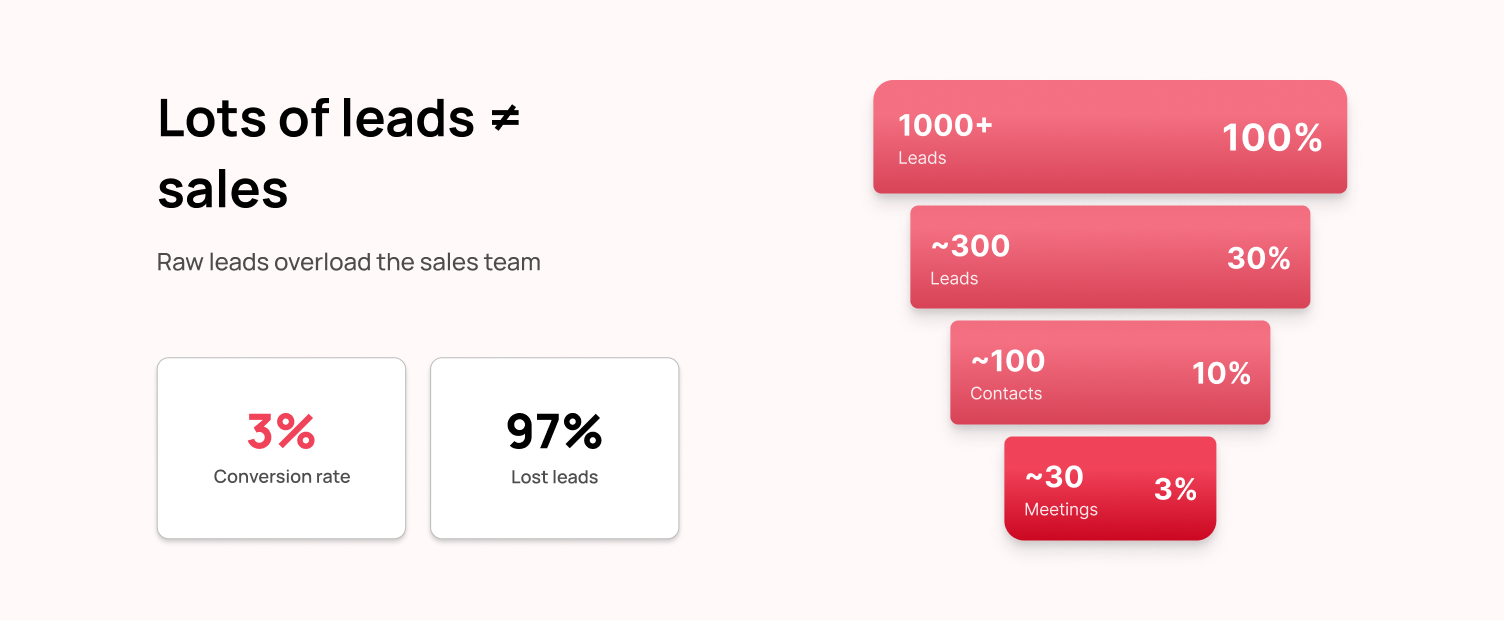
Content lead generation often creates an illusion of success. Marketing sees a low CPL and a large volume of contacts at the top of the funnel. However, without a separate qualification stage, these “raw” contacts fall directly to the sales department.
In its 2025 review, Demand Gen Report explicitly notes that the market is moving away from the classic lead-centric model, where the main goal is to collect as many contacts as possible through gated content and quickly pass them to sales. The volume of requests no longer equals business efficiency.
And this is exactly where the entire funnel starts to break.
Where the sales funnel breaks: when sales becomes a “filter”
If there is no primary qualification process, the sales team is forced to do someone else’s job. For example, a manager gets a request for a “free checklist,” calls quickly, and it turns out the person just came to “take a look,” with no budget and no specific task.
Instead of negotiating, managers manually sift through non-target requests, clarify basic things, and waste time on contacts who aren’t ready for a substantive conversation yet.
According to Salesforce, sales reps spend up to 60% of their working time on non-selling tasks. When there is no qualification system, the sales department works not as a revenue generator, but as a simple filter for the “raw” flow. This is the hidden cost of mass leads.
The root of the problem is the lack of a systematic LQM
In most companies, the LQM (Lead Qualification Management) stage is either completely absent or exists only “in the heads” of managers. There is no unified standard, script, or evaluation criteria.
As a result, one manager qualifies leads in 2 minutes, another takes 15, and a third skips important questions altogether. The quality of request processing becomes entirely random.
LQM is not just an additional process. It is a critical filter between marketing and sales. Without it, any successful lead generation will eventually overload your sales department.
What a proper LQM process should look like
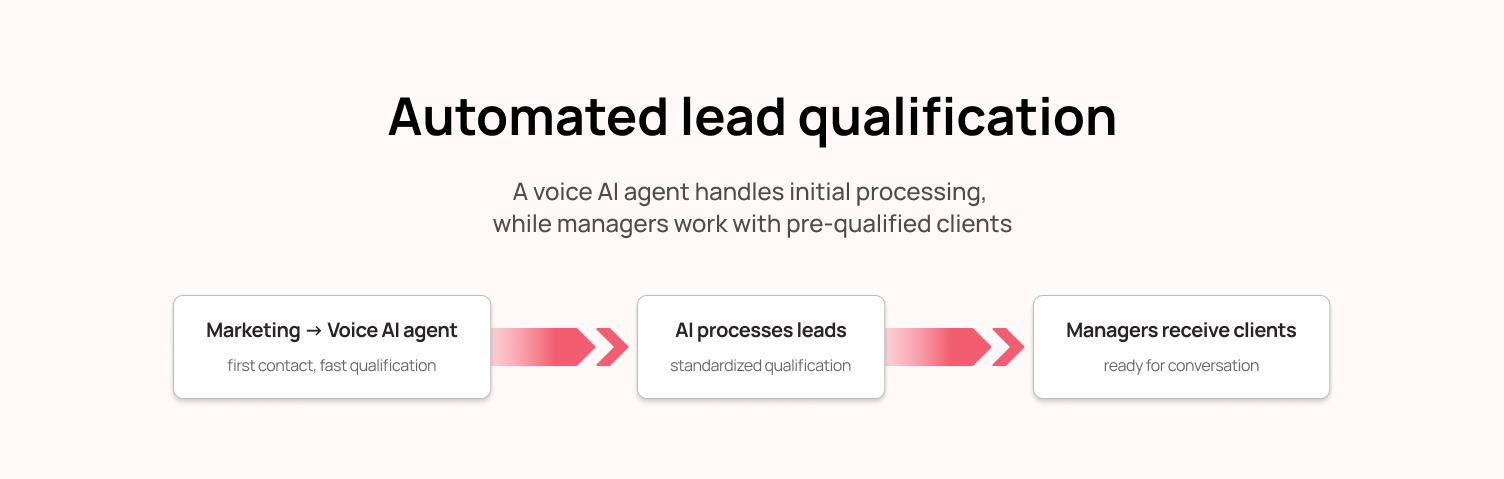
Properly set up qualification consists of several mandatory steps. Speed is critical in this process: the faster the first contact happens, the higher the probability that the lead is still “in the context” of their request.
- Fast first contact: minimum response waiting time for the client.
- Standardized questions: a unified approach to gathering information.
- Clear criteria: evaluation against the Ideal Customer Profile (ICP), identifying needs and readiness to buy.
The result of this approach is always transparent. Targeted requests go to the sales department, “cold” ones return to marketing for further nurturing, and irrelevant ones are filtered out immediately.
Why manual qualification doesn’t scale
The more new requests you get, the faster manual processing breaks down. The human factor inevitably leads to slow responses, inconsistent call quality, and a sharp increase in the team’s workload. Managers get tired and burn out, and business process automation becomes a vital necessity.
AI voice agent as a modern solution for LQM
Moving qualification into a separate, manageable process is much easier with the UniTalk AI Voice Agent. Essentially, the AI agent takes over the entire first level of working with leads, which is the exact part that is absolutely impossible to scale manually.
What Artificial Intelligence does:
- Provides instant first contact with the client.
- Asks the same qualifying questions without deviating from the script.
- Determines the relevance of the request.
- Records the collected data and automatically transfers it to the CRM.
As a result, sales receives not just a contact, but a clear situation and a prepared client. It’s important to remember: AI does not replace a manager in complex sales; it only removes the routine from the first stage.
AI is becoming the new standard in sales
Artificial intelligence gives managers their time back for real sales. Modern research shows that AI agents are already becoming a key element both in actual sales and in the process of attracting and warming up new clients. LQM is gradually transitioning from a manual function to a fully automated infrastructure.
The business impact of proper automation
Implementing automated qualification radically changes the way a company works:
- Sales reps work only with high-quality, interested leads.
- The chaos in processing requests disappears, and response time is reduced to a minimum.
- Conversion from lead to call and from call to deal becomes predictable and manageable.
- Marketing gets the opportunity to scale campaigns without the risk of “crashing” the sales department.
Conclusion
Cheap leads from content funnels have become the new market reality. But the volume of requests itself no longer creates sales. Without systematic qualification, it only overloads the sales department and reduces the efficiency of the entire funnel.
In these conditions, the winners are not the companies that generate the most requests, but those that can quickly and systematically determine their value. By building a separate LQM process, you get not just more contacts, but a manageable and predictable sales funnel, passing only prepared clients to your managers.