SEO + Call Tracking: How to Understand What Prevents a Website from Converting
In 2026, evaluating SEO effectiveness based only on traffic and rankings is methodologically flawed. A website may be growing in organic visibility, reaching the top 3 for competitive queries, increasing CTR — and still not showing corresponding sales growth.
The reason is simple: a significant share of commercial inquiries happens outside standard web analytics. In other words, your SEO is working, but you simply do not see it because you are not tracking all the right indicators. There are also opposite situations: everything on the website seems to be working well, but sales are not growing — and here too, additional parameters need to be analyzed.
According to HubSpot and Invoca studies conducted in 2025, in high-ticket niches such as healthcare, B2B services, construction, and automotive, 55% to 75% of leads come through phone calls. At the same time, up to 30–40% of these inquiries are not recorded as SEO conversions unless a call tracking system is in place.
This creates a critical gap in analytics:
- the SEO strategy is built on click data;
- budgets are redistributed based on traffic metrics;
- keyword effectiveness is evaluated without accounting for real purchase intent.
As a result, a business may optimize the wrong pages, scale the wrong queries, and lose leads without even realizing it.
In projects where phone analytics is implemented through UniTalk, teams often see a major shift in how they understand the effectiveness of organic traffic. Based on RegisTeam’s observations, after call tracking is connected, the real effectiveness of SEO may turn out to be 30–70% higher than standard web metrics suggest.
At the same time, phone analytics also helps reveal the opposite situation: some high-volume keywords that generate significant traffic may in fact bring no commercial inquiries at all. With UniTalk tools, companies get a complete view of how customers interact with the business — not only through website forms, but also through calls.
As a result, SEO teams can assess the true value of keywords more accurately and adjust their strategy based on actual business outcomes, not just traffic or behavioral metrics.
In this article, we will look at:
- where sales are lost in a traditional SEO approach;
- how call tracking integration changes the analytics model;
- which metrics should be added to SEO reporting in 2026;
- how to understand what exactly prevents a website from turning traffic into real revenue.
Why don’t classic SEO metrics show the real picture?
In most reports, SEO is evaluated through:
- keyword rankings;
- organic traffic;
- CTR;
- bounce rate;
- average time on site;
- number of inquiries submitted through forms.
The problem is that these metrics track interaction with the website, but not always commercial intent or the actual outcome.
What traffic growth without sales growth can look like — based on one of our projects:
| What classic metrics showed | Results after call tracking was connected |
|---|---|
| Organic traffic: +42% over 6 months | 58% of inquiries came by phone |
| CTR: stable at 21% in the TOP 3 | 34% of calls came from informational articles |
| Form conversion rate: 1.3% → 1.4% | Commercial pages generated fewer calls than expected |
At the same time, sales remained at the same level, which means SEO was working for reach, but not for conversion.
Call tracking makes it possible to understand exactly where sales are “breaking down.” In most cases, the problem comes down to the following:
- Mismatch between search intent and page content — the page ranks, but it does not match the user’s actual intent.
For example, a person searches for “cost of ventilation system installation” and lands on a page with a general overview of services. As a result, you get a high CTR but a low share of calls, because the user did not find the information they came for.
Call analysis shows the same thing: since the page does not include pricing, the first question on the phone is directly about the cost.
What can be done: add service pricing to the page that ranks for this query, add a calculator if the price depends on multiple factors, and strengthen the CTA for consultation.
- The page ranks, but does not motivate users to call — SEO brought in the traffic, but the page does not create enough trust.
This is indicated by short sessions during which users view only a few sections, as well as a low number of calls.
Call analysis reveals hesitation among potential customers: they ask about guarantees, terms, and other details — in other words, they are looking for information they could not find on the website.
What can be done: present key benefits more clearly, place them higher on the page, add information about service stages, terms, guarantees, portfolio examples, and so on. In other words, analyze what concerns potential customers most often and provide that information on the website.
- Missed calls — even with highly effective SEO, some leads are simply lost.
Research from 2025 showed that approximately 20–35% of incoming calls go unanswered, and more than 60% of users do not call back. This means you are losing potential customers and revenue.
What can be done: first measure the share of missed calls, answer wait time, and callback time, and then work with managers, optimize company processes, and so on — in other words, identify and eliminate the cause of lead loss.
- Poor lead handling quality — even if a call is answered, the sale may still not happen.
Conversation analysis often shows that the manager does not move to the next step, does not clarify the budget, does not arrange a meeting, and does not bring the sale to a logical outcome. In such cases, SEO gets blamed for “low-quality traffic,” while the actual issue lies in the sales funnel.
What can be done: as in the previous case, this is a human factor issue, so the team needs training and review to identify what exactly is preventing effective performance.
- Incorrect SEO prioritization — the focus is placed on what does not bring the highest profit.
For example, a company may promote pages for high-volume queries with low commercial intent while ignoring mid-volume queries that generate more phone inquiries.
Call tracking shows which pages truly sell, which keywords are most effective, and which traffic segments are actually profitable.
What can be done: track phone inquiries and set the right priorities in SEO.
How does the SEO strategy change after call tracking is implemented?
Once we start tracking calls, we usually do the following:
- We review the semantic core by grouping keywords into three categories — traffic without inquiries, calls without sales, and calls with a high conversion rate into deals. As a result, the main focus shifts to the third group.
- We optimize the page for a call, not just for a click. To do this, we add visible phone contact blocks, micro-conversions, and arguments for why the user should contact the company right away — in other words, we introduce urgency triggers.
- We integrate SEO with CRM data, which makes it possible to measure:
- Revenue per Organic Keyword — revenue from users who came through specific keywords;
- Cost per Organic Lead — the average cost of a lead;
- ROI of the organic channel — return on investment.
This shift in approach leads to SEO no longer being just a visibility tool — it becomes a tool for predictable revenue.
Which metrics should be added to an SEO report?
To understand what exactly is preventing a website from generating sales, the standard set of SEO metrics is no longer enough. In projects where UniTalk phone analytics is used, it becomes clear that a significant share of customer inquiries happens through calls that are not reflected in standard web analytics.
That is why a complete report should combine data on search visibility, user behavior on the website, calls, and actual deals. This approach makes it possible to see the real effectiveness of acquisition channels and understand which pages and queries truly bring in customers. Let’s look at the key metrics that create a complete picture.
Call Conversion Rate (from organic traffic)
Call Conversion Rate is a measure of real interest in the service. It is calculated using the following formula:
| Number of calls from organic traffic | × 100% |
| Number of organic sessions |
For example, if there were 10,000 organic sessions and 320 users called, the Call Conversion Rate = 3.2%.
If, at the same time, the form conversion rate is only 1.1%, then the main value of SEO is hidden in phone inquiries. But without a tracking system, those 320 inquiries will not be fully reflected in the SEO evaluation.
Revenue per Organic Session
Revenue per organic session is one of the strongest metrics for managing SEO. It is calculated using the following formula:
| Revenue from organic traffic |
| Number of organic sessions |
If 15,000 organic sessions generate UAH 1.2 million in revenue, then Revenue per Organic Session = UAH 80.
This makes it possible to compare SEO with PPC not only by traffic, but by actual return.
Missed Call Rate
The percentage of missed calls is calculated as follows:
| Missed calls | × 100% |
| (Missed calls)/(All incoming calls) |
If SEO generates 250 calls and 22% of them are missed, this means that every fifth sales opportunity is lost before contact even happens.
In many companies, after phone analytics is implemented through UniTalk, this metric becomes the first signal that the problem lies not in SEO, but in operational processes. According to the RegisTeam team, call analysis helps identify situations where potential customers contact the company, but the sale does not happen due to internal reasons — for example, slow lead handling or lost calls.
Average Response Time
Response time directly affects conversion. On average, if a call is answered or a callback is made within 1 minute, conversion to sale increases to 35–45%, while after 5 minutes it drops by almost half.
SEO may be working perfectly, but a delayed response cancels out its effect.
Keyword-to-Call Attribution
Keyword-to-call attribution is one of the key SEO metrics that makes it possible to:
- identify the queries that truly generate leads;
- detect pages with high commercial potential;
- avoid scaling ineffective queries.
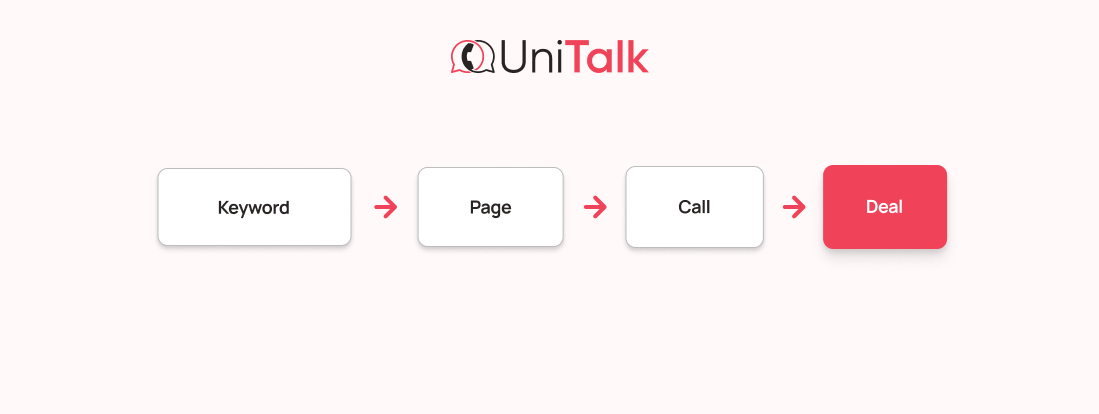
Modern phone analytics platforms (including UniTalk) allow this data to be transferred to GA4 and CRM systems, making full attribution technically possible.
What does complete SEO analytics look like?
Previously, SEO was measured by visibility, but in 2026 it is measured by revenue.
An effective model can be represented as a pyramid:
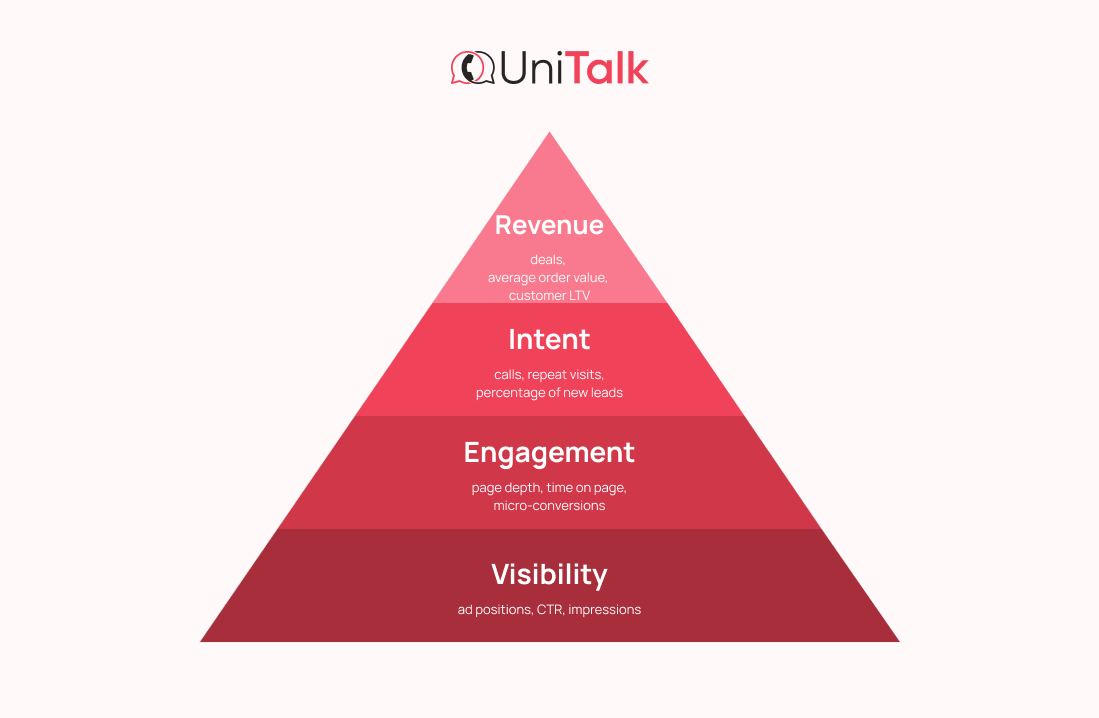
If the third level — phone calls — is missing from analytics, the overall picture becomes distorted.
Let’s illustrate what changed after integrating call tracking using one of our projects as an example:
| Before integration | After full attribution integration |
|---|---|
| 18,000 organic sessions | +480 calls from organic traffic |
| 210 form submissions | 52% of deals came through phone calls |
| Conversion rate – 1.16% | Actual channel conversion rate – 3.8% |
| SEO performance assessment – “average” | Cost per lead was 37% lower than PPC |
So SEO was not weak — it was measured incompletely.
How do you find the point where sales are being lost?
Usually, the issue is caused by several factors at once — for example, a gap between SEO, UX, and lead handling. Here is a simple algorithm to help identify the real cause:
1. Is the problem really in SEO?
To find out, answer a few questions:
- Is organic traffic growing?
- Is visibility increasing in target clusters?
- Is there movement for commercial queries?
If traffic is growing steadily but sales are not, the problem is most likely not in SEO reach.
2. Does the page match user intent?
To check this, take pages ranking in the TOP 5 and answer the following:
- Does the headline match the actual query?
- Is there a clear offer above the fold?
- Is it obvious what the user should do next?
- Is there a phone number and a call-to-action to call?
For example, a user comes through the query “turnkey solar panel installation” and lands on a page where 70% of the text is about the benefits of solar energy. The person is looking for information about timelines, pricing, completed projects, and similar specifics — but instead reads what they already know. In this case, SEO did its job, but the page does not match user intent.
3. Does the page generate calls?
After call tracking is connected, we check:
- the number of calls from a specific page;
- the share of new inquiries;
- the average call duration.
If a page ranks in the TOP 3 but generates almost no calls, the issue is conversion, not SEO.
If there are many calls but few deals, the next step is to work with the sales team.
4. Are inquiries being lost?
This is a critical check, during which we analyze:
- the percentage of missed calls;
- response time;
- whether follow-up contact takes place.
In practice, it often turns out that SEO generates a stable flow of inquiries, but 20–30% of calls go unanswered or some clients never receive a callback.
After phone analytics is implemented through UniTalk, these losses become measurable — and often turn out to be higher than expected.
5. Which keywords actually generate revenue?
This is the most important level of analysis, where we focus not on which keywords drive traffic or have a high CTR, but on which keywords generate calls and lead to deals.
Let’s look at two simple examples for comparison:
| Cluster 1 | Cluster 2 |
|---|---|
|
|
Previously, Cluster 1 would have been considered more effective, but after full analytics, we can see that Cluster 2 is the one worth scaling.
What can call tracking help reveal?
After full analytics is implemented, three scenarios are identified most often:
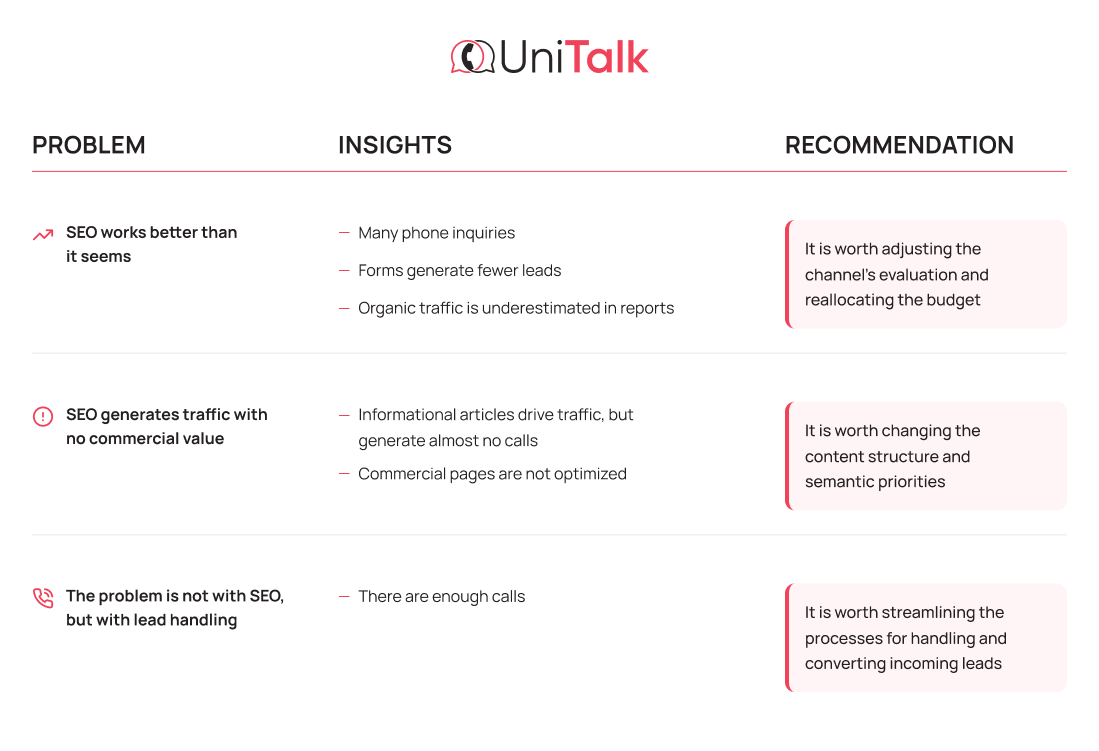
In 2026, SEO is no longer just a visibility tool. A website may rank in the TOP 3, have stable traffic, and show a strong CTR — yet still fail to generate sales because of intent mismatch, a weak page, missed calls, or poor lead handling quality.
Call tracking does not replace SEO, but it makes SEO measurable at the revenue level.
Conclusions
SEO can no longer be evaluated only through rankings, traffic, and CTR. These metrics reflect search visibility, but they do not always show the real commercial outcome.
In projects where phone analytics is implemented through UniTalk, it becomes clear that a significant share of customer inquiries comes specifically through calls and does not appear in standard web analytics. According to the observations of the RegisTeam team, in high-ticket niches, the phone often becomes the key point in the customer’s decision-making process.
If calls are not included in analytics, a business risks:
- investing in traffic without generating revenue;
- underestimating effective queries;
- mistakenly treating SEO as a weak channel;
- losing leads due to operational issues.
A complete SEO model in 2026 is a combination of visibility, intent, inquiries, and actual deals. Only this kind of system makes it possible to understand what is really preventing a website from selling: the strategy, page structure, lack of commercial triggers, or lead handling issues. If you see traffic growth while sales remain at the same level, it is worth checking not only SEO, but also the completeness of your inquiry analytics.
In SEO projects, the organic channel is increasingly viewed not just as a source of traffic, but as a tool for predictable revenue. Based on the observations of the RegisTeam team, a full understanding of SEO economics is only possible when search analytics data is combined with information about real customer inquiries — including phone calls.
If a business wants to understand the real effectiveness of the organic channel and identify points where sales are being lost, it is worth starting with a comprehensive audit: technical, semantic, and analytical. In projects where UniTalk phone analytics is used, this approach makes it possible to combine SEO data with information about actual customer inquiries.
A request for this kind of review is not a strategy change — it is the first step toward transparent channel management and decision-making based on complete analytics.