What is Caller ID spoofing and how does it work
Each of us has seen an unknown number on our phone screen at least once. Sometimes it’s a delivery courier, and sometimes… it’s a scammer. But not every unknown number hides deception. Often, it’s a convenient and secure business technology that makes communication with customers simpler and more effective.
Caller ID spoofing works like a digital mask or a company’s business card: the call is made from one device, but the client sees a familiar corporate number. This allows companies to stay recognizable, protects employees’ personal phone numbers, and increase customer trust.
In this article, we will take a detailed look at how Caller ID spoofing technology works, why businesses need it, and how to use it safely.
What does caller ID spoofing mean?
In traditional telephony of the last century, every subscriber had a unique identifier called Caller ID. These are the exact digits you see on your smartphone screen whenever someone tries to call you.
Phone number spoofing (known in international IT terminology as Caller ID spoofing) is the process of changing this digital data directly during call routing. To better understand what a spoofed number is, imagine it as a virtual digital mask. You make a call from one physical device, but a smart communication system assigns a pre-configured corporate phone number to your call.
As a result, the incoming number displayed on the client’s device is replaced. Today, this technology is used in many areas of business:
- Call centers: displaying a single company phone number for all outbound calls.
- Delivery and taxi services: protecting the personal phone numbers of couriers and drivers.
- CRM systems: enabling managers to make calls directly from a customer’s profile.
- Marketing: dynamic number insertion (DNI) on websites for advertising analytics.
- International business: using local phone numbers for customers in other countries.
How Caller ID spoofing works during a call
Technically, phone number masking became possible due to the development of IP telephony and the SIP data transfer protocol. Unlike old analog lines, where a number was hardwired to a copper cable, in internet telephony, the Caller ID is transmitted as a standard digital data packet.
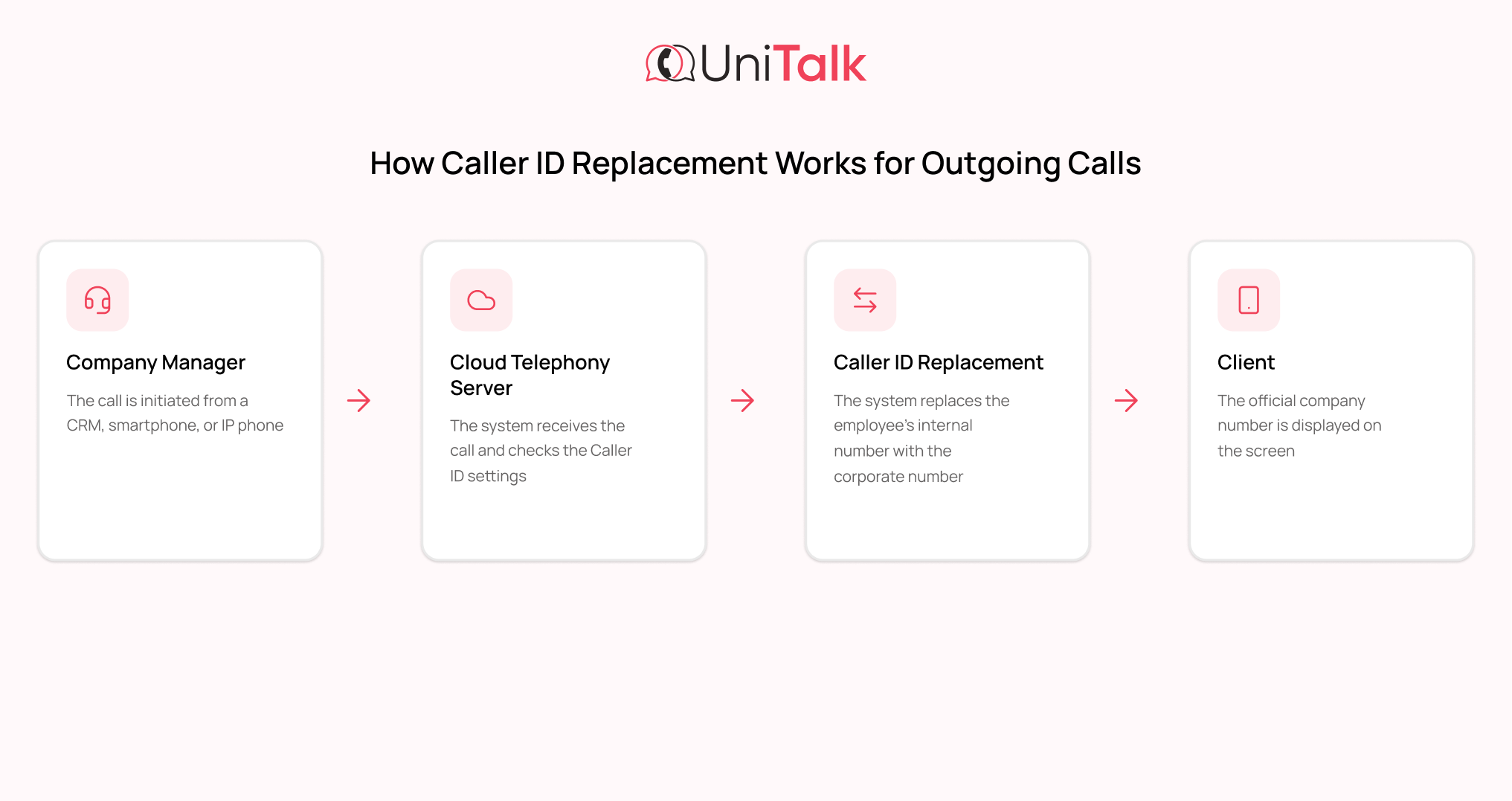
Without getting bogged down in complex telecom engineering jargon, the basic workflow is quite simple. Because of this simplicity, many companies are interested in how to implement phone number masking in their corporate telephony to improve customer service. The process consists of four stages:
- Call initiation. A sales manager initiates a call from their work computer, smartphone, or desktop IP phone.
- Server routing. The call is instantly routed to the secure server of the cloud telephony provider.
- Replacing digital data. The server identifies that the Caller ID replacement feature is enabled for this specific user. Instead of the employee’s actual internal address, the system seamlessly inserts the designated official company number.
- Final connection. The call is routed into the global telephone network, and your client sees a familiar branded number on their screen.
Why does business need legal Caller ID spoofing?
This technology originally emerged as a tool for solving complex corporate tasks. Today, it is impossible to imagine effective customer communication without it: centralized call management has become a standard for modern business.
Using Caller ID spoofing provides businesses with several important advantages:
- creates a single, recognizable contact for customers;
- increases call answer rates for both inbound and outbound calls;
- protects employee privacy;
- simplifies monitoring and analytics of phone communications;
- helps scale sales and customer support.
Let’s look at the most common use cases for this technology and see how they can benefit your business specifically.
Single callback number for multi-branch operations
Imagine a large online store with dozens of managers. If each of them calls customers from their personal mobile number, it becomes difficult for the customer to keep track of contacts. And when calling back, they might reach a specific employee who could be busy on another call, on a lunch break, or on vacation.
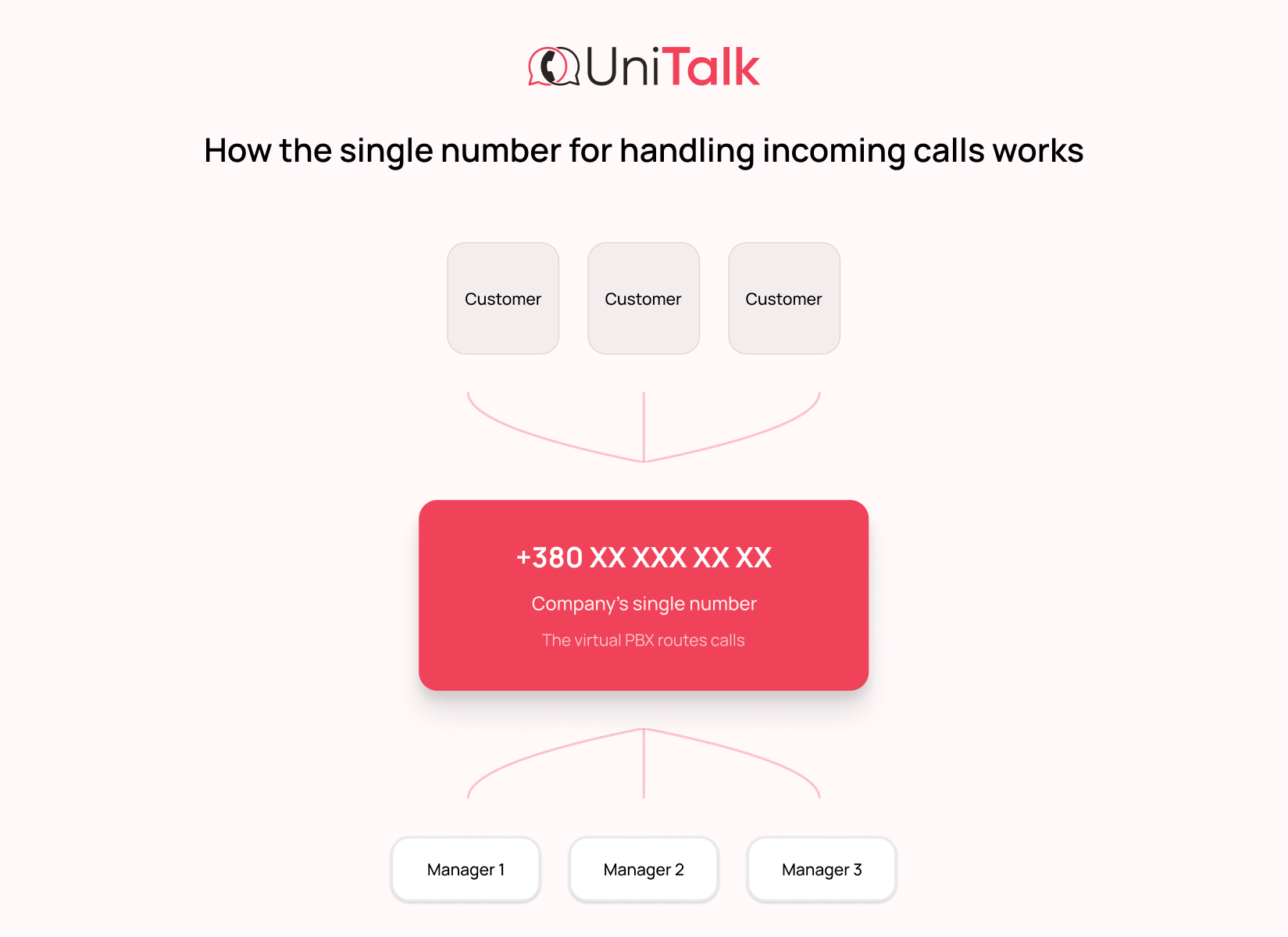
Using a single corporate number completely solves this issue. All outgoing calls are displayed as a single multi-channel company number. When a customer calls back, the call is routed to the Virtual PBX, which automatically directs it to the first available operator.
Examples of business use cases
The theory sounds convincing, but how does it work in practice? Let’s look at two real-life scenarios.
- A delivery courier calls a customer to confirm the delivery time. The call is made from the courier’s personal smartphone, but the customer sees the company’s corporate number on their screen. The customer immediately recognizes the familiar brand, trusts the call, and answers it. At the same time, the employee’s personal number remains hidden and protected from unwanted calls outside working hours.
- A language school manager in Kyiv contacts a prospective student in Warsaw. Instead of an unfamiliar international dialing code, the client sees a familiar Polish number. Trust in the call increases, the person answers comfortably, and the company achieves more successful sales.
Use in CRM systems and virtual PBX
A modern and efficient sales team always operates within a single window of its CRM system. The manager only needs to click once on a client’s profile to initiate a call. This is exactly where the magic of integration with corporate telephony happens.
The reliable UniTalk Virtual PBX makes it incredibly easy to change the caller ID so that it perfectly matches your customer’s department or region. At the same time, the cloud PBX guarantees a stable connection, automatically records the entire conversation, and attaches the audio file to the deal card. This gives managers full control over work quality without any technical complexity.
Dynamic number insertion for call analytics (call tracking technology)
In addition to regular outbound calls, caller ID substitution technology is widely used in marketing analytics. Here, it refers to the dynamic number insertion (DNI) directly on your website pages. This is the fundamental basis of call tracking technology.
Call tracking can be static or dynamic. The static option assigns unique phone numbers to each offline advertising channel, such as a billboard or a printed flyer. The dynamic approach is used for online traffic and allows tracking the journey of each individual user on the website. How dynamic number insertion works:
- a potential customer visits your company’s website via a link from a contextual ad;
- a smart system analyzes their session and displays a unique phone number to them;
- the customer calls this specific number for a consultation;
- the system accurately records the original traffic source, the advertising campaign, and even the keyword.
As a result, the company clearly understands which advertising actually drives real calls and sales, and which simply wastes the marketing budget. This process can be set up using our UniTalk call tracking service. With it, you stop guessing and start making decisions based on solid statistical data.
Increasing brand awareness through outbound calls
People are reluctant to answer calls from completely unknown numbers, and are even more likely to ignore calls from hidden ones. When a client sees a call from a company’s substituted number that is already familiar to them from a website or previous advertising, the likelihood of answering increases significantly. This directly boosts audience loyalty and improves the effectiveness of your sales managers.
The shadow side of technology used by phone scammers
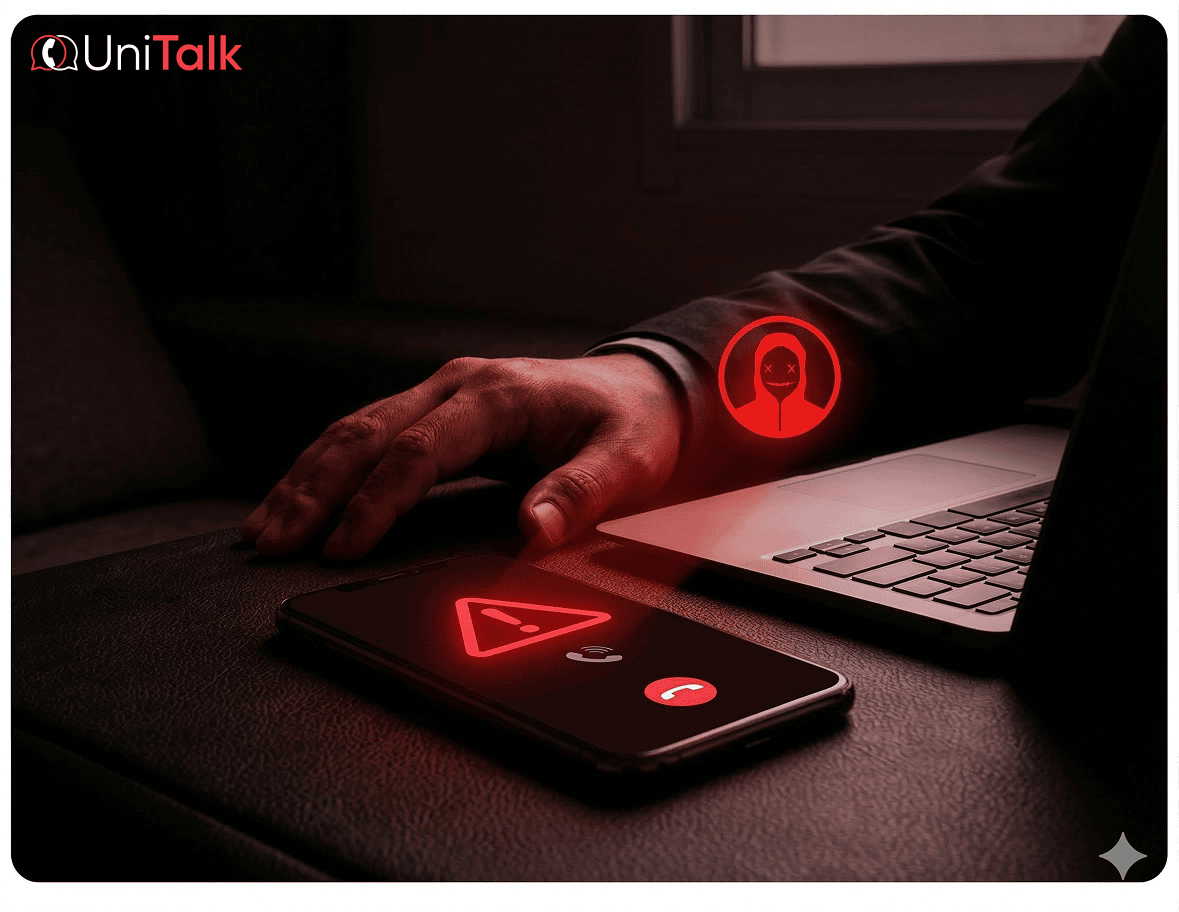
Unfortunately, the technology of phone number substitution, also known as number spoofing, is increasingly used by criminals for telephone scams known as vishing. According to the National Bank of Ukraine, telephone fraud remains one of the most widespread types of financial fraud (source).
Phone scams are particularly attractive to criminals because many people automatically trust the number they see on their screen — especially if it looks like the number of a bank or another official service. Then social engineering comes into play: the scammer introduces themselves as a security officer, frightens the person with threats of account blocking or an error, and tricks them into revealing card details, passwords, or one-time codes (more on the schemes).
Such schemes remain widespread, and law enforcement agencies and financial regulators continue to warn the public about the risks associated with these calls, as well as the need to verify the authenticity of contacts and avoid sharing personal information over the phone (official statement from the National Bank).
Is caller ID spoofing legal
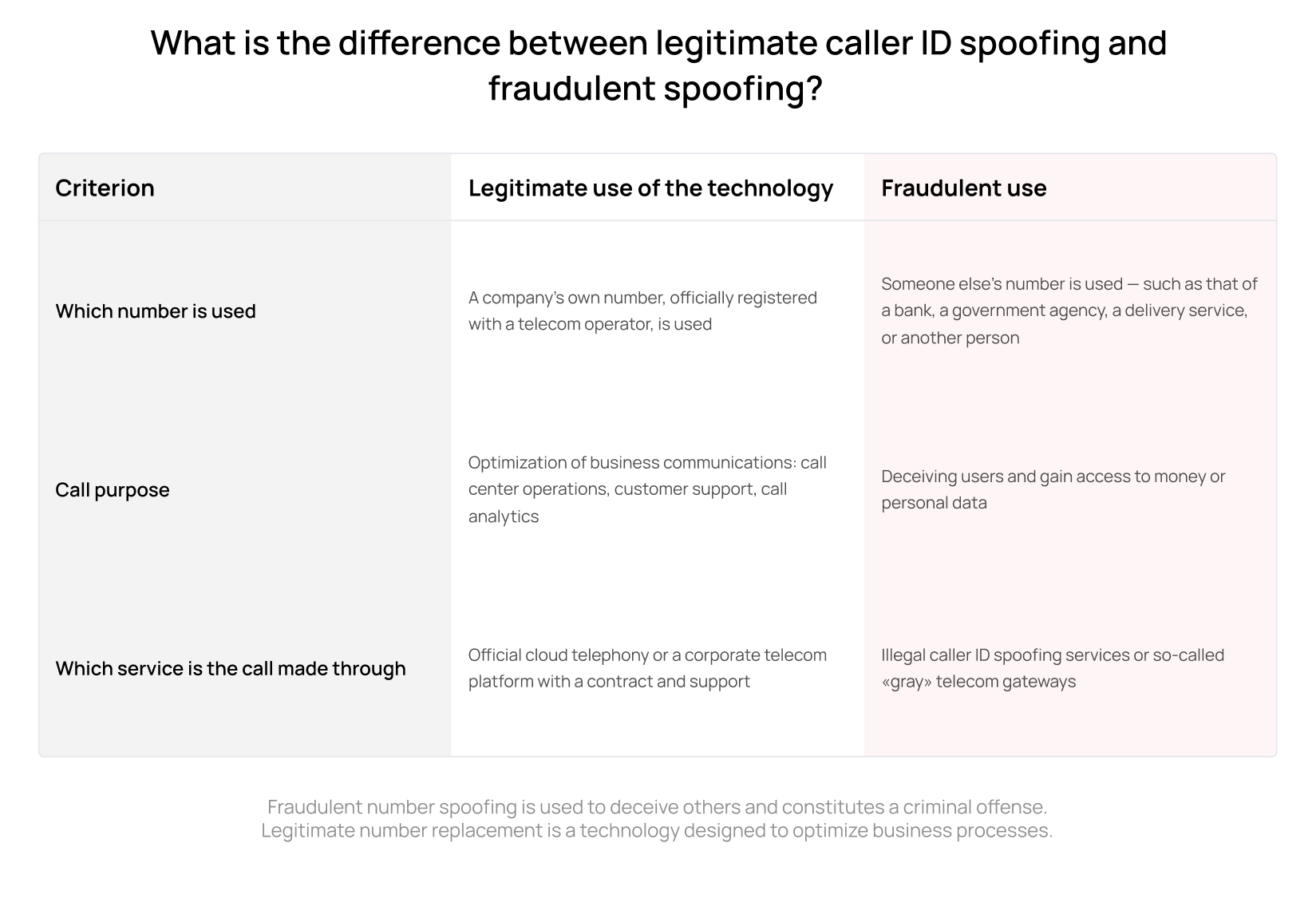
The number spoofing technology (Caller ID) itself is legal. It is widely used in corporate telephony, call centers, and call tracking systems.
The key question is which number is used for the call and for what purpose.
How to protect yourself from caller ID spoofing
How regular users can protect themselves from caller ID spoofing
Although telecom operators are constantly implementing new call filtering systems and anti-spam mechanisms, the best protection is basic digital caution. A few simple rules can significantly reduce the risk of fraud.
What’s important to remember:
1. Don’t trust the contact name on the screen
Caller ID can be spoofed. Even if the screen shows the name of a bank or a well-known company, it does not guarantee that the call is actually from that organization.
2. End suspicious calls and call back yourself
If you are asked to urgently provide personal information or make a transfer during a call, hang up. Then independently dial the company’s official number — for example, from their website or your bank card.
3. Use anti-spam apps
Modern applications analyze the behavior of calling numbers against global databases. They can warn you about suspicious calls, even if the number appears to be a regular one.
4.Never share confidential information over the phone
Real bank employees and security services will never ask for:
- full card number
- CVV code
- online banking passwords
- one-time SMS codes
If someone tries to get this information over the phone, it is almost always a sign of fraud.
Conclusion
Caller ID spoofing is not «hacker magic» but a standard feature of modern IP telephony. Companies use it to ensure proper call center operations, track marketing calls, and maintain convenient communication with customers.
The issue lies not with the technology itself, but with its abuse by scammers who use illegal caller ID spoofing for social engineering and deception.
For businesses, the key rule is simple:
use only your own numbers and operate through official telecom platforms.
If you want to implement caller ID substitution legally and safely, you should set up corporate telephony with a licensed telecom operator.
The UniTalk platform allows you to configure number substitution, call recording, and call analytics within a single system for managing customer communications.
Sometimes, you can identify a spoofed call through a series of indirect signs. Pay close attention to unusual caller behavior, especially if they are rushing you or aggressively scare you with the threat of losing money. Unnatural audio delays or poor call quality can also indicate spoofing. The most reliable and foolproof way to verify a call is to simply hang up and call the number back yourself.
A virtual number is a real cloud-based phone number that is officially assigned to your company under a contract and used to receive calls over the internet. Caller ID spoofing, on the other hand, is a system feature that only temporarily changes the digital identifier displayed on the recipient’s screen during an outgoing call.
No, the technology has absolutely no impact on audio quality. Changing the Caller ID simply involves modifying the text-based digital data within the initial SIP protocol packet. Sound clarity, absence of echo, and overall call stability depend solely on the server capacity of your cloud IP telephony provider and the stability of your internet connection.
To change the number during calls absolutely legally and without any risk of being blocked, a business needs to connect to an official licensed telecom provider. Using a reliable cloud-based virtual PBX or end-to-end call tracking systems allows you to easily display your company’s corporate numbers without violating any laws or facing technical difficulties. Integrate modern telecommunications solutions into your business and communicate with customers at a whole new level.