What Is SMS Marketing and How Does It Work
You send an email: at best, 20–25% of recipients will open it. You run an ad on social media, but the algorithm won’t show it to everyone, every time. Now imagine a channel where more than 90% of recipients see your message within the first three minutes of receiving it. That’s SMS marketing – a tool that needs no introduction, but still needs to be used correctly.
In this article, we’ll break down what SMS marketing is, how it works from the inside, what types of campaigns exist, how to build a strategy from scratch, and what mistakes to avoid. And of course, real-life cases that prove SMS advertising works even in 2026.
What Is SMS Marketing in Simple Terms
SMS marketing is a direct marketing tool where a business sends text messages to the mobile phones of its customers or potential buyers. The goals can vary: informing, driving sales, sending event reminders, confirming orders, or simply staying in touch with the audience.
Put simply: SMS marketing is a way to talk to a customer directly, on their phone, without any middlemen in the form of social media algorithms or email filters.
The first commercial SMS was sent back in 1992, but the marketing potential of this channel truly came into its own with the mass adoption of mobile phones in the 2000s. Today, according to GSMA Intelligence, there are more than 5.8 billion unique mobile subscribers worldwide, meaning the potential audience for SMS campaigns is enormous.
What makes SMS such a special channel?
- Accessibility. SMS works on any phone – from the latest smartphone to the simplest feature phone. No internet required.
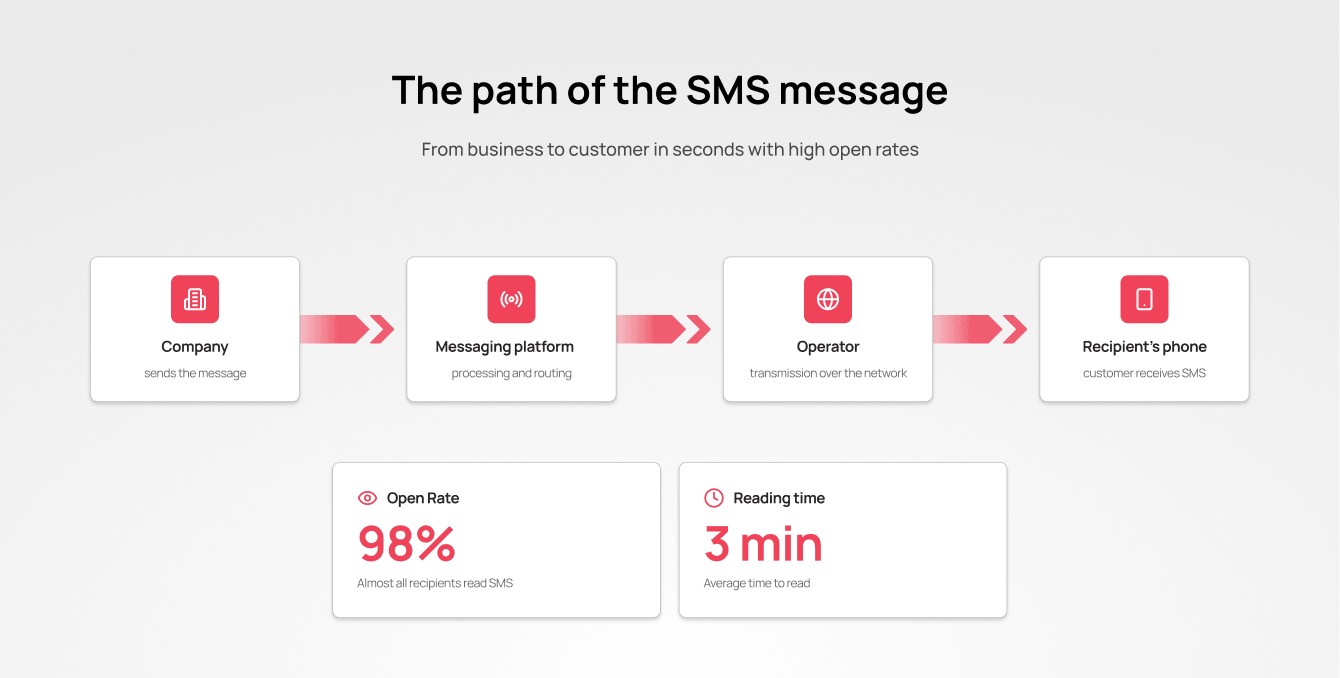
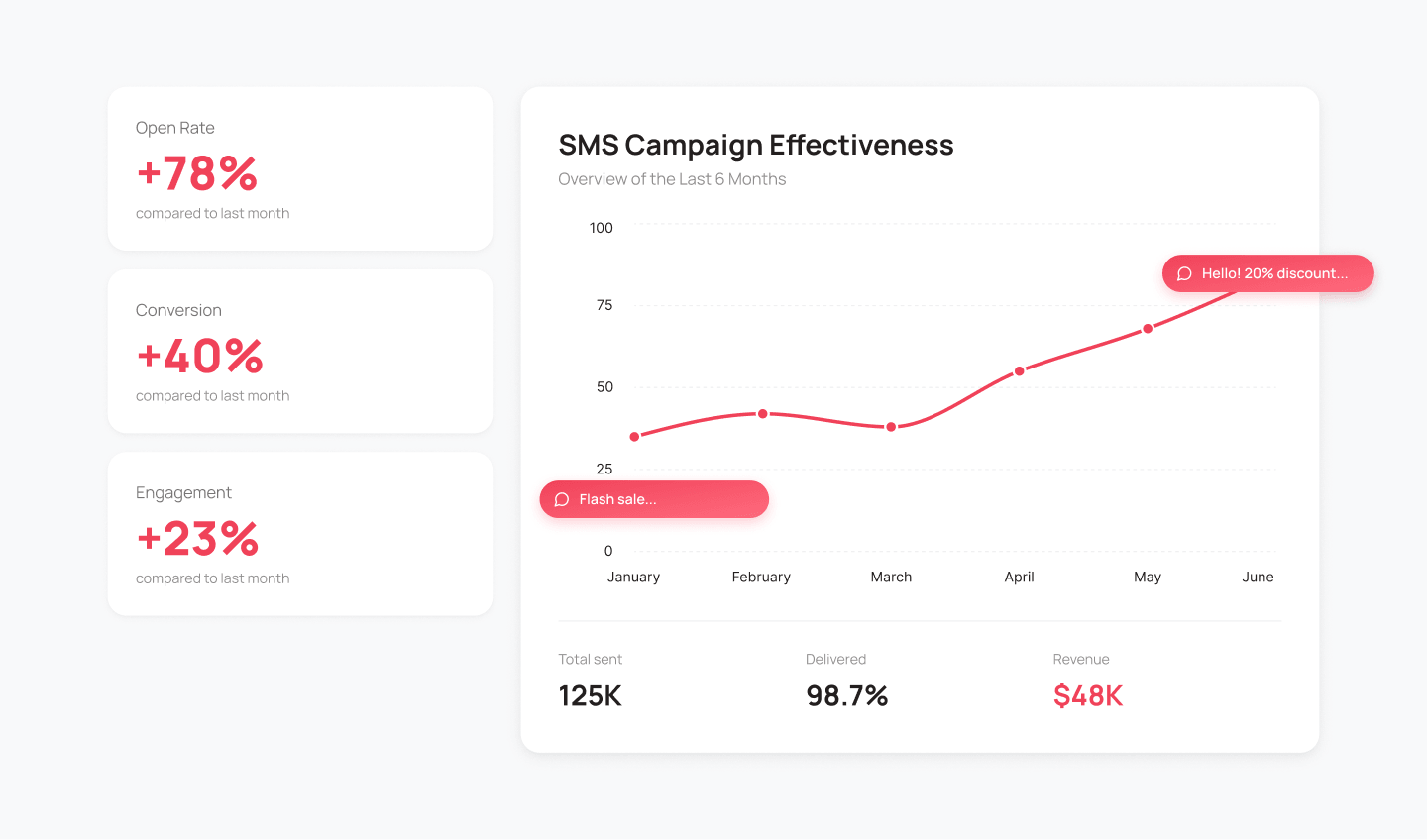
- Speed. Messages are delivered instantly. The average open rate is 98%, and most people read an SMS within 3 minutes of receiving it.
- Brevity. 160 characters keep the author disciplined: no fluff, just the point.
- Personal touch. A phone is a personal device. An SMS feels like a personal message, not a mass advertising blast.
If you think SMS is something from the past, this article will change your mind. SMS advertising is a living, high-conversion channel that continues to deliver real results for businesses.
Types of SMS Campaigns
Not all SMS messages are the same. Depending on the goal and content, SMS campaigns in marketing fall into several key types.
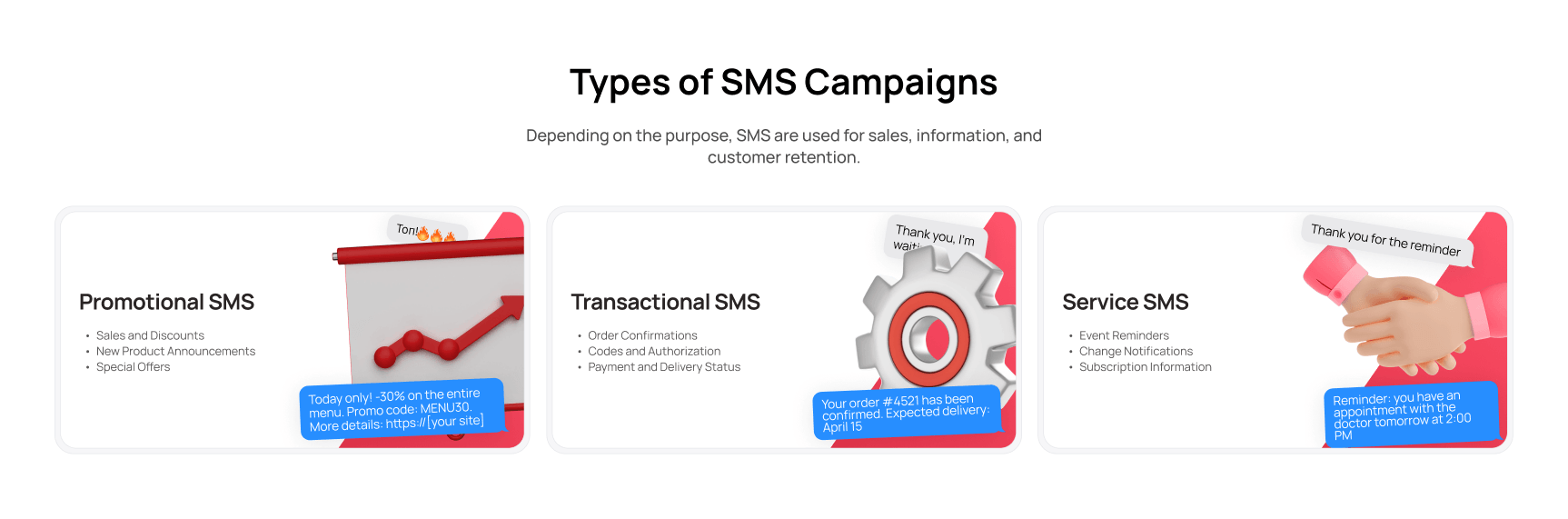
Promotional SMS
This is classic SMS advertising: sales, discounts, new product announcements, special offers. The goal of these messages is to drive a purchase or visit right now.
Example:
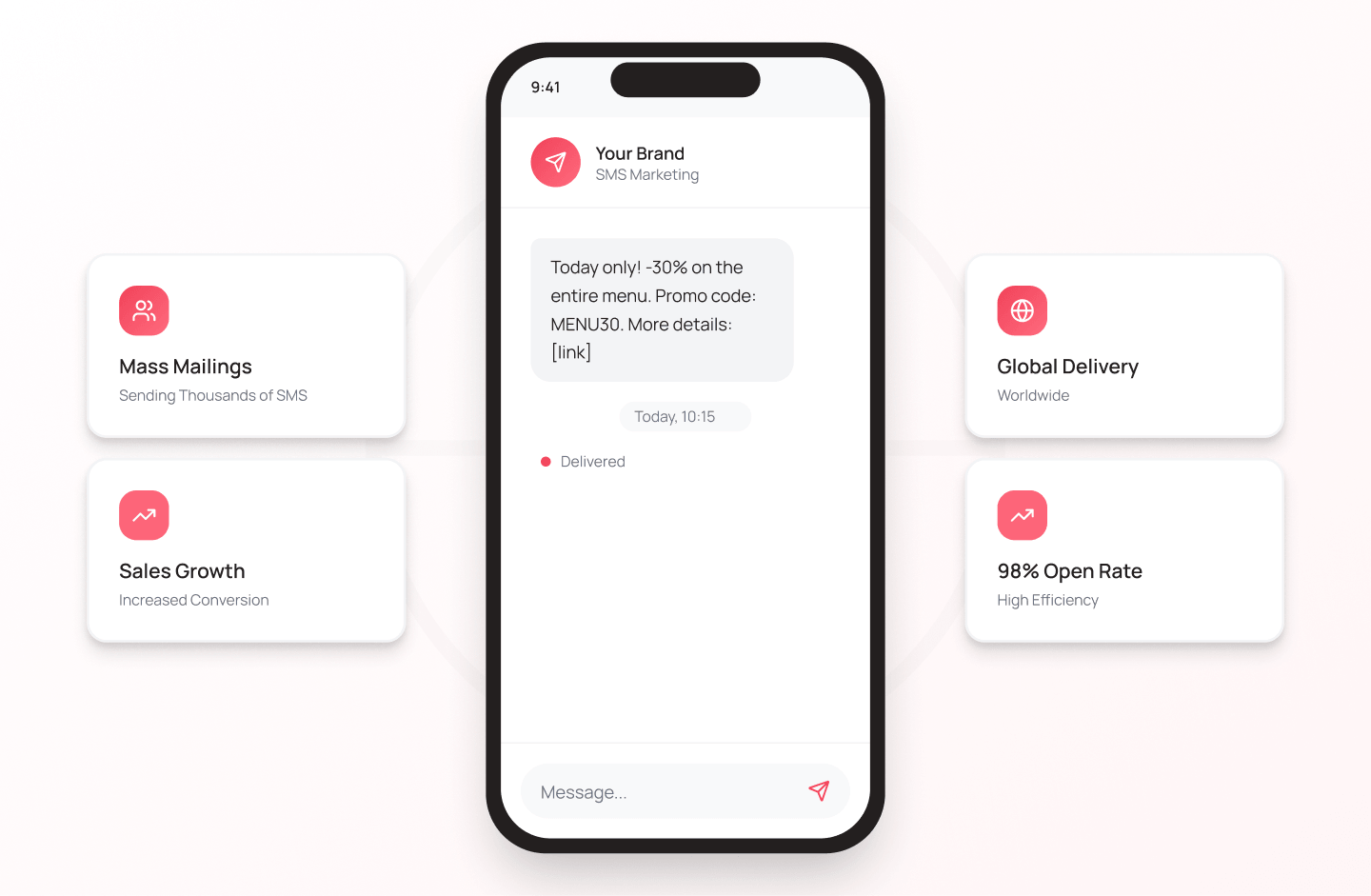
“Today only! 30% off the entire menu. Promo code: MENU30. Details: [link]”
Promotional SMS works best combined with a clear call to action (CTA) and a time-limited offer, creating a sense of urgency and pushing recipients toward immediate action.
Transactional SMS
These are automated notifications sent in response to a specific user action: placing an order, making a payment, a delivery status update, or registering on a website. These messages aren’t perceived as pushy advertising – on the contrary, the customer is expecting them and values them.
Examples:
“Your order #4521 has been confirmed. Expected delivery: April 15”
“Payment of UAH 1,250 was successful”
“Your confirmation code: 7834”
Transactional SMS has the highest open rate of all types: users almost always read them because they carry information that matters to them.
Service Notifications
A middle ground between promotional and transactional. These include appointment reminders, subscription expiry notices, maintenance warnings, and updates about changes to a loyalty program.
Examples:
“Reminder: you have a doctor’s appointment tomorrow, April 10, at 2:00 PM. Zdorovye Clinic, 5 Khreshchatyk St.”
“Your subscription expires in 3 days. Renew now with a 20% discount: [link]”
“Dear customer, the loyalty program terms will change from May 1. Details: [link]”
These SMS messages don’t sell directly, but they build trust and loyalty: the customer sees that the company cares and keeps them informed about important events. In the long run, this increases LTV (Lifetime Value) – the value of a customer over their entire lifecycle.
How SMS Marketing Works for Business
Understanding the theory is one thing. Understanding how SMS marketing works in practice for a business is quite another. Let’s be honest: this channel has both strengths and limitations.
Advantages
1. High open rate. 98% open rate versus 20–25% for email – the difference speaks for itself. According to EZ Texting, the average time to read an SMS is 90 seconds, while the average email response time is 90 minutes.
2. Direct and personal contact. SMS lands right in the customer’s pocket. No algorithms deciding whether to show it or not. No spam folder. No need to open an app.
3. High conversion. The average CTR (click-through rate) for SMS campaigns is 19–36%, while email rarely exceeds 4–5%. Conversion is especially high for SMS with personalised offers and a clear CTA.
4. Affordable cost. Compared to pay-per-click advertising or social media targeting, the cost per contact through SMS remains relatively low, especially when working with a warm list.
5. Fast to launch. You can create, set up, and send an SMS campaign in just a few minutes. This makes the channel ideal for urgent promotions or reactive marketing.
6. Works without internet. SMS will get through even where there’s no Wi-Fi or mobile data. For Ukrainian businesses, this is especially relevant: during power outages, messengers like Viber or Telegram stop working because they rely on an internet connection. SMS is transmitted through the mobile network, whose base stations are equipped with backup power supplies. More on this in a dedicated section below.
Disadvantages
1. Volume limitation. 160 characters is both a discipline and a constraint. Complex proposals, detailed instructions, or multi-part stories can’t be conveyed in an SMS. You have to be very precise and concise.
2. Requires user consent. Sending SMS without the recipient’s consent is not only unethical but illegal. Ukrainian law, like that of most EU countries, requires explicit opt-in, meaning the customer must actively confirm they want to receive messages – for example, by ticking a checkbox or texting a keyword. This limits options for working with cold audiences but protects the brand’s reputation.
3. Risk of being perceived as spam. If you send too frequently or irrelevant content, the customer will simply unsubscribe. Or worse, complain to their carrier. You need to maintain a balance of frequency and message quality.
4. No visual elements. Unlike email, push notifications, or social media ads, SMS is plain text. You can’t add an eye-catching image, infographic, or video (in standard SMS format).
5. Limited analytics. Delivery can be tracked, and so can link click-through rates, but getting a full picture of user behaviour after the click is harder than with email marketing.
Understanding both the advantages and limitations helps you use SMS marketing where it’s truly effective, and not expect it to do what other tools do better.
SMS in the Ukrainian Context: When the Power Goes Out
For Ukrainian businesses, there’s one argument in favour of SMS that rarely comes up in international guides but is critically important here. It’s power outages.
When the electricity goes out, the internet disappears from most apartments along with it. The router is dead, the home Wi-Fi is down. In this situation, messengers – Viber, Telegram, WhatsApp – stop delivering messages because they require a stable internet connection. If a customer is in a blackout zone, your Viber message will simply hang and arrive much later, once the power comes back.
SMS works differently. The mobile network operates independently of residential or office electricity: operators’ base stations are equipped with backup power sources (batteries, generators). The customer’s phone is charged via a power bank or car charger – and the SMS arrives. Immediately. At the moment it’s sent.
This makes SMS the most reliable communication channel in Ukrainian conditions – especially for urgent notifications: updated working hours, emergency information, appointment reminders, delivery confirmations.
The technical side matters too: every SMS has a TTL (Time to Live) parameter – the message’s lifespan. If the customer’s phone is unavailable at the time of sending (for example, it’s dead), the message is stored on the operator’s server and delivered as soon as the device comes back online. A smart messaging platform can also build a cascade: it first tries to send via Viber, and if that fails, automatically falls back to SMS. This way you protect your communication and never lose contact with a customer under any circumstances.
For a detailed look at why messages don’t get through during outages and how to handle it, read UniTalk’s article: Why SMS and Viber Messages Don’t Get Through During Power Outages.
How to Build an SMS Marketing Strategy from Scratch
Random occasional sends are not a strategy. For SMS campaigns to deliver measurable results, you need a system. Here’s how to build one.
Building Your List and Staying Legal
Everything starts with a contact list. And here the most important rule is: every number on the list must belong to someone who has given explicit consent to receive messages. This isn’t just ethics – it’s a legal requirement.
Ways to build your list legally:
- A subscription form on your website with a clear checkbox: “I want to receive SMS with offers and news”
- Paper forms when issuing loyalty cards at a physical location
- Subscription via USSD request or keyword
- Event registration with clearly stated consent to receive messages
In Ukraine, the rules around messaging are governed by the Law of Ukraine “On Electronic Communications” and GDPR requirements for those working with European customers. Always keep records of consent – the date, source, and exact wording.
Audience Segmentation
Sending the same message to your entire list is a common mistake. Relevance is the key to high conversion. Segment your list by:
- Location – for local businesses with multiple outlets
- Purchase history – new customers, regulars, lapsed buyers
- Gender and age – if it affects the relevance of your offer
- Interests – based on product categories viewed or past purchases
- Funnel stage – prospects vs. existing customers
For example, customers who haven’t made a purchase in over 90 days are a good target for a personalised reactivation SMS. Loyal buyers could get exclusive early access to new arrivals.
Personalisation and Content
“Dear customer” no longer works. The minimum level of personalisation is the recipient’s name. Modern platforms can insert names automatically, making a mass send feel like a personal message.
What to write in an SMS:
- A clear and straightforward offer – what it is, what it costs, what to do
- One call to action – not three links and not two propositions
- A time limit – “today only”, “until April 30”
- A short link – use link shorteners to save characters
- An opt-out option – “STOP to unsubscribe”. This is a legal requirement and a sign of respect for the customer
Example of a good SMS:
“Hi Elena! 25% off your favourite category – this Sunday only. [link] STOP to unsubscribe”
Timing and Frequency
When you send is just as important as what you send. General guidelines:
- Weekdays: 10:00–12:00 and 17:00–20:00 – peak activity hours
- Weekends: 11:00–14:00 – people are relaxed and more open to purchases
- Avoid: early morning (before 9:00), late evening (after 21:00), and public holidays (unless the send is tied to a greeting)
On frequency: the optimal rate for most businesses is 2–4 SMS per month. More frequent sends sharply increase unsubscribe rates.
Technical Setup
Sending SMS campaigns requires a dedicated platform. It provides:
- Alpha name registration (your company name instead of a phone number) – the customer immediately sees who the message is from
- High-speed bulk sending
- Templates and personalisation
- Campaign scheduler
- Delivery and click-through reports
For a full guide to setting up a mass SMS campaign from scratch – from choosing your alpha name to optimising your text and send time – see UniTalk’s guide: Mass SMS Advertising: A Complete Setup and Optimisation Guide.
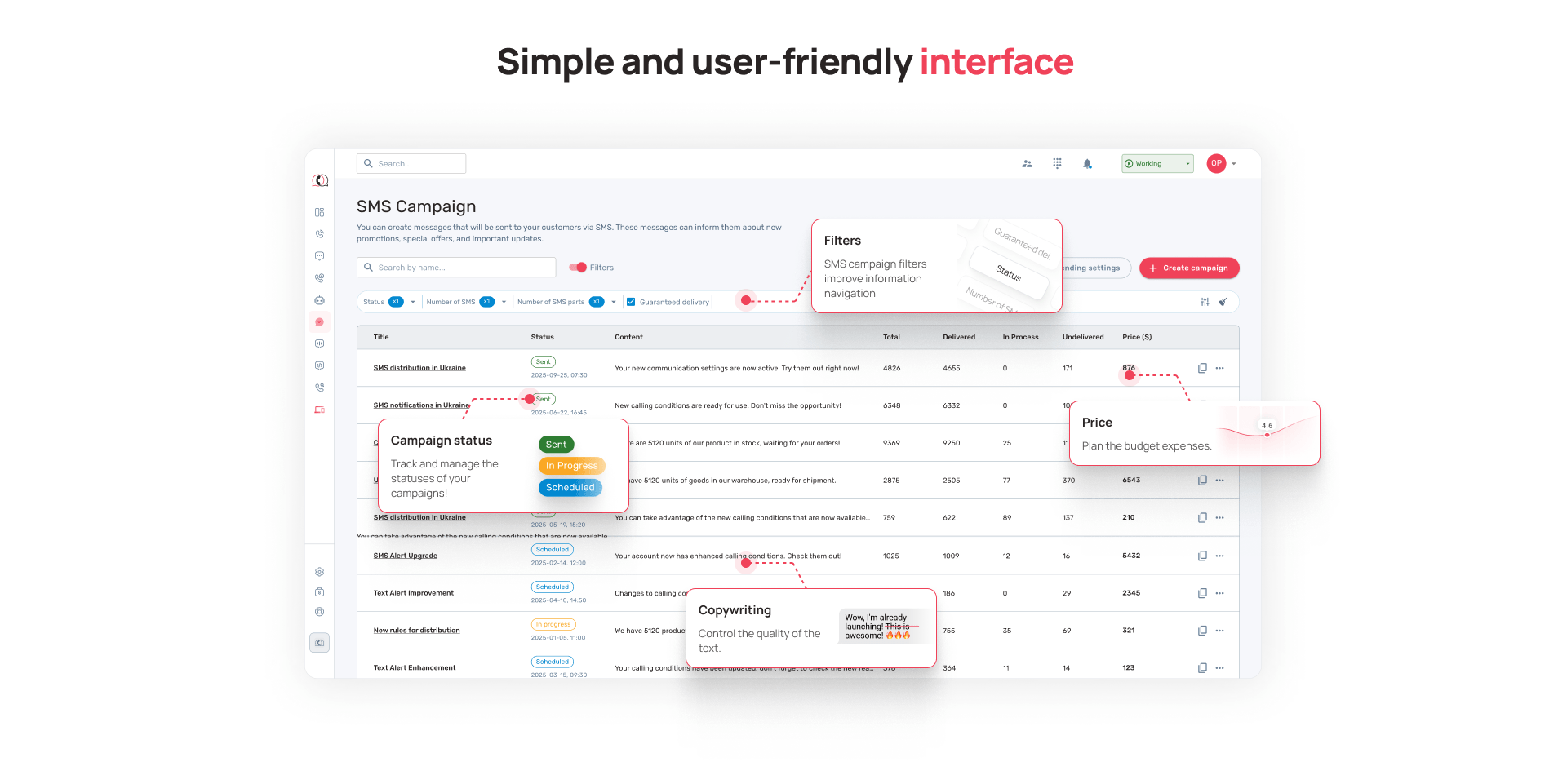
Forget complicated settings and confusing interfaces. With UniTalk’s SMS sending service, you manage your communication easily and stress-free. Through a convenient web dashboard or a simple API integration, you can launch any campaign in a matter of minutes: from a targeted reminder to a local list, to a large-scale personalised send to thousands of contacts. Working with customers outside Ukraine? That’s what international SMS campaigns are for. Reliable hybrid routing does the heavy lifting: 98% of SMS messages are delivered to your customers within 5 seconds, to any of 200+ countries worldwide.
Measuring Performance
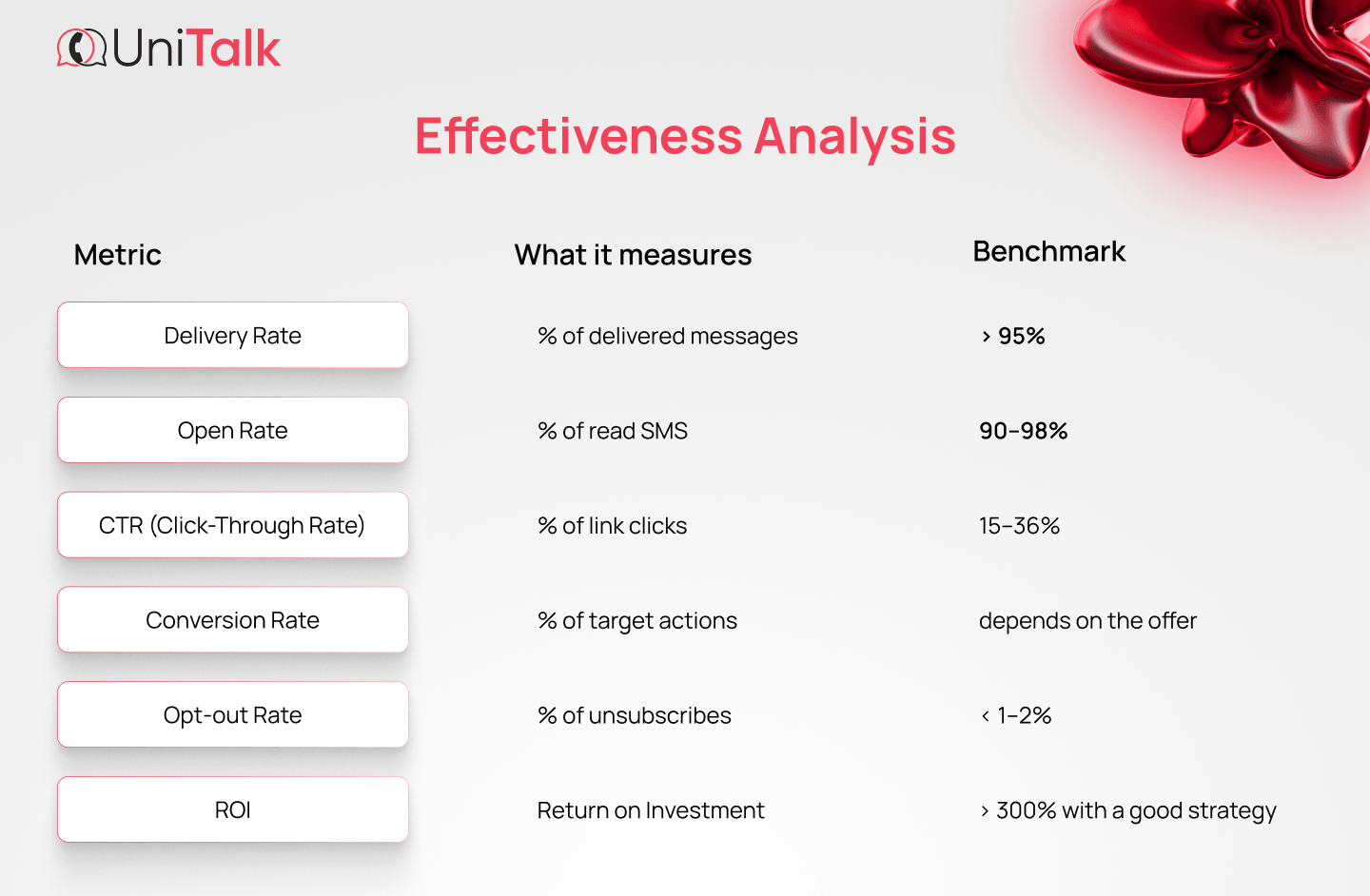
Launching a campaign is only half the job. The other half is understanding whether it worked. Key metrics for SMS marketing:
Test regularly: different copy (A/B testing), different send times, different segments. SMS marketing is an iterative process where every new campaign learns from the previous one. Don’t be afraid to experiment: sometimes changing a single word in your CTA or shifting your send time by two hours can boost conversion by 50%. Keep track of all changes and results – over time, you’ll build your own knowledge base of what works for your specific audience.
Common Mistakes That Kill Conversion
Even knowing the theory, many businesses still get weak results. Here’s why.
Mistake 1: Sending without consent. Aside from the legal risks, these sends have catastrophically low conversion rates – people simply delete messages from unknown senders.
Mistake 2: A vague call to action. “Come visit us” is not a CTA. “Get a free gift with your order by Friday: [link]” is a CTA. Every SMS must contain one clear action for the recipient to take.
Mistake 3: Sending too frequently. Three SMS messages in one week is almost a guaranteed wave of unsubscribes. Respect your customer’s personal space.
Mistake 4: Sending at the wrong time. An SMS at 7:30 AM on a Saturday isn’t marketing – it’s an annoyance. Schedule your sends for optimal times.
Mistake 5: The same message for everyone. Offering an umbrella to a customer in the south of Ukraine in midsummer, or promoting winter coats in April – these are classic segmentation mistakes. Segment and personalise.
Mistake 6: No link, or a broken link. Always check your links before sending. A broken link means a lost customer and wasted budget.
Mistake 7: Ignoring analytics. If you’re not looking at the numbers, you’re working blind. Even basic metrics (delivery, clicks, unsubscribes) give you a wealth of information for optimisation.
Mistake 8: Forgetting the opt-out. By law, customers must always have the option to unsubscribe. If that option isn’t there – it’s a violation, not a cost-saving measure.
Real-Life SMS Campaign Success Stories
Theory is less convincing than real examples. Here are a few cases from different industries that show how SMS advertising works in practice.
Retail: Reactivating dormant customers A grocery store chain segmented its list and identified customers who hadn’t made a purchase in over 60 days. They received a personalised SMS: “We miss you! Here’s a UAH 300 bonus for your next purchase – this week only.” The campaign conversion rate was 23%, meaning one in four dormant customers came back.
Restaurant: Filling empty tables A restaurant noticed consistently low footfall on Tuesday evenings. Every Tuesday at 4:00 PM, it sent an SMS to its list: “Quiet Tuesday is the best Tuesday. Steak + a glass of wine for the price of a steak. Reserve: [link].” Over two months, Tuesday occupancy grew from 35% to 78%.
E-commerce: Abandoned carts An online store set up an automatic SMS sent 1 hour after a customer abandoned their cart: “You forgot something important! Your cart is waiting, and we’ve saved your 10% discount. Complete your order: [link].” Cart recovery conversion via SMS was twice as high as via email.
Healthcare: Appointment reminders A clinic started sending SMS reminders 24 hours and 2 hours before each appointment. No-show rates dropped by 40%. An added benefit – higher patient satisfaction, with people appreciating the thoughtful follow-up.
These cases confirm one thing: SMS marketing works when it’s timely, relevant, and personalised. It’s not magic – it’s the right strategy.
Conclusion
SMS marketing is not yesterday’s news – it’s a proven, working tool. Its strength lies in direct contact, speed, and near-guaranteed message delivery. Like any marketing channel, though, it requires a strategic approach: a legally compliant list, segmentation, thoughtful content, and regular analysis.
For businesses in Ukraine, SMS marketing is particularly relevant: high mobile penetration, the habit of receiving important messages via SMS, and the ability to operate without internet access – all of this makes the channel a universal tool for businesses of any size.
Ready to launch your first campaign or scale up your existing sends? UniTalk’s SMS service will help you set everything up – from registering your alpha name to detailed analytics for every campaign. And if your customers are outside Ukraine, UniTalk’s international SMS service will ensure delivery to over 200 countries worldwide.
Yes, and here’s why. Despite the rapid growth of messengers and push notifications, SMS retains a unique advantage: it works on any phone without internet and has an open rate of nearly 98%. According to Statista, the global A2P SMS market continues to grow and is valued at tens of billions of dollars heading into 2026. That’s not the sign of a dying channel – it’s the sign of a mature, stable market. For a detailed breakdown with data and case studies, see UniTalk’s article: Why SMS Still Works in 2026: Numbers, Cases and Examples.
Yes, as long as you have explicit user consent to send marketing messages. In Ukraine, this area is governed by the Law “On Electronic Communications”. Required conditions: opt-in (consent), the ability to unsubscribe at any time, and identification of the sender. Sending without consent is a legal violation and a risk of serious fines.
Yes, and this is one of the biggest advantages of modern platforms. You can set up automatic triggers: SMS upon registration, upon placing an order, for abandoned carts, on a customer’s birthday, or when a discount is about to expire. Automation saves time and improves message relevance – the customer gets an SMS exactly when it makes sense.
Absolutely. This is not just an ethical norm – it’s a legal requirement. Consent must be explicit and voluntary: the customer ticks a box or otherwise confirms they want to receive messages. Implied consent (“if you didn’t opt out, you agreed”) is not legally valid. Keep records of consent with the date and source – this will protect you in the event of any dispute.