From Dreams to Reality: How Artificial Intelligence Was Born and How It Helps Businesses Today
How the idea of artificial intelligence emerged, what early scientists thought about it, and why today it is no longer sci-fi, but a practical tool for your company.
Today, artificial intelligence writes texts, answers clients in chats, analyzes thousands of calls, and forecasts sales. It sounds like the usual routine of a modern business. But just 70 years ago, all of this seemed like pure science fiction.
So, how exactly did scientists imagine artificial intelligence at the very beginning of this journey? Let’s travel back in time and see how a bold hypothesis turned into the ultimate tool for business process automation.
Alan Turing and the First Big Question
Artificial intelligence didn’t start with ready-made products or complex code; it began with a philosophical question. In October 1950, the brilliant mathematician Alan Turing published the paper “Computing Machinery and Intelligence.” In it, he posed a simple yet revolutionary question: “Can machines think?”
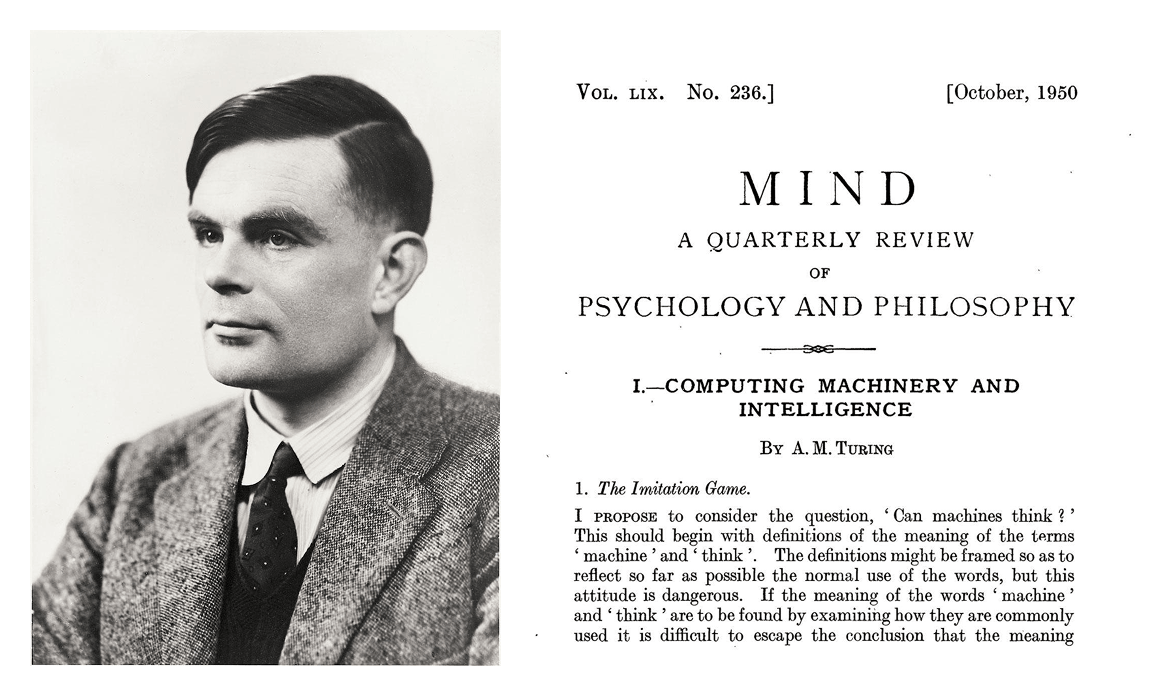
Alan Turing, who in 1950 first asked the question: “Can machines think?”
In the 1950s, computers took up entire rooms and performed only basic calculations. The idea that such a machine could not just calculate, but actually “think,” sounded almost like science fiction. That is why Turing’s question was a breakthrough: he was the first to suggest evaluating not how a machine is built, but how it behaves.
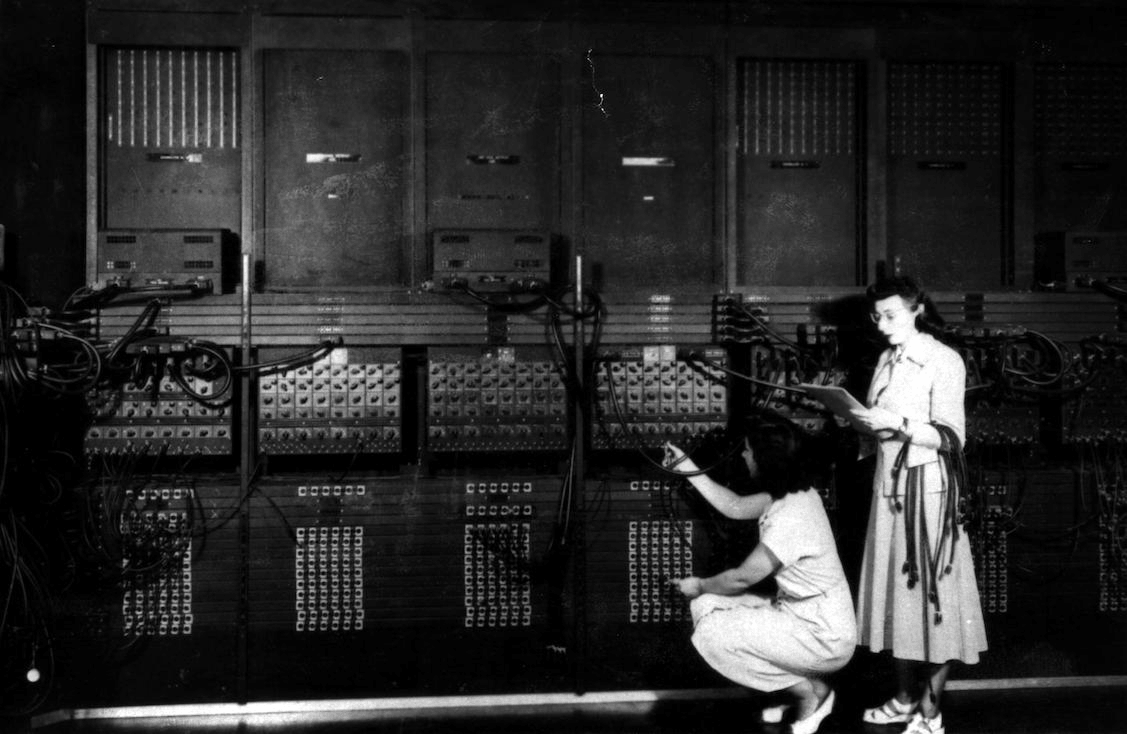
In the 1950s, computers took up entire rooms and required manual configuration.
To test this, Turing proposed his famous test. The premise is very simple: if a human is conversing with a machine and cannot tell who is on the other end (a machine or another human), the machine has passed the test (known as the Turing Test) [source]. Back then, it was just a theory, but it set the trajectory for technological development for decades to come.
💡 Interesting Fact: Alan Turing believed that by the end of the 20th century, machines would be able to imitate humans so well that most people wouldn’t be able to tell the difference in a conversation. This prediction only partially came true decades later, with the emergence of modern AI systems.
1956: The Birth of Artificial Intelligence
The starting point for AI as a science was the Dartmouth Summer Research Project, held in the US in the summer of 1956. It was there that American computer scientist John McCarthy officially coined the term “Artificial Intelligence.”
A true team of dreamers and geniuses gathered for the workshop. Among them were Marvin Minsky, information theory creator Claude Shannon, and Nathaniel Rochester. Their main goal was to explore a very bold hypothesis:
“Any aspect of learning or any other feature of intelligence can be described so precisely that a machine can be created to imitate it.”
In reality, it was just a small summer gathering of researchers, but its significance is hard to overstate. This was the first time the idea emerged that intelligence isn’t something unique strictly to humans, but rather a process that can be replicated. At the time, this sounded so bold that many considered the hypothesis far too ambitious.
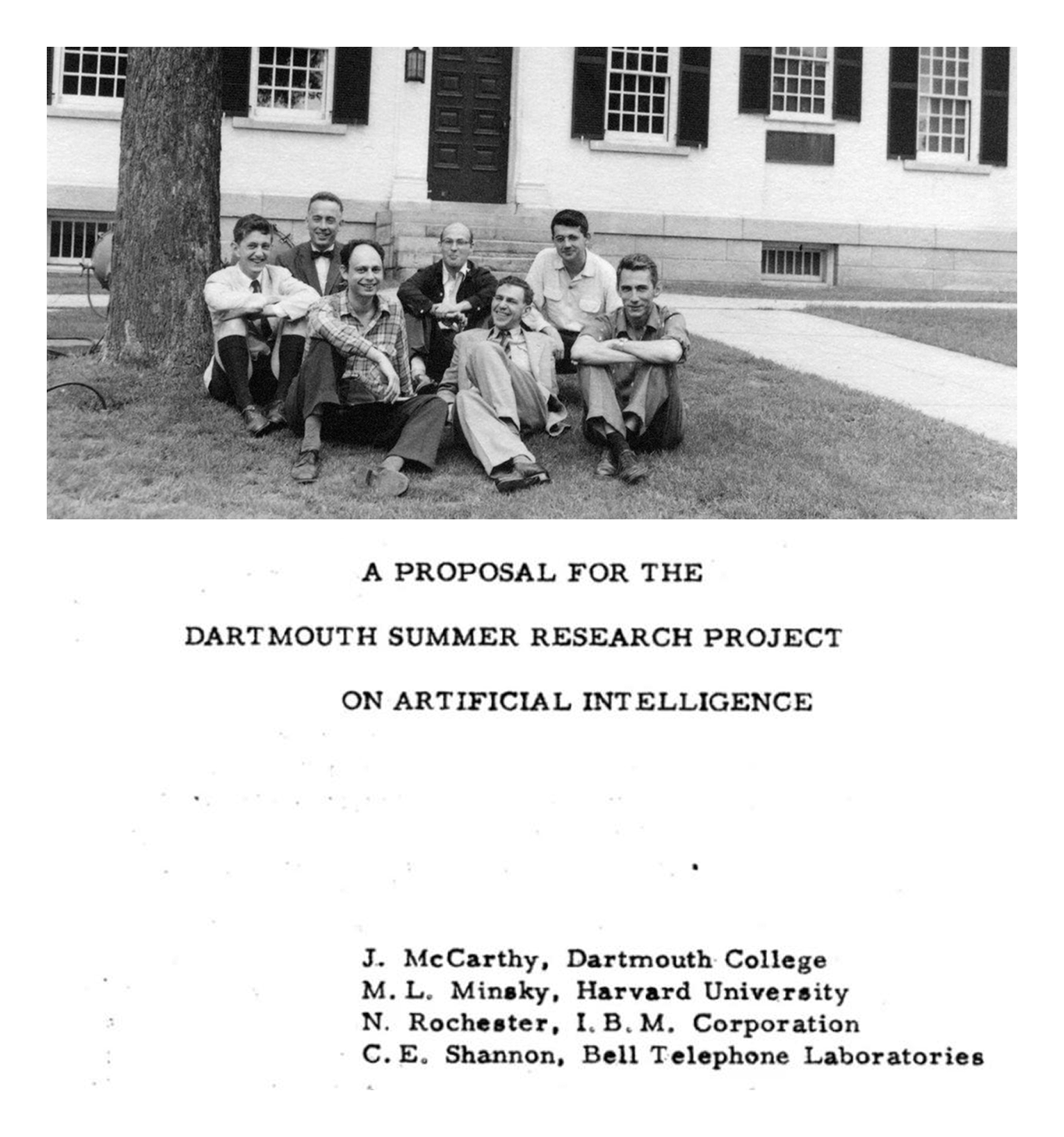
Participants of the historic 1956 Dartmouth workshop.
How AI Was Imagined Then vs. What We Have Today
The optimism of the early researchers is astounding. They expected that machines would very soon start thinking exactly like humans, possess universal intelligence, and flawlessly understand human language with all its subtext.
Let’s compare what was expected back then with what it looks like now:
- Thinking and tasks: Back then, scientists dreamed of a universal mind capable of solving any life problem. Today, we have highly specialized AI that doesn’t know how to “feel,” but performs specific business tasks with lightning speed and zero errors.
- Conversing with humans: Back then, they expected completely natural conversations on any topic. Today, we have voice assistants and chatbots. They sound and write very naturally, perfectly imitating dialogue within the scope of their assigned tasks.
- Speed of development: Scientists in the 1950s thought they would solve the AI problem in a few decades. The breakthrough happened later than they planned, but its scale exceeded all expectations.
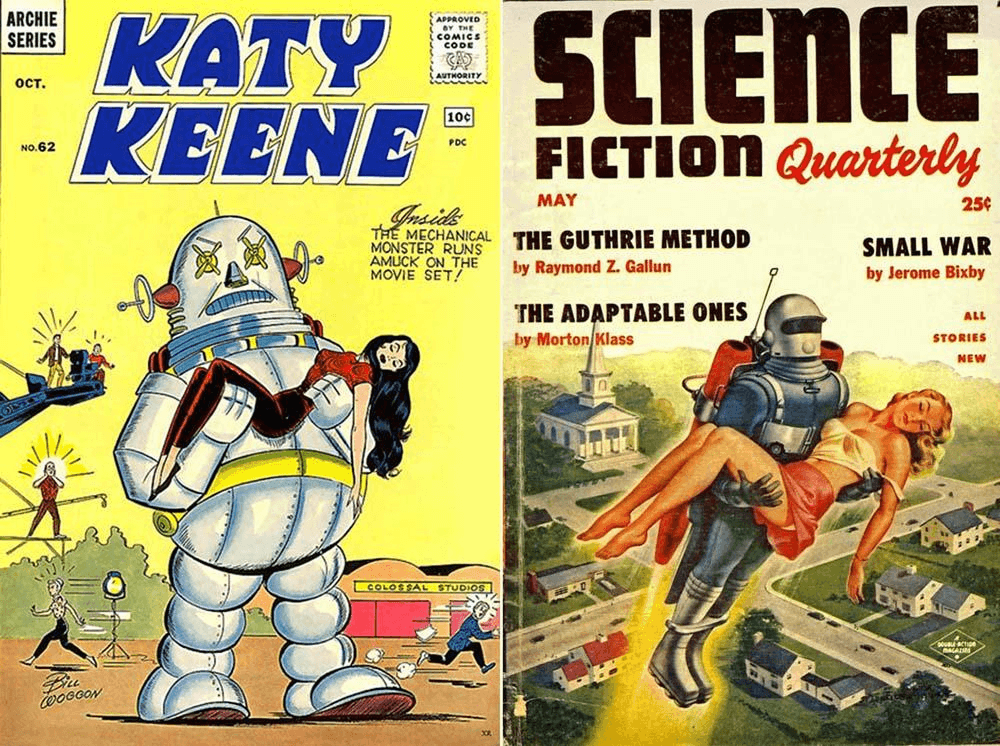
Back then, scientists and society dreamed of a universal mind and anthropomorphic robots.
Why Artificial Intelligence Didn’t Emerge as Fast as Expected
Despite the massive optimism, the development of artificial intelligence proved to be much more complex than early researchers anticipated. The main reasons were:
- Limited computing power. Computers simply couldn’t process enough data.
- Lack of data. Modern AI is trained on massive datasets that simply didn’t exist back then.
- The complexity of human language. It turned out that understanding context and subtext is one of the most difficult challenges.
Only with the development of the internet, cloud computing, and big data did artificial intelligence truly begin to unlock its full potential.
AI in Business: Not the Future, But the Present
As John McCarthy once hypothesized, intelligence is a process that can be replicated. Today, we are seeing this idea transform into concrete business tools.
Modern artificial intelligence isn’t trying to replace humans entirely. It has become a reliable assistant that handles the routine. Business automation powered by AI is already helping companies process orders, support customers, and monitor service quality today.
What does this look like in practice? An online store automatically processes thousands of order confirmations without a manager’s involvement. A call center analyzes all conversations and identifies the reasons for customer churn. The marketing department gets precise data on buyer behavior without tedious manual analysis.
Let’s look at how UniTalk products cover these tasks.
UniTalk Speech Analytics
Previously, a Head of Sales had to listen to call recordings selectively. It took hours and didn’t provide an objective picture. Today, artificial intelligence analyzes 100% of your team’s calls. The system recognizes speech, transcribes it into text, and automatically evaluates the conversation based on your criteria. You instantly see whether a manager is following the script, how they handle objections, and if there are any conflicts. For example, the system can automatically detect trigger words or log the exact reasons for customer refusals. As a result, the company gets more than just call recordings—it gets a clear understanding of exactly what impacts sales.
UniTalk Voice AI Agent
This is a smart assistant that takes over customer communication. It understands the context of the conversation, speaks with natural intonations, and answers questions based on your internal knowledge base. The agent can take inbound calls 24/7, automatically confirm orders, or run outbound campaigns. If a question requires human intervention, it will seamlessly transfer the call to a manager, instantly saving all the data into your CRM. This allows companies to process significantly more inquiries, stop losing leads, and provide instant service without expanding their staff.
In Conclusion
Seventy years ago, artificial intelligence was just a hypothesis. Today, it is a real tool that is already changing the rules of the game in business. It allows you to stay one step ahead of the competition, spend resources more efficiently, and provide better customer service.
The question is no longer whether you should use it, but how fast you’ll start doing so. Those who start using AI today will be the ones setting the market rules tomorrow.