How to Effectively Use Call Information for Business Growth
In sales departments working with cold calls, an agent can make up to 150 calls daily. Each such call is not just a one-time communication but a source of valuable data that can be key to improving business processes and company growth.
Support service conversations also contain useful information. From them, one can identify customer needs, problems, objections, feedback, and even suggestions for product improvement, which marketing and product departments can then use.
However, processing such a volume of communication manually is quite a challenge. This requires time and, consequently, money. It can be done faster and cheaper with AI.
In this article, we explain how the AI solution, Speech Analytics, handles this, and how to turn call data into insights, and insights into real improvements.
What Data Can Be Obtained from Calls?
With proper analysis, calls with customers can significantly influence business development strategy: determine which direction to move, which services and practices to abandon, etc. This is thanks to the following information contained in communications:
- Customer Objections. You can identify what most often stops customers from buying, such as high price, doubts about quality, lack of certain features, or fear of changing their current solution.
- Popular Questions. If customers constantly ask about the same things, it indicates a lack of information about them. Accordingly, there were gaps on the website, in presentation materials, or during previous contacts.
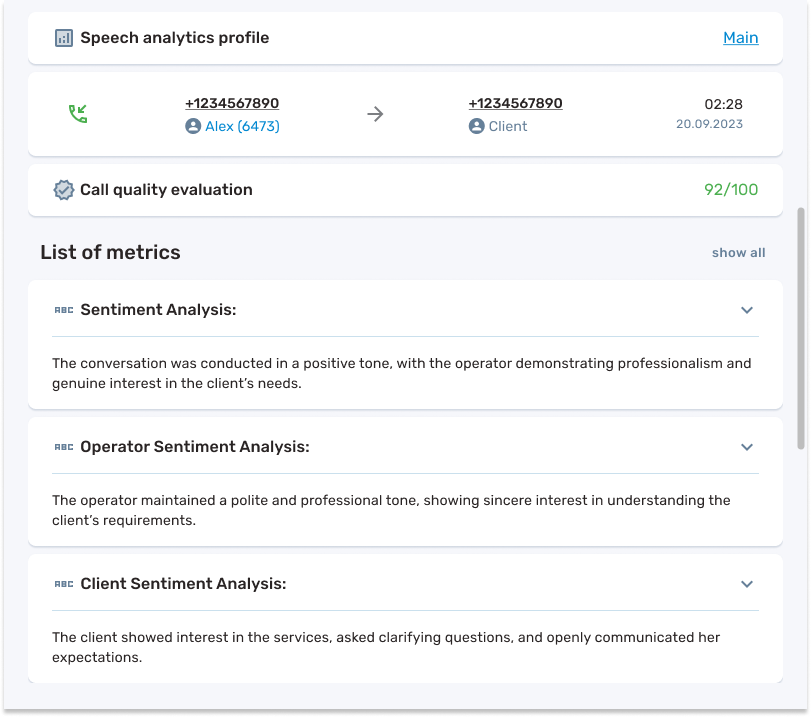
- Customer Sentiment. A person’s emotional state during a conversation is a direct indicator of their satisfaction with the service. By the way, studies show that most customers are willing to pay more for a high level of service (specific statistics vary by industry and market). Here is an example of sentiment analysis that can be obtained from UniTalk’s Speech Analytics:

- Team Performance Quality. Call analysis allows you to assess how well managers adhere to scripts, whether they correctly respond to objections, and if they offer appropriate solutions. Speech Analytics can be configured to evaluate different stages of a dialogue (such as opening or closing) separately, using different assessment criteria and parameters. Below is an example of how an ‘opening’ assessment might look, indicating the operator’s strengths and weaknesses, recommendations for improvement, and the customer’s reaction:
- Trends and Insights. You can identify new trends in customer needs. For example, if more and more people start asking about a particular feature or complaining about a certain aspect of the product, this may indicate a change in market expectations.
Challenges in Call Analysis
Large Volume of Data
Manual call analysis is feasible for volumes of no more than 100 calls per month. In most companies, this number of communications, or even more, occurs daily. Considering that one call lasts an average of 4 minutes (and in some areas can last up to 15 minutes), this amounts to over 200 hours of conversations monthly. Analyzing all these recordings is either physically impossible or requires significant financial investment.
Speech Analytics solves this problem by automatically processing all necessary calls (e.g., only incoming, or only long ones), transcribing them into text, and analyzing them according to set parameters. This allows for 100% coverage of important calls without needing additional staff.
Human Factor
Even if resources are allocated for listening to recordings, human assessment is always subjective. A person can miss important details due to fatigue, inattention, or bias.
Speech Analytics provides objective analysis by applying the same criteria to all conversations. Its data accuracy is 97%, whereas a quality control specialist can achieve only 86%
Lack of Systemization
For effective analysis, it’s important to aggregate data—collect and summarize information from various sources such as CRM systems, chats, email, and calls. Each source requires a separate approach, as only comprehensive analysis allows for finding patterns and identifying trends.
It is particularly difficult to work with calls because they are stored in audio format, which complicates search and structured analysis. The Speech Analytics automated system solves this problem: it transcribes conversations, identifies key topics, assesses their importance, and helps prioritize.
How to Turn Calls into a Source of Business Insights?
Listening to hundreds of hours of recordings for months is inefficient and economically unjustified. Therefore, automation is a must-have. According to McKinsey, it speeds up contact center operations by 40%.
Not all conversations are equally valuable. Instead of spending resources on analyzing every call, it’s better to focus on critical communications. These can be:
- Calls with a high level of emotion (both positive and negative)
- Conversations where the client mentions competitors
- Communications that ended in a sale or, conversely, a refusal
By the way, automation can also help with this: quickly tagging such conversations and sorting them by priority, creating a ‘hot list’ for management.
Finally, analytics. It is what transforms a pile of words, numbers, and facts into valuable insights that can then be transformed into real business implementations.
Here are a few recommendations on how to analyze data:
- Collect data systematically. Group conversations by problem types, satisfaction levels, mentions of competitors, and outcomes (successful sale, refusal, request for additional information).
- Find recurring patterns. Pay attention to phrases and questions that appear in most conversations.
- Track dynamics. Compare how conversation topics change after a product update, price change, or new advertising launch.
- Analyze correlations. For example, how often do questions about discounts turn into successful sales? Is there a connection between mentions of competitors and refusals?
- Create a dashboard with key metrics. For example, average satisfaction level, or the percentage of conversations where the client mentions prices.
- Test hypotheses. If you notice a problem, select 10-15 calls where it is mentioned and analyze them in more detail to understand the root causes.
- Prioritize findings. Evaluate each insight based on two criteria: how easy it is to implement and its potential impact on the business.
Solution: How Speech Analytics Helps Business
Speech Analytics addresses several of the tasks we listed above. First and foremost, it automatically transforms all calls into structured data. By the way, the system works with over 100 languages—if needed, it not only transcribes the conversation into text but also translates it.
You can customize parameters in your profile, create personalized metrics, and receive only the information you need. For example, an insurance company can track mentions of competitors and their rates, while a bank can focus on security issues and user comfort in the mobile app.
One of the key advantages of Speech Analytics is the identification of problematic moments in communication. The system flags conversations with heightened emotion, helping managers quickly respond to negative feedback and resolve difficult situations promptly.
The system operates continuously and does not require external supervision. It can process hundreds of calls in five minutes and free up your specialists’ time to work directly with clients.
Real-World Scenarios for Using Call Information
Let’s look at a few examples of how Speech Analytics can be used by different teams:
- Sales Department. Sales managers can identify the most common customer objections and adjust scripts to respond to them more effectively. This also helps determine which arguments work best when closing deals and adapt the approach to different customer segments.
- Support Service. Support specialists can analyze typical customer problems and identify which ones require improved instructions or additional training. The team can optimize problem-solving processes based on real dialogues with users.
- Marketing. Marketers can better understand what questions most concern potential customers and adapt their content strategy accordingly. This allows for the creation of more relevant advertising materials and informational resources that answer the audience’s real questions.
- Product Team. Developers and product managers receive direct customer feedback on product functionality and can use this data to determine development priorities. This helps create updates that truly solve user problems and meet their expectations.
Conclusion: How Business Changes When Call Information Starts Working
When a company starts to effectively use information from customer communications, it can lead to fundamental changes in processes. Among them:
- Decision-making based on real data, not assumptions. Instead of relying on subjective impressions, companies receive structured information from hundreds and thousands of real conversations. This allows for the identification of hidden trends and the making of informed decisions that directly impact business results.
- Improved customer service and increased customer loyalty. By understanding real needs and problems, companies can quickly adapt their processes and offerings. Customers appreciate being heard and understood, and this directly impacts their satisfaction and desire to stay with the company.
- Identification of hidden problems and growth areas. Proper analysis of communications reveals aspects of the business that need improvement, as well as new opportunities for development. Often, customers themselves point out needs that the company had not previously considered.
All these benefits can be achieved much more easily and quickly with Speech Analytics, as data collection and analysis are automated. Ordinary conversations are transformed into a strategic asset, and this happens in minutes, not months.