AI-Powered Sales Management: Why 90% of Implementations Fail – and How to Join the Successful 10%
Artificial intelligence in sales is no longer science fiction or a luxury reserved for large corporations. Today, AI tools are available to small and medium-sized businesses – so why do most companies that attempt to implement them end up with zero results?
We’ve broken down the most common mistakes and gathered real-world cases so you can understand the difference between “money spent on AI” and actual sales growth.
Three Reasons Why AI Doesn’t Work
1. Implementation Without a Goal – The Most Expensive Mistake
Imagine a company that deploys AI call analytics but, instead of defining what information it actually needs from calls, simply enables all available evaluation criteria – more than 30 different metrics. A month later: mountains of useless data and no concrete result.
Sound familiar? AI gets purchased because “competitors already have it” or “it’s the trend.” But technology on its own solves nothing – it only amplifies what’s already there. Without a clear business goal, you’re simply automating chaos.
The right question before any AI implementation is: what specific metric do we want to change? The answer immediately points to the right tool. If the goal is to understand why managers aren’t closing deals, you need Speech Analytics. If the goal is to automate an entire communication process – handling inbound call volume, outbound lead calling, order confirmation, lead qualification – you need a Voice AI Agent that conducts a full, live conversation from start to finish, not just “takes a call and logs a number.”
These are different tasks and different tools.
2. The Team Sabotages – and It’s Not Their Fault
You connect AI call analytics and announce to the team: “The system will now listen to all your calls.” The expected outcome is improved quality. The actual outcome is quiet sabotage, scripted “correct” answers during recordings, and complete disregard for the system’s recommendations.
This happens when AI is presented as a control mechanism rather than a support tool. Managers see it as a threat of dismissal or a tool for total micromanagement – and resistance becomes inevitable.
The solution is to change how you present AI to the team. Speech analytics should be seen as a development tool, not a surveillance tool. For a manager, it’s a personal coach: the system objectively shows exactly where in a conversation the customer was lost and what needs to be fixed. You’re evaluated not by “the manager’s mood on a Friday,” but by a clear algorithm, consistent for everyone. Fix one mistake in handling objections – close more deals and earn more.
For a team lead, it means a different way of working: instead of spending up to 80% of their time manually listening to individual calls, they get a complete picture of the entire team in real time and can focus on developing managers and working on strategy.
3. Shadow AI – The Silent Enemy of Systemic Value
Managers discover free AI tools on their own and start using them – each in their own way, separately from their colleagues. It looks like initiative – so what’s wrong with that?
Plenty. This “shadow AI” creates no systemic value: commercial data ends up in unknown services, there’s no unified quality standard, and scaling the successful approach of one manager across the whole team becomes impossible. The company continues to manage “by feel,” just with the illusion of being tech-savvy.
Different Tools for Different Problems
Before implementing AI in sales, the key question isn’t “which tool should I choose?” – it’s “where exactly are we losing money?”
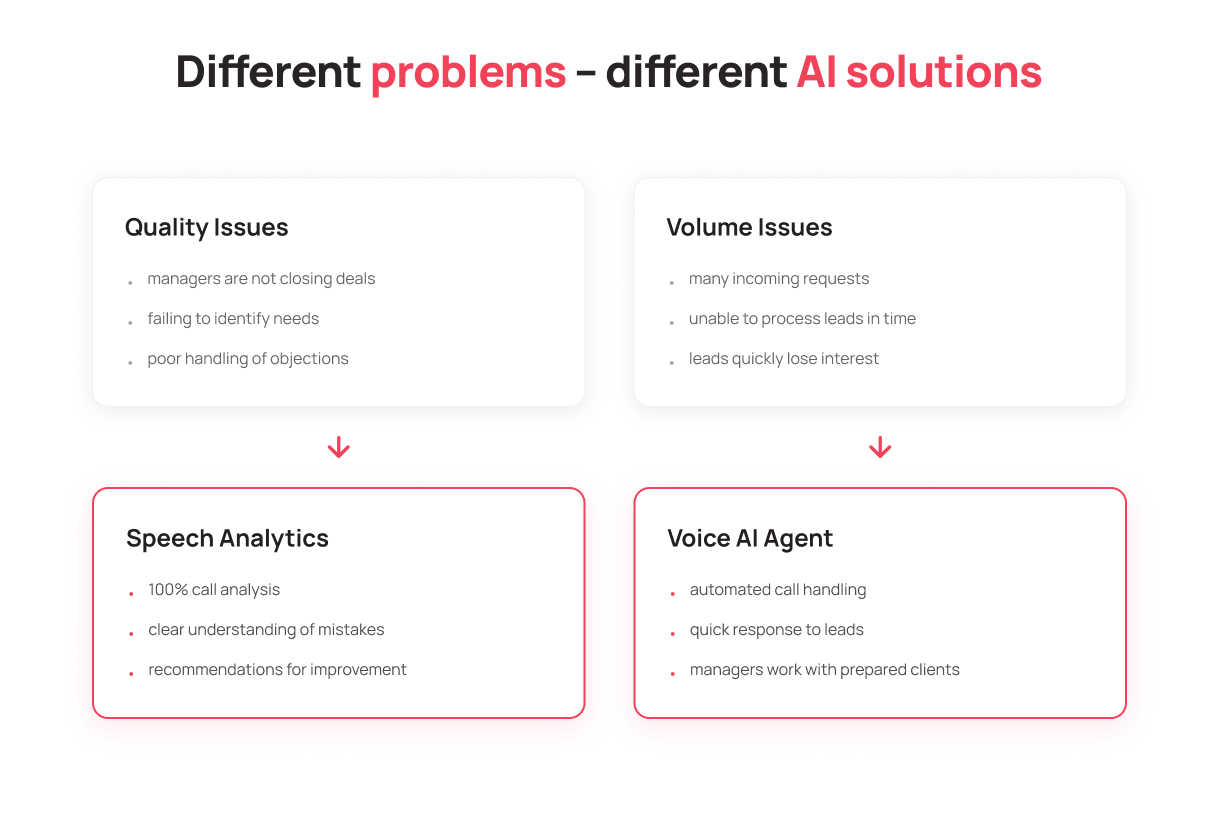
If the problem is the quality of your managers’ work – you don’t understand why deals aren’t closing, where customers drop off in the conversation, which mistakes keep repeating – you need a tool that provides transparency and control. In this case, AI acts as a diagnostic system: it highlights weak points and helps fix them.
If the problem is volume and speed – the team can’t keep up with all the incoming requests, leads lose interest quickly, managers are burning time on repetitive conversations – then you need a tool that takes over part of the communication and relieves the load on your people.
These are fundamentally different problems. And whether AI delivers results or simply adds another layer of complexity to your processes depends entirely on correctly identifying that bottleneck.
Real Cases: How It Works in Practice
Case 1. Conversion Grew by 15% – Without New Leads
The client came with a specific pain point: “We generate a lot of leads, but the conversion to payment is low. Where we’re losing deals – it’s unclear, but we don’t have the resources to listen to hundreds of hours of calls a month.”
The task for Speech Analytics: map out each stage of the conversation. Every call was broken into 4 critical blocks – needs discovery (did the manager ask at least 3 clarifying questions), solution presentation (did the manager connect the product to the customer’s pain), objection handling (were at least 2 attempts made to retain the customer after “I’ll think about it”) and closing (was a clear next step defined).
The findings were unexpected: 70% of managers skipped needs discovery and jumped straight to selling. Objections were handled in only 20% of cases. And all successful deals closed by the top 10% of salespeople shared one common element – a clear “call summary” block at the end.
The client redesigned their training system and focused on exactly two things. Conversion to payment grew by 15% with no increase in lead volume.
Case 2. Managers Stopped Wasting Time on “Cold” Calls – and Conversion Improved
An online platform offering professional development courses. Hundreds of leads coming in monthly from advertising and webinars. Plenty of leads, it seemed. But managers were spending half their workday calling through a database where most people didn’t pick up – and those who did asked the same questions over and over: what’s included in the course, how long is it, will there be a certificate, how much does it cost.
There was almost no time left for meaningful work with people who were actually ready to buy.
The Voice AI Agent took over the first qualification call: it reached out to each new lead from the CRM within minutes of registration, while interest was still fresh. During the conversation, it clarified learning goals, current skill level, and preferred format, answered common questions, and if the person was interested – immediately transferred the call to a manager. Along with the transfer, a completed profile card was automatically created in the CRM: what was asked, what was answered, how they responded.
If the person wasn’t ready yet – the agent wrapped up the conversation professionally and scheduled a follow-up call for the following week.
The result: managers started receiving only warm, pre-qualified leads with full context already in hand. The time from first contact to payment shortened, and the share of “cold” conversations in their workday dropped to near zero. Team productivity grew without adding headcount.
What Successful AI Implementation Looks Like: Six Steps
Successful AI implementation isn’t about buying software. It’s about changing a management habit.
Step 1. Identify the bottleneck – a specific goal. Not “improve sales overall,” but “stop losing orders during peak hours” or “increase conversion from the first call.”
Step 2. Choose the right tool – the Voice Agent solves the problem of availability and repetitive tasks; Speech Analytics solves the problem of quality and understanding. These are different challenges, and they often complement each other well: the agent handles leads, analytics helps you understand how managers are closing them.
Step 3. Configure AI around your hypothesis – don’t connect everything at once. Start with a minimal set of metrics or a single specific scenario.
Step 4. Analyze 100%, not selectively – spot-checking gives a distorted picture. AI lets you see all calls and the whole team at once.
Step 5. Adjust and coach – data without action has no value. Regularly update scripts and run team debriefs based on real examples from the analytics.
Step 6. Make data-driven decisions – your sales team’s strategy should be built on numbers, not gut feeling.
Two AI Tools for Sales from UniTalk
UniTalk Speech Analytics
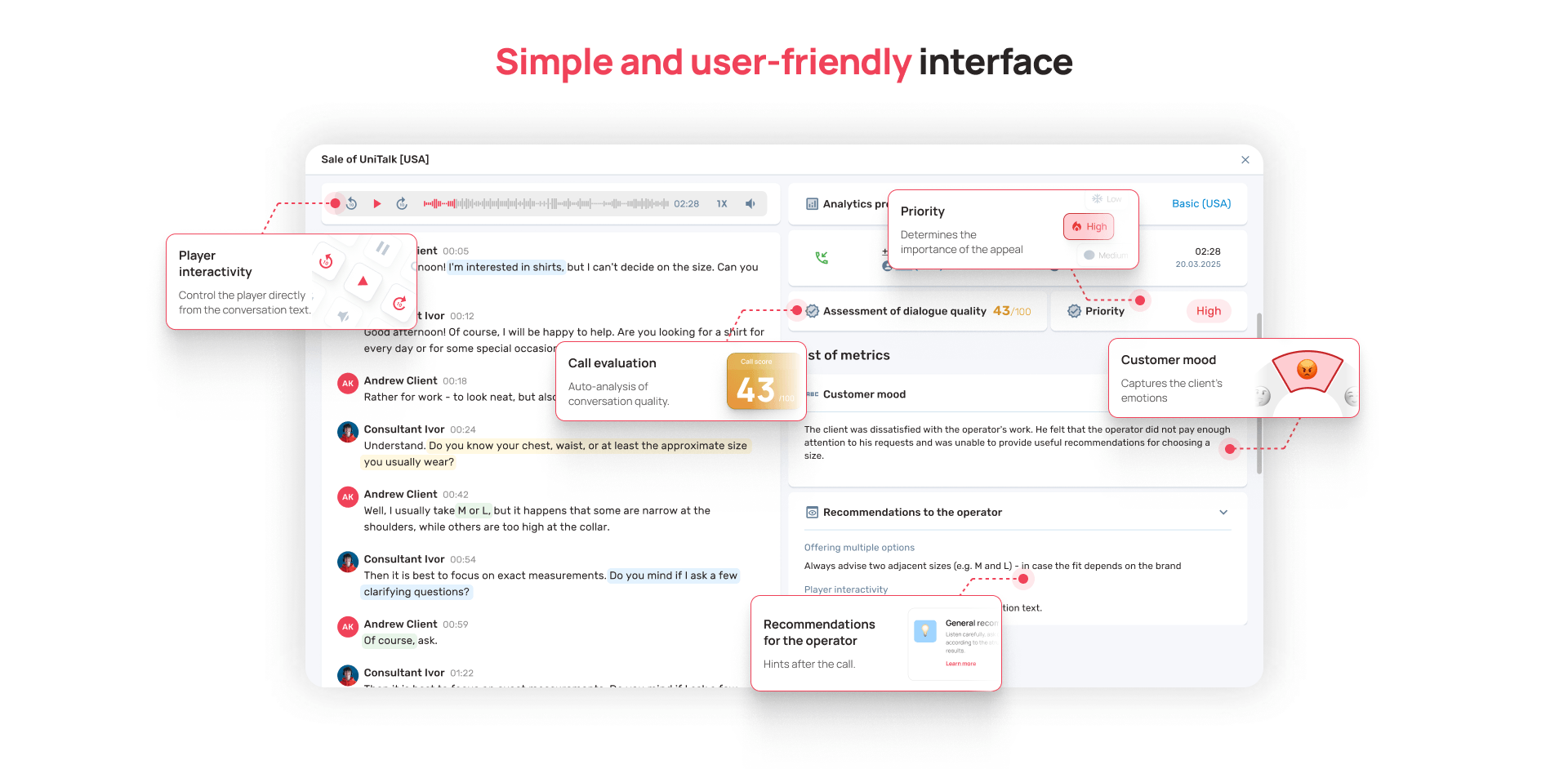
Speech Analytics helps bring order to the sales team’s work. It automatically analyzes 100% of calls, turns them into structured data, and shows exactly where managers are losing deals: at the needs discovery stage, the presentation, or objection handling.
Instead of selective spot checks – a complete picture of the entire team. Instead of subjective evaluations – clear, consistent criteria applied equally to everyone.
UniTalk Voice AI Agent
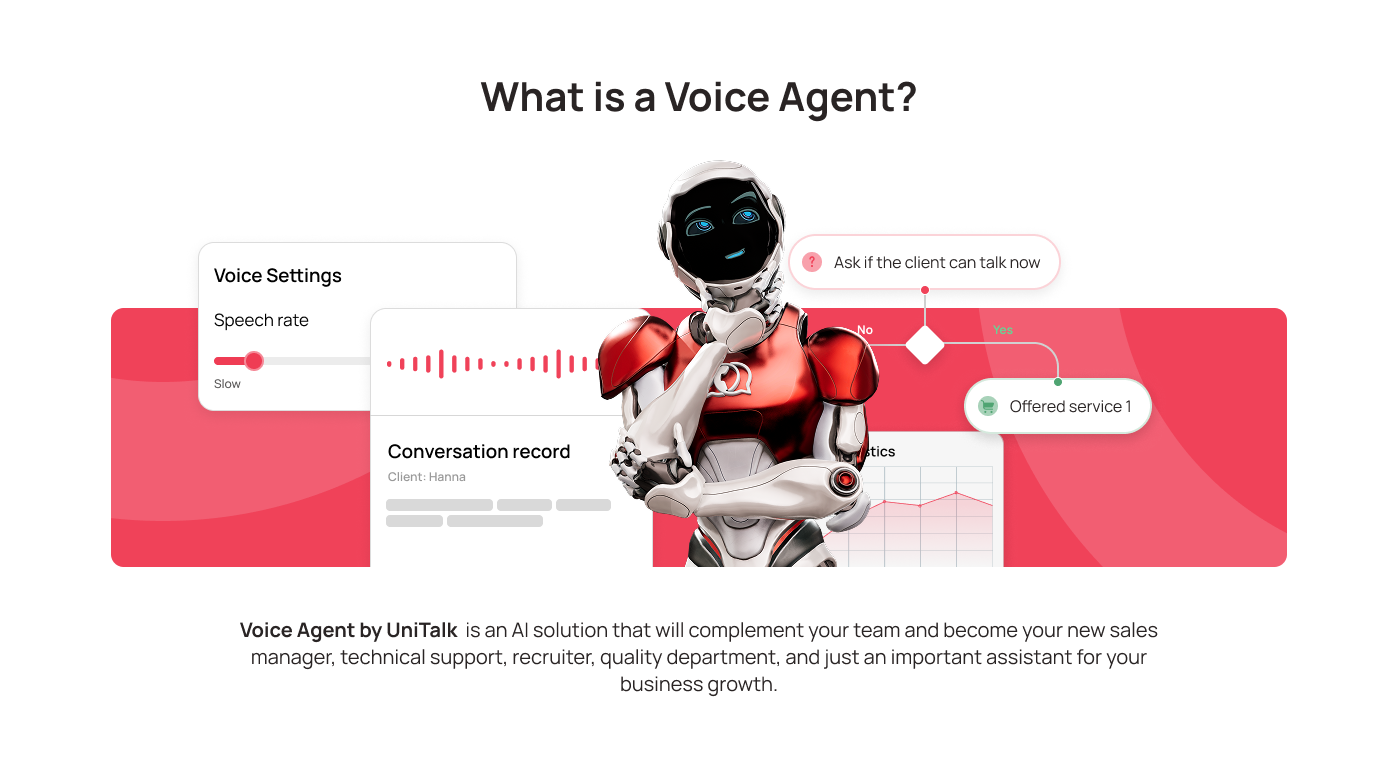
The Voice AI Agent handles routine customer communication. It answers and makes calls on its own, processes inbound requests, clarifies details, answers common questions, and passes warm, pre-qualified leads over to managers.
This frees the team to focus on deals where a human is truly needed, instead of spending time on repetitive, predictable conversations.
Together, these tools don’t replace the sales team – they make it manageable and scalable: one provides understanding of what’s happening, the other removes the load and accelerates the process.
The Bottom Line
AI won’t replace your sales team. But a sales team with AI will replace those working without it.
The difference between companies that get results and those who “tried AI and nothing happened” isn’t budget or technology. It’s approach: start with a specific business question, not with the technology.
What metric do you want to improve today?