
Hiring More Won’t Fix It: Why More Operators ≠ Better Results
When a contact center can’t keep up with the workload, the first reaction is almost always the same: we need to hire more people. More operators, more calls, more sales. The logic seems clear, but it doesn’t work. And it’s not about the quality of the people you hire. The problem is that without a system, even the best operator simply multiplies the existing chaos. In this article, we break down why this happens and what actually changes the situation.
Costs Are Growing, Results Aren’t: Sound Familiar?
The team has grown, the payroll has increased, but conversion rates and closed deals haven’t moved. Or they’ve even dropped.
This isn’t a coincidence. It happens almost every time there’s no system at the core of how the team works.
Hiring scales what already exists. If the team works in chaos, every new operator simply becomes another participant in that chaos. More people, more disorder.
Why Leaders Keep Choosing to Hire
Before diving into the numbers, it’s worth honestly answering one question: why do even strong teams keep making the same mistake?
There’s nothing surprising about it. Hiring is a clear, tangible decision. You post a job, run interviews, a new person starts. Something is happening, there’s forward movement. That’s psychologically much easier than admitting: we don’t have a system and we don’t know how to fix it.
On top of that, most managers simply don’t have the full picture. If there’s no data on how many calls are being lost, how much time operators actually spend on the line, or where delays occur, you’re left acting on gut feeling. And the gut says: we don’t have enough people. Let’s hire.
There’s also the pressure from above. The CEO wants results now. The Head of Sales is accountable to targets. In that situation, “we’re rebuilding our processes” sounds much worse than “we’re already looking for three new operators.” Hiring looks like a solution, even when it isn’t.
What’s Actually Happening Inside
In many cases, the issue isn’t just the number of people — it’s how their work is organised.
Here’s what it looks like from the inside:
- No clear order: someone handles calls manually, someone else just waits
- Missed calls aren’t logged, or are logged chaotically and get lost
- One operator is overloaded while another sits idle at the same moment
- Every outbound call is a manual process: find the number, dial, wait, log the result
- The manager finds out about problems only after they’ve turned into complaints or losses
Add three more people to this picture and you don’t get a solution — you get a more expensive version of the same problem.
The Math That Doesn’t Add Up
An operator works an 8-hour shift. But how many of those hours are they actually on calls?
Industry observations show that in teams without a clear system, the operator’s active time (Utilization or Occupancy) averages 35-40% of the shift. The rest is waiting, manual tasks, and gaps between calls.
That means out of 8 working hours, only about three are genuinely productive for the business. Five hours are paid for but not delivering results.
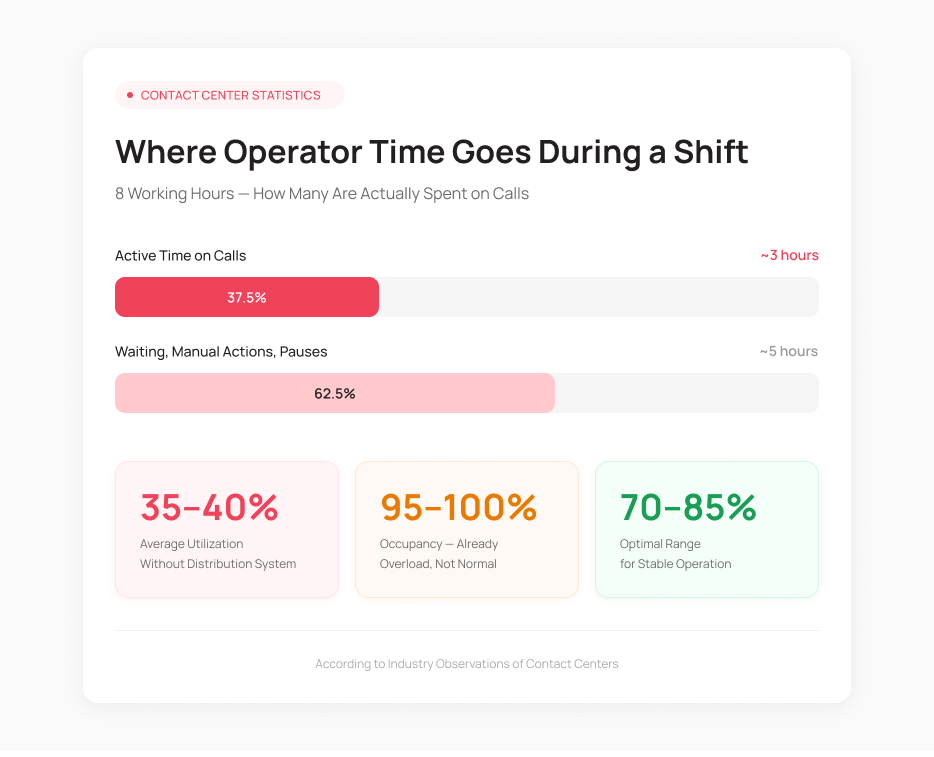
If you have 10 operators like this, you’re paying for ten but getting the productivity of three or four. Hiring five more won’t fix that ratio — it will only increase the number in the “Personnel costs” line.
Note: Occupancy at 95-100% is not the goal either. It’s a sign of overload, not efficiency. An operator without any break between calls burns out faster, makes more mistakes, and ultimately performs worse, not better.
The optimal range for stable team performance is 70-85% Utilization. You can reach it not by hiring, but by organising the process.
Three Things Hiring Won’t Fix
1. No Logic for Call Distribution
If there’s no clear rule for who takes which call, some operators will always be overloaded while others are underutilised. This isn’t solved by headcount. It’s solved by routing.
2. Slow Outbound Calls Due to Manual Work
The operator searches for the number, dials manually, waits for a pickup, logs the result in a spreadsheet. A hundred actual conversations take several times longer than they should. The problem here isn’t the size of the team — it’s the outbound process itself.
3. A Manager Flying Blind
If there’s no visibility into how many calls are in the queue, which operators are idle, or where customers are dropping off, decisions get made by instinct. And in that situation, hiring seems logical simply because there’s nothing else visible to act on.
Two Companies, Six Months, Different Results
Imagine two similar companies: both running active outbound campaigns, both with teams of 10 operators, both struggling to keep up.
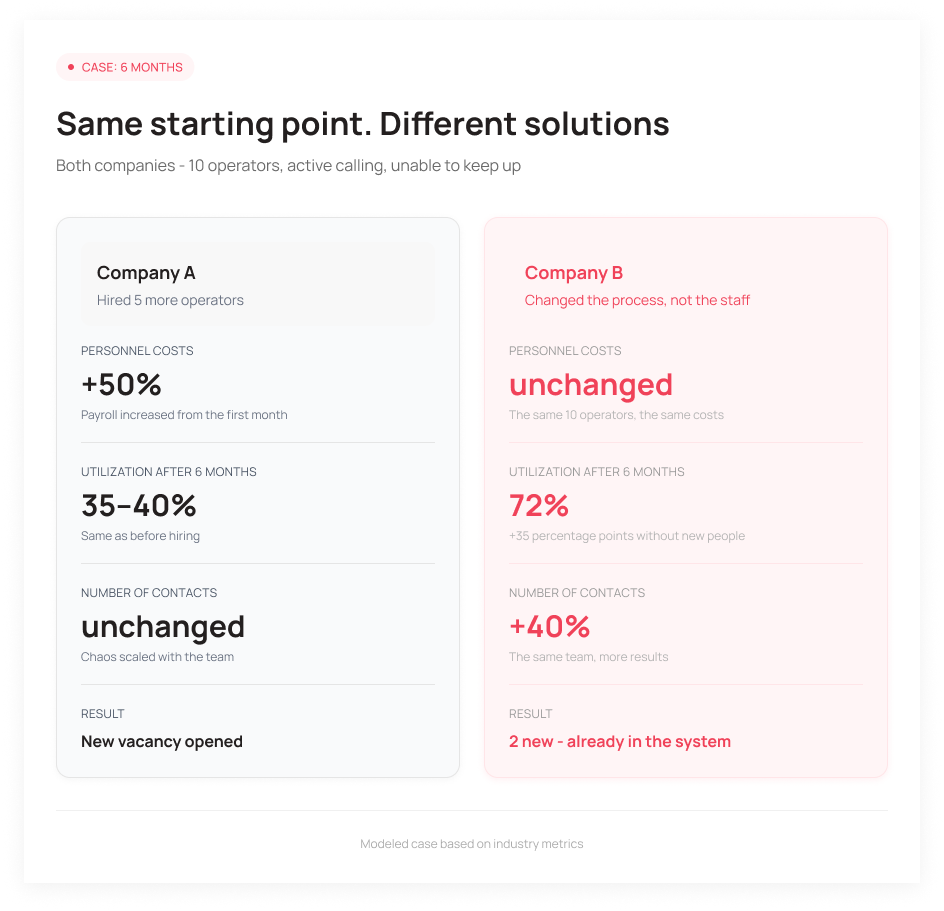
Company A decides to hire five more people. Personnel costs rise by 50%. The first month brings adaptation chaos and a temporary drop in productivity. Once the new operators settle in, they work the same way as the existing team: the same manual processes, the same disorganised call distribution, the same Utilization of 35-40%. Six months later, the team is bigger, costs are higher, and conversion is unchanged. They open a new vacancy.
Company B stops and asks: what’s actually going on? They look at the data and see: operators are on calls for 3 hours out of 8, the database is being worked manually and slowly, missed calls aren’t being tracked anywhere. They don’t hire. Instead, they change the process: automate outbound calls, remove manual steps, set up clear distribution rules. Two months later, the same team of 10 is making 40% more contacts. Six months later, Utilization is at 72%, conversion has grown, and only then do they consider bringing in two more people — into a system that’s already working.
Same starting point. Different decisions. Different results.
When Hiring Actually Makes Sense
There are situations where hiring is the right move. Specifically when:
- Team Utilization is already at 75-85%, the system is set up and running smoothly
- you know with certainty that call volume exceeds the team’s real capacity
- a new person will join a ready-made structure, not figure things out on their own
If even one of these conditions isn’t met, hiring will simply increase costs. Nothing more.
Where Efficiency Is Actually Hiding
Companies that start with process organisation rather than hiring get results without growing their headcount:
- More contacts in the same number of hours through automation of routine tasks
- Even workload distribution across the team through clear routing
- Fewer lost customers through a clear logic for handling inbound calls
- The manager sees what’s happening in real time, not after the fact
First, give your team the conditions where they can actually work to their full potential. Then think about expanding.
Conclusion
Next time the thought comes up — “we can’t keep up, we need to hire someone” — stop for a moment and ask yourself: are we struggling because of a lack of people, or because of a lack of system?
If the answer isn’t obvious, chances are it’s about the system.