Outbound Contact Center: How to Get More Productive Contacts Without Growing Your Team
400 calls a day, 140 conversations. From the outside it looks like the team is working at full capacity: phones ringing nonstop, agents always busy, a solid number in the report.
But if you break that day down minute by minute, a large part of it turns out to bring the business no value at all. Ring tones, busy signals, waiting for an answer that never comes. A business doesn’t need hundreds of calls. It needs productive contacts — conversations that move a sale forward, confirm an order, bring back a customer, or drive some other business outcome.
The team works all day, yet the manager can’t answer a simple question: where exactly is productivity being lost?
Managers and agents see a different picture
For an agent, the day looks like a continuous stream of calls. Dial a number, wait, talk or don’t talk, dial the next one.
For a manager, the picture is different. He doesn’t see individual calls, he sees the overall picture of how the team is performing: how many attempts the team made, how many of them led to a result. And this is exactly where the gap appears. Activity is high, but there’s no answer to the questions that matter: how much time the team actually spends talking to customers, which list is being worked through best, and whether it’s even worth hiring more agents just to make more calls.
That’s the root of the problem. Call volume is easy to count. Process efficiency isn’t, unless you can see what’s happening at every stage of it.
UCC manages the process, not just the dialing
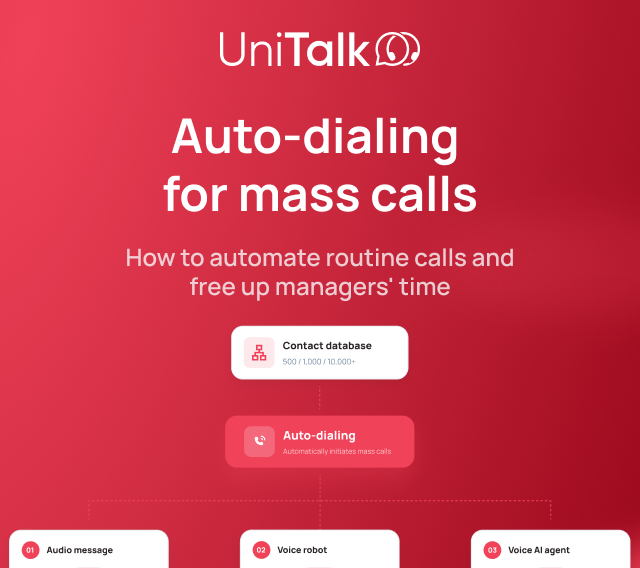
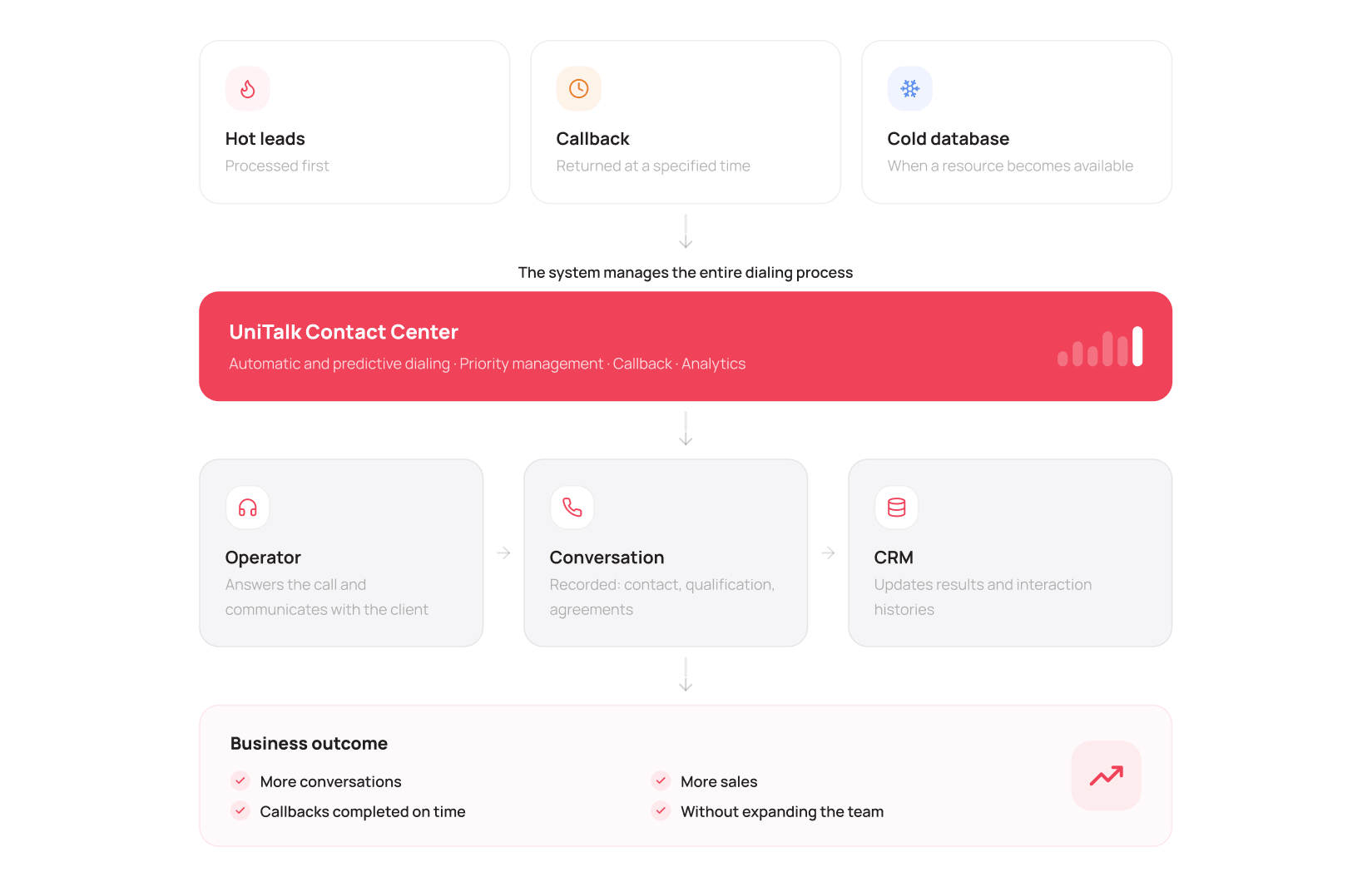
UniTalk Contact Center doesn’t just dial numbers automatically. It manages the entire outbound communication process.
The system decides which list to work first, what logic to use for dialing, who gets a successful connection, when a callback returns to the queue, and how campaign performance is shown to the manager.
Automatic and predictive dialing, meaning the system starts a call ahead of time based on how busy the team is, is just one of UCC’s capabilities. The real value is that the entire outbound communication runs as a single, managed process. The system automates routine actions, distributes workload correctly, helps prevent losing important contacts, and gives the manager a complete picture of how the team is performing.
As a result, agents spend less time on manual actions and more time talking to customers, while the manager can manage the efficiency of the whole process instead of individual calls.
The minutes that quietly eat up the workday
Even if an agent spends just a minute between calls dialing a number, waiting for an answer, and moving to the next contact, those minutes add up to dozens over a day. For a team of ten agents, that’s already hours of work time not spent talking to customers.
When the system dials and distributes numbers on its own, that time turns into additional conversations with customers. As a result, the business gets more productive contacts with the same resources, without growing headcount.
Dialing logic depends on the process
A company handling hot leads right after a website form submission and a company working through a large cold list every day need different rules. In the first case, speed matters most; in the second, it’s about spreading a large volume of contacts evenly.
In UCC, dialing intensity can be configured for a specific process: maintaining a set number of simultaneous calls, basing it on the number of available agents, or using smart pacing. In the last case, the system analyzes statistics from previous calls and can start the next dial before an agent has actually become free, shortening the pause between conversations.
In predictive dialing, once the called party answers, UCC automatically routes the connection to the agent group, specifically to whoever has been free the longest. As a result, an agent never has to manage the call flow manually: the system regulates dialing and distributes successful connections on its own.
Priority decides who waits and who doesn’t
When several lists and campaigns run at the same time, the question of order comes up. A hot lead who just submitted a form shouldn’t have to wait for the team to finish calling yesterday’s cold list.
UCC lets you build this hierarchy: which lists get worked first, how many retry attempts are made per number, which contacts are excluded from the list entirely. The team’s resources go where they’re needed most right now.
If a cold list and fresh leads are being dialed at the same time with no prioritization, a hot contact can end up “waiting” until evening simply because the queue reached them later in the schedule.
A promise to call back shouldn’t depend on memory
“I’ll call you back tomorrow at three” is an everyday phrase in any sales or support team. The problem is that this kind of commitment often lives only in the agent’s head or in a note that’s easy to forget.
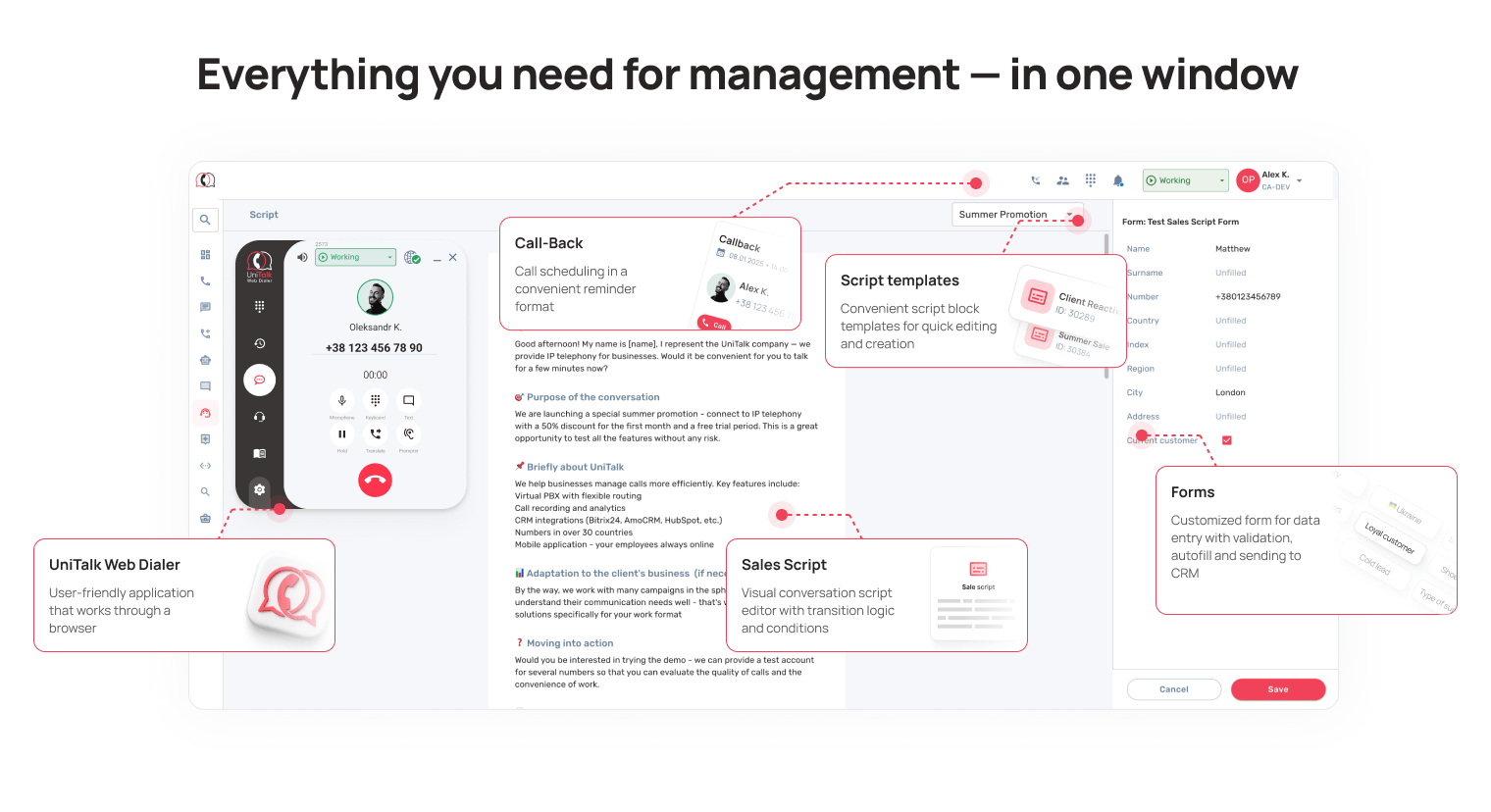
In a systematic process, a callback returns to the dialing queue automatically, with the right priority and at the right time. The commitment isn’t lost, even if the agent who made it isn’t working that day. This matters especially for sales and recruiting, where a follow-up contact often determines the final outcome.
A call isn’t a business outcome yet
The fact of a connection alone says nothing about the quality of the team’s work. The conversation could have ended in a sale, a rejection, a follow-up, or a qualified lead, and each of those has its own value to the business.
When UCC is integrated with a CRM, call statistics can be linked to the actual outcome of each contact. The manager gets an answer not just to “how many calls did the team make,” but also to “which lists, campaigns, and approaches actually drive sales.” Without that link, you can see activity, but not what it’s converting into revenue.
What a manager sees in the numbers
Number of attempts, Contact Rate — the share of successful contacts, agent workload, call duration, trends across the team and individual campaigns: this is the baseline level of visibility, without which it’s hard to see where exactly the process is losing efficiency.
Add CRM data on top of that, and the picture becomes more complete: conversion to sale, the performance of specific lists, the effectiveness of different customer segments. Together, this answers the question that actually matters: where in the process is there room to get a better result without growing the team.
One morning in a sales department
At 9:00, managers receive thirty new leads from the website. By 9:05, the system has already started dialing them, hot leads get priority, so the team connects with the freshest contacts right away.
By midday, part of the leads have been worked through, and the freed-up capacity automatically shifts to the cold list that had been waiting its turn. Agents don’t need to switch between contact lists or decide themselves who to call next, the system runs on configured priority rules and automatically directs the team’s resources to the right campaign. At 15:00, callbacks scheduled the day before return to the queue, exactly at the time agreed with the customer.
Agents spend the whole day focused on talking to customers. Dialing, campaign order, and callback returns are all handled by the system. By the end of the day, the manager sees not just “how many calls,” but how many leads were processed, how many callbacks were completed on time, and, with CRM integration, how much of that turned into sales.
The manager’s task used to sound like “how do I get the team to make more calls.” Now it sounds different: how do I get more productive contacts with the same resources.
In closing
Call volume will always be a visible metric. But it doesn’t show how effectively an outbound contact center is actually running. What matters far more is how much time agents genuinely spend talking, how well lists are worked through, whether callbacks get completed, and what business outcome those contacts produce.
That’s exactly what UniTalk Contact Center is built for: managing the entire outbound communication process, from priorities and dialing logic to analytics. The system’s job isn’t to make agents dial more, it’s to help the team get more successful contacts with the same resources. And CRM integration helps connect that data to real sales and other business outcomes.