481 viewings booked without a manager: how Scandi automated the first call in three countries
The case at a glance

Serhii Lotsman
founder of Scandi and DABL
“We don’t implement AI to replace people. We’re building a digital system that can scale the business without growing the team at the same rate.”
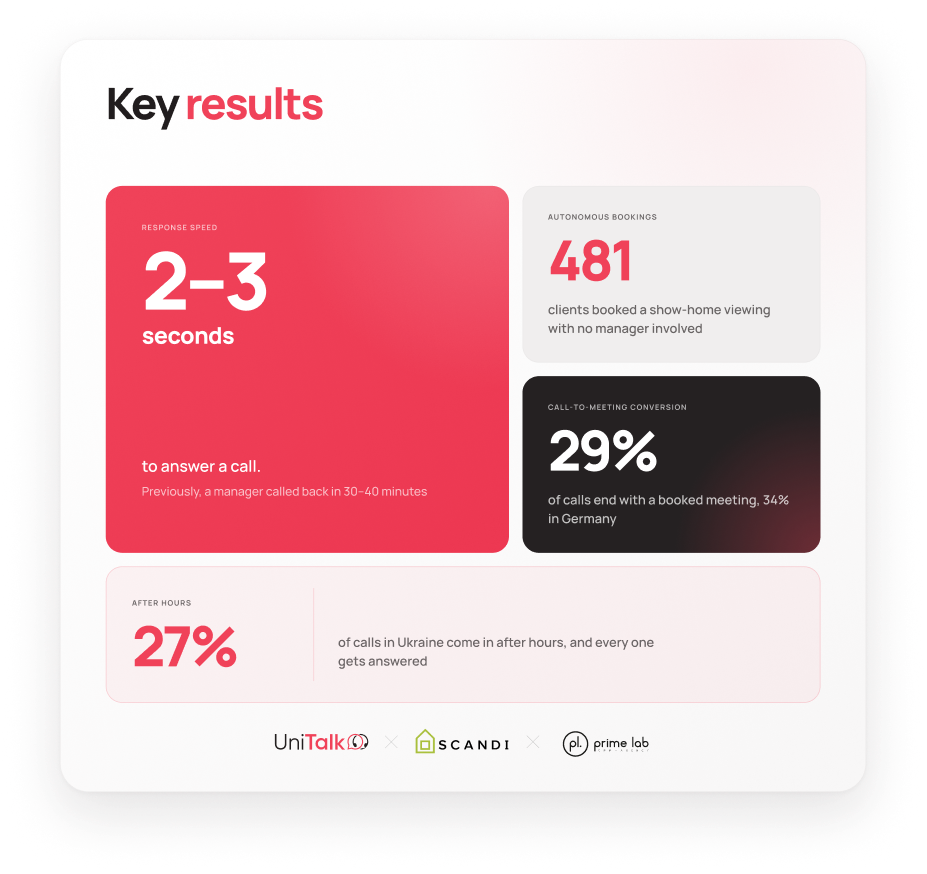
People rarely choose a modular home during working hours. They get home, open the website again, study the floor plans in the 3D configurator and decide to call to clarify the details. In Ukraine, 27% of Scandi clients do exactly that: they call on weekdays after 6 p.m. or at weekends.
That kind of call used to wait until a manager was free. Now the UniTalk AI Voice Agent answers it within 2–3 seconds: it advises the client in their language, books a show-home viewing, sends an SMS with the address and passes the conversation to the CRM. The agents have already handled 1,647 calls in Ukraine, Germany and the Netherlands, and 481 people booked a viewing without a manager getting involved. The process was built together with the CRM integrator PrimeLab.
Scandi: a home you choose rather than build
Scandi has been making modular homes for more than 17 years. In that time the company has delivered over 1,400 homes in Ukraine and Europe, and it now works in three markets: Ukraine, Germany and the Netherlands.
The business model is built on predictability. The client chooses a ready-made home with a fixed price and specification, adjusts the options in the 3D configurator on the website, sees the final cost straight away and can sign the contract online via Diia, Ukraine’s e-government app. Scandi takes care of the foundation, delivery, installation and interior work.
The homes are bought by private clients, to live in or as a country house, and by businesses that rent modular homes out. Most come from ads on Instagram, Facebook and Google, or on the recommendation of people who already live in a Scandi home.
Despite the digital buying journey, the phone is still Scandi’s main channel of trust. A home is a purchase for years, so before deciding people want to hear the answers to their questions from a real voice:

Yevheniia Yuzkova
assistant to the head of Scandi
“Buying a home is a serious decision, and behind every order is a person who needs to feel heard and understood. We believe in the principle that people buy from people.”
Where leads were lost before automation
When PrimeLab started working with Scandi, sales were run in spreadsheets and messengers. For a business with a long sales cycle this hurts the most: choosing a home, the specification, the contract and production take dozens of contacts with one client.

Danylo Osin
senior business analyst at PrimeLab
“The main problem we saw at the start was that leads were lost outside working hours and there was no single client history: messages lived on personal phones and calls weren’t logged.”
A manager handled every lead by hand from start to finish:
- Received the lead and called the client.
- Advised them and agreed on a date for a show-home viewing.
- Sent an SMS with the showroom address.
- Reminded them about the viewing the day before.
- Called back after the visit to get feedback.
While the manager was talking to one client, other calls waited. A missed client got a call back in 30–40 minutes. By then they could have called another company or simply lost interest.
Why not just hire another manager
The obvious answer to missed calls is to grow the sales team. For Scandi that didn’t work, and here is why.
Three languages. Clients call in Ukrainian, German and Dutch. Finding a manager who can advise fluently in all three is close to impossible, and their working day still ends at 6 p.m.
After hours and at weekends. A large share of enquiries comes in exactly when no managers are on the line.
Scaling. Scandi plans to add markets and partners, and every new market would need more people.
Serhii Lotsman
founder of Scandi and DABL
“We work in several European markets and languages, and we want to scale sales without growing the admin team at the same rate. Our goal is a system where 90% of processes are digital and people stay involved where they add the most value.”
So Scandi decided to automate the first contact: answering the call, handling typical questions and booking the viewing. Conversations about the specification, the contract and production stayed with the managers.
Who did what: PrimeLab and UniTalk
Two partners delivered the project, and the result came from where their work met.
| PrimeLab | UniTalk | |
|---|---|---|
| Role | CRM integrator | Telephony and AI Voice Agents |
| What they did | Moved sales from spreadsheets into the CRM, set up deal stages, lead distribution and automatic tasks | Launched three AI agents, viewing bookings in the CRM, SMS confirmations, Speech Analytics and CRM integration |
| What it delivered | Every lead is in the CRM with a history and a next step | Every inbound call is answered and processed |
Who PrimeLab are and why Scandi trusted them with the CRM
PrimeLab has been implementing, supporting and improving CRM systems for more than 14 years. In that time the team has set up CRMs for over 400 companies, from small sales teams to large businesses. PrimeLab works with off-the-shelf cloud and on-premise systems as well as custom-built solutions.
Companies usually come to PrimeLab when they already have a CRM but no results: leads get lost, managers work in outdated tools, or the system is set up in a way that doesn’t cover key sales processes.
How PrimeLab implements a CRM
The work starts with how the business runs today, and the setup comes later. At the first meeting the team finds out how managers receive and handle leads, where delays happen, what information gets lost and what is still done by hand. Only then does PrimeLab design the CRM logic: stages, automations and integrations.
Every project involves three roles:
- A sales manager gets to know the business, gathers requirements and estimates the scope, cost and timeline.
- A CRM analyst maps the processes, sets tasks and makes sure the finished solution meets the business’s needs.
- A developer joins for complex automations, integrations and custom work.
After launch, PrimeLab provides a warranty on the work and a month of support. After that, clients can add ongoing support with a dedicated analyst, team training and gradual development of the system. Some clients have worked with PrimeLab for more than 10 years.
Why businesses choose PrimeLab
Marat Abdulaiev, head of sales at PrimeLab, gives four reasons:
- Solutions tested on hundreds of projects. The team knows what works in a CRM and what is better left alone, and measures results by the growth of the client’s revenue.
- Service with minimal client involvement. PrimeLab proposes the solution and delivers it.
- An experienced team. CRM analysts have three or more years of experience on average, sales managers four or more. For specialist technical tasks there are in-house developers and trusted partners.
- Focus on one area. PrimeLab deliberately works only with CRM.
Why PrimeLab works with UniTalk
PrimeLab and UniTalk have been working together for more than two years. PrimeLab values the flexible arrangements, the partnership terms, fast responses under a clear service agreement and the fact that agreements are kept.

Marat Abdulaiev
senior manager and head of sales at PrimeLab
“The main indicator is that the clients we referred to you are still with you and aren’t going anywhere. If they’re happy, we made the right call.”
It was PrimeLab that suggested the UniTalk AI Voice Agent to Scandi:
Danylo Osin
senior business analyst at PrimeLab
“We recommended it because of the advanced voice assistant. Their previous telephony didn’t offer anything like that.”
How PrimeLab set up the CRM at Scandi
So that the AI agent had somewhere to pass leads, PrimeLab first moved Scandi’s sales from spreadsheets and messengers into a CRM. The system was built around the real path of a lead, from the first enquiry to the handover to a manager and the deal.
Danylo Osin
senior business analyst at PrimeLab
“The main principle was that the CRM shouldn’t just store leads. It should help the team go all the way from first contact to sale, automating routine actions and leaving managers the work where a person is really needed.”
Deal stages that match Scandi’s process
The team built the sales stages so that at each one it is clear what is happening with the client and what the manager’s next step is. They also accounted for different types of enquiries and for working with three countries and languages.
What the CRM now does instead of the manager
A manager used to check each new enquiry, decide who should handle it, call the client, log the result and keep the next contact in their head. Now most of these steps run automatically:
- Lead creation. When a client calls or writes, the CRM creates the record and sets a task for a manager. Nobody fills in records by hand.
- Lead distribution. Each enquiry goes to the responsible manager based on the market, language and type of request.
- Tasks and reminders. The CRM prompts when to follow up with a client and what to do next on the deal, so the next contact doesn’t depend on a manager’s memory.
- Link with telephony and the AI agent. Each enquiry reaches the CRM together with the call data, so the manager gets the contact with context.
The hardest part: who gets the client after the AI agent
Setting up the CRM itself was easier than aligning three countries, the telephony, the AI agent and the managers.
Danylo Osin
senior business analyst at PrimeLab
“At the start it was important to correctly decide who should receive the enquiry after the first conversation with the AI agent. If every enquiry simply went into a shared queue, managers would have to work out where the client came from, which language to speak and what they were asking about.”
So routing was built by market, language and type of request, and the manager receives the right client straight away.
How the Scandi team adopted the CRM
PrimeLab didn’t just hand over a finished system. The team walked the managers through the CRM logic and everyday situations: where to find a contact, how to change a stage, what to do after a call, how to pass a client to a colleague and where to see the communication history.
Today the managers’ questions are about optimising the process: which actions take up extra time and where automation would help. PrimeLab keeps improving the system based on this feedback.
Results of the CRM implementation
PrimeLab sees three changes in how Scandi handles leads:
- Faster first response. Every enquiry goes into work immediately, even when managers are busy.
- Control over next steps. The CRM creates tasks and reminders itself, so follow-ups don’t get lost.
- Less manual work. The system handles record creation, lead distribution and part of the first contact, and the manager steps in where a person is needed.
How Scandi tested the AI agent before launch
Serhii Lotsman names three criteria the company used to assess the solution:
- Multilingual support: a separate agent for Ukraine, Germany and the Netherlands.
- Integration with the existing telephony and CRM, without rebuilding the processes PrimeLab had already set up.
- A fast launch.
There were doubts at the start, and they were to be expected. Would clients want to talk to AI? Would the conversation sound artificial? Would it hurt trust in a brand whose sales are built on the idea that people buy from people?
So during the demo Scandi tested the agent on their clients’ typical requests: how it understands different languages, how naturally it holds a conversation, what it does with an off-script question and how it hands the call over to a manager.
Yevheniia Yuzkova
assistant to the head of Scandi
“It was important for us not just to see a presentation of the features, but to test the solution on our clients’ typical requests.”
What the UniTalk AI Voice Agent does
The UniTalk AI Voice Agent takes over routine phone conversations with clients: it answers calls, advises based on the company’s knowledge base, qualifies enquiries and books meetings. It runs on UniTalk’s own telephony, so the business doesn’t need extra services, and the agent passes non-standard questions to a manager. This lets the sales team focus on conversations that need a person’s expertise and decisions.
The agent isn’t set up “out of the box”: our team implements it around the client’s real scenarios and builds it into their existing processes and CRM. For Scandi we launched three agents, one for each market and language.

Valentyn Zubal
Head of Sales at UniTalk
“We implemented an AI voice agent that took over the whole first-line handling of inbound enquiries, from answering the call to booking a meeting with a manager.”
Answers every call in three languages
Calls used to wait for a free manager. Now each of Scandi’s three websites leads to its own agent, which answers in Ukrainian, German or Dutch within 2–3 seconds. There are no more missed inbound calls, whatever the day or time.
Advises clients and filters out irrelevant requests
The agent answers typical questions about modular homes and finds out what the client needs. If someone is interested in something else, for example building with SIP panels, the agent recognises this during the call, and the manager doesn’t spend time on it.
Books show-home viewings
If the client is interested, the agent agrees on a date and time to visit the show home and creates the event in the CRM itself. The manager sees a scheduled meeting, not a “missed call from an unknown number”.
Sends an SMS with the showroom address
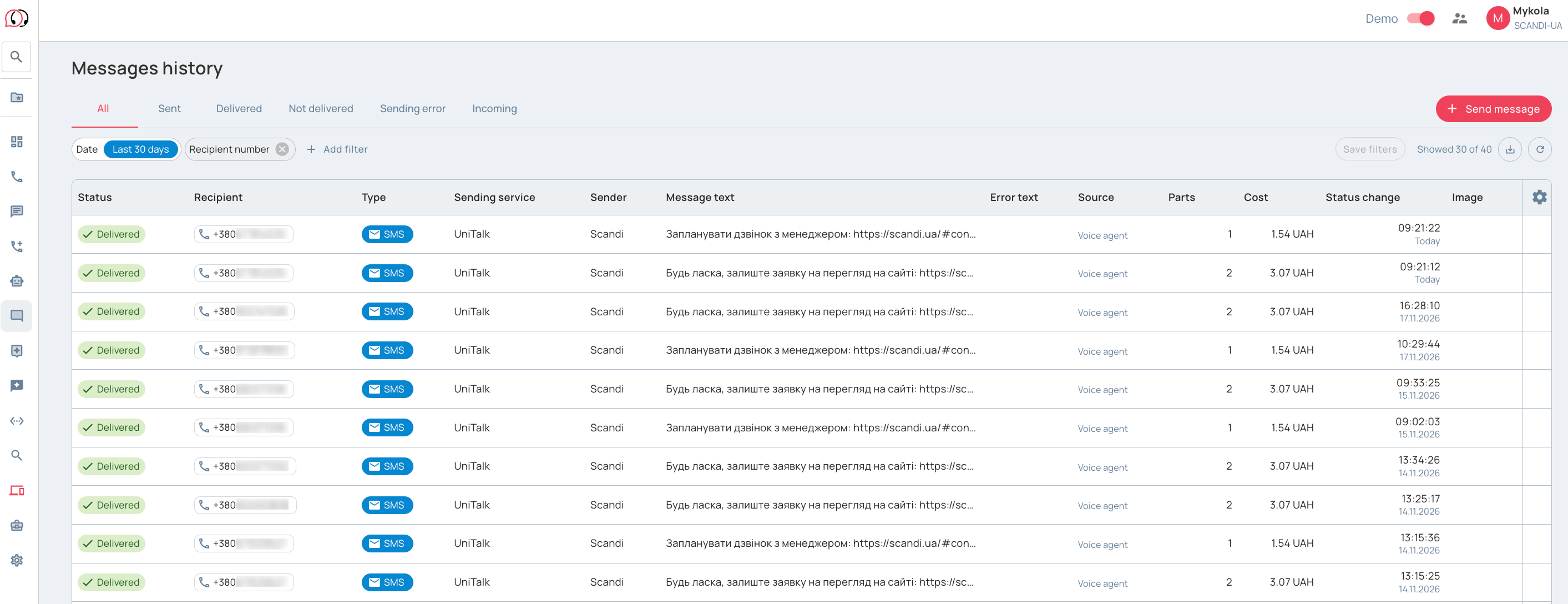
Managers used to send an SMS by hand after every booking. Now, right after the call, the client receives a message with the date, time and location of the show home.
Passes the conversation and data to the CRM
After every call, the client’s details and the call recording go to the CRM. If the client wants to talk to a person, the agent transfers the call to a manager.
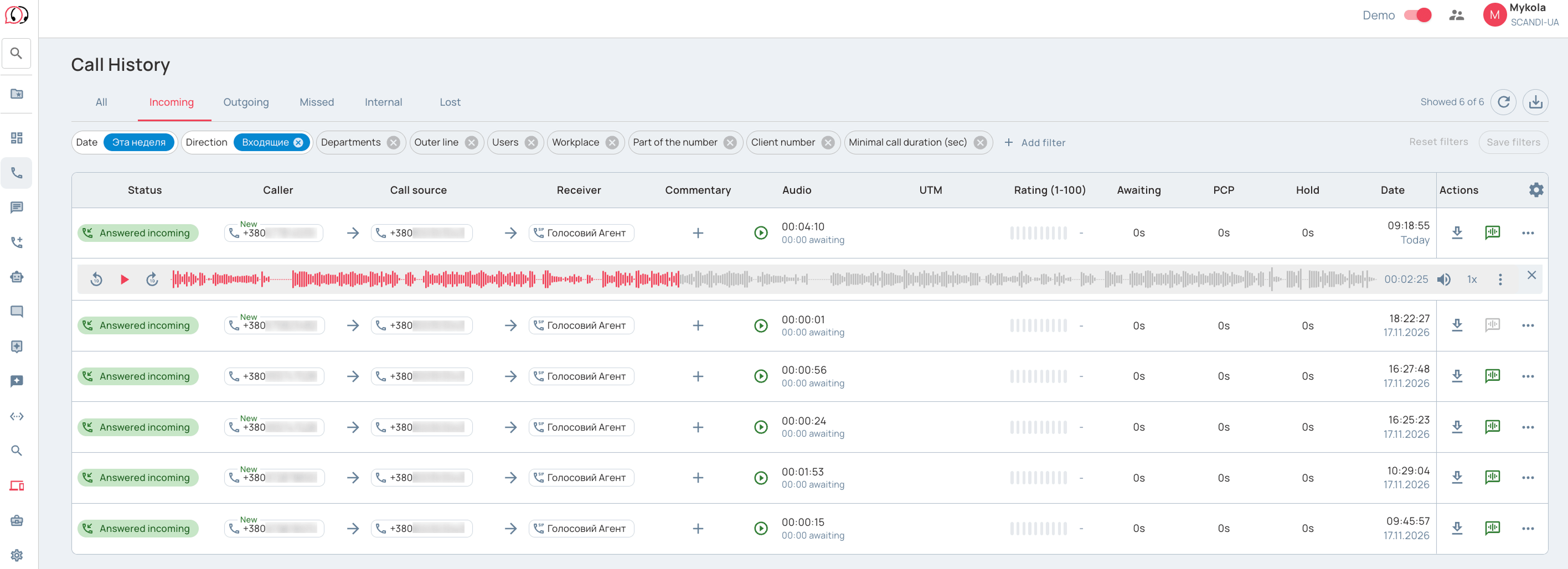
Gives control over every agent conversation
Speech Analytics transcribes and analyses every agent conversation: what the client asked, what the agent answered and how the call ended. The results go into the lead record in the CRM together with the recording. This way the Scandi team sees where the agent answered inaccurately and adjusts the scenario if needed, and goes back to the recording itself when they need to hear the details.
Saturday, 9 p.m.: the path of one call
This is what an evening enquiry looks like now, one that used to be answered only during working hours:
- A person browses homes on the Scandi website and calls the number shown.
- The AI agent answers within 2–3 seconds.
- The agent answers their questions and finds out what exactly they are interested in.
- The client picks a convenient date for a show-home viewing.
- The agent creates the event in the CRM.
- The client immediately gets an SMS with the date, time and location of the showroom.
- A lead with the call recording appears in the CRM.
On Monday morning the manager sees the scheduled meeting and the full context of the call in the CRM. The client got an answer when their interest was at its peak.
1,647 calls and 481 bookings: results by market
The three agents handled 1,647 inbound calls. 481 of them ended with a show-home viewing booked.
| Market | Calls answered | Viewings booked | Call → booking |
|---|---|---|---|
| Ukraine | 1,161 | 343 | 29.5% |
| Germany | 311 | 106 | 34.1% |
| Netherlands | 175 | 32 | 18.3% |
| Total | 1,647 | 481 | 29.2% |
Conversion is highest in Germany, where every third call turns into a showroom booking.
An answer in seconds instead of waiting. The agent picks up within 2–3 seconds, whether managers are busy or not.
Yevheniia Yuzkova
assistant to the head of Scandi
“Inbound calls are handled faster. Some used to be missed, now every call gets dealt with.”
Evening calls no longer wait until morning. In Ukraine, 27% of calls to the agent come in on weekdays between 6 p.m. and 9 a.m. and at weekends; in Germany and the Netherlands it is 7%. These clients get advice straight away and book a viewing while their interest is still high.
The manager gets a prepared contact. PrimeLab, which supports Scandi’s CRM, has noticed that managers now join the conversation when it is already clear who is calling, what about and what the next step is.
Serhii Lotsman
founder of Scandi and DABL
“We solved an important problem: an inbound call no longer depends on whether a particular manager is available.”
The AI agent needed training too
The agent on its first day and the agent a few months later sound different. The voice was adapted quickly, and the CRM integration ran smoothly from the first weeks. Two things took the most time:
- SMS confirmations. Sending had to be tested for a long time so that clients received the right date, time and address in each of the three markets.
- Conversation scenarios. The Scandi and UniTalk teams listened to real calls, saw where the agent answered inaccurately and adjusted its instructions.
To make this work, the teams set up an ongoing feedback loop: a Scandi manager spots an inaccuracy in a call, tells our team, and we pick up the fix.
One more observation: some clients are happy to talk to AI, while others ask to be put through to a manager straight away. That is why every agent scenario includes a quick handover to a person.
Who this approach suits
Scandi’s experience is worth repeating if:
- you have a high average deal value and a long sales cycle, where every lost lead is expensive;
- clients call in the evening and at weekends, when managers are unavailable;
- you work in several markets or languages;
- the first call is typical: answering basic questions and booking a meeting, demo or visit;
- you have a CRM and are ready to set up a process in it, so the agent has somewhere to pass leads.
Advice from Scandi and PrimeLab
Scandi’s founder and the CRM integrator PrimeLab independently give the same advice: don’t try to automate chaos.
Serhii Lotsman
founder of Scandi and DABL
“I’d advise starting not with choosing an AI tool but with understanding your own business processes. If processes aren’t structured, AI won’t make them efficient on its own. It can only automate the chaos you already have.”
Danylo Osin
senior business analyst at PrimeLab
“First, digitise and map out your business process on paper or in Miro. And don’t be afraid to connect telephony, CRM and AI. In high-ticket niches like modular construction, one lost lead means tens of thousands of dollars of missed revenue.”
Where to start
- Check your telephony reports to see how many calls come in outside working hours and how many go unanswered.
- Choose one typical scenario for the agent, for example advice and booking a meeting.
- For the first few weeks, listen to the agent’s calls and refine the scenario.
Not sure how many enquiries you lose in the evenings and at weekends? We’ll show you on your own data and suggest which scenario to start with.