Contact Center Myths: Myth #1. Is a Call Center the Same as a Contact Center?
Call center and contact center are often used as if they mean the same thing. Because of that, businesses end up buying a solution that handles calls well but doesn’t actually help manage how the team works. At first, the difference is barely noticeable. But as the volume of requests grows and the team expands, it becomes clear: answering calls is one thing, and organizing efficient work around them is something else entirely. That’s exactly what we’ll unpack here.
Where This Confusion Actually Comes From
This mix-up didn’t happen by accident. The market itself has been shaping it for years. Some vendors call anything with queues and IVR a “contact center,” while others slap the same label on any tool that’s added messaging apps. As a result, it’s getting harder for companies to understand what they’re actually buying and what business problem it’s supposed to solve.
The outcome is predictable: a manager pays for a “contact center” and gets rebranded telephony instead. Or the opposite happens, they spend the budget on a complex platform when all the team really needed was a properly configured call center.
What a Call Center Is Actually Responsible For
If a company only handles phone requests, has a small team, and doesn’t need detailed control over workload or SLA, a well-configured call center can fully cover its needs.
A call center is a tool for handling voice interactions. It covers:
- inbound calls;
- outbound campaigns;
- IVR (voice menu);
- call queues;
- routing calls between agents.
A call center has one job: answer or place a call and quickly connect the person with the right agent.
But picture an ordinary situation. An agent comes back from lunch, and in the meantime three customers hang up without getting an answer. Nobody noticed that one group of agents was overloaded while another had already wrapped up their tasks. The company lost potential customers not because of understaffing or bad telephony, but because there was no properly organized process around it.
That’s exactly the point where a business needs more than a call center. It needs a contact center.
What a Contact Center Is Actually Responsible For
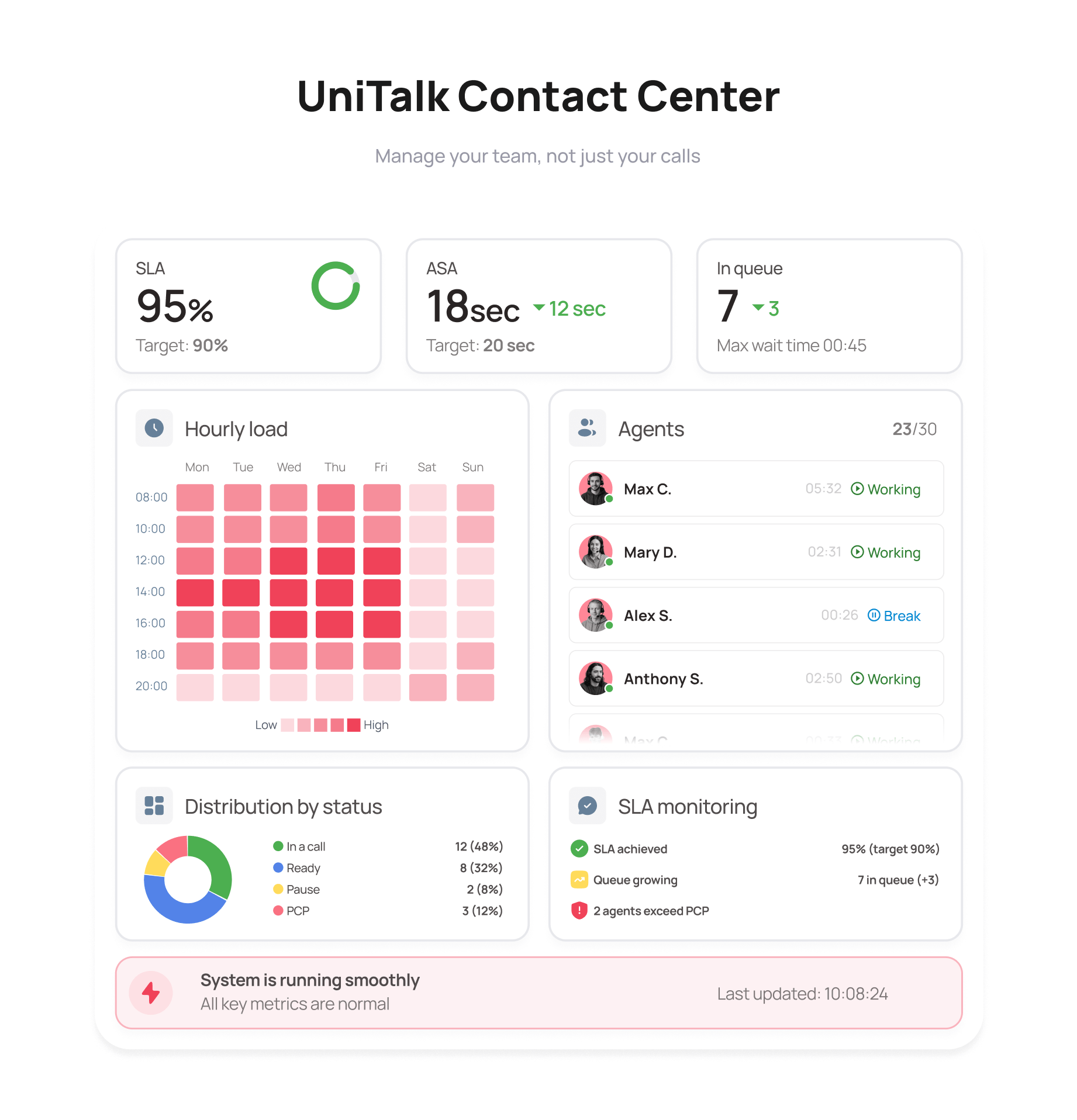
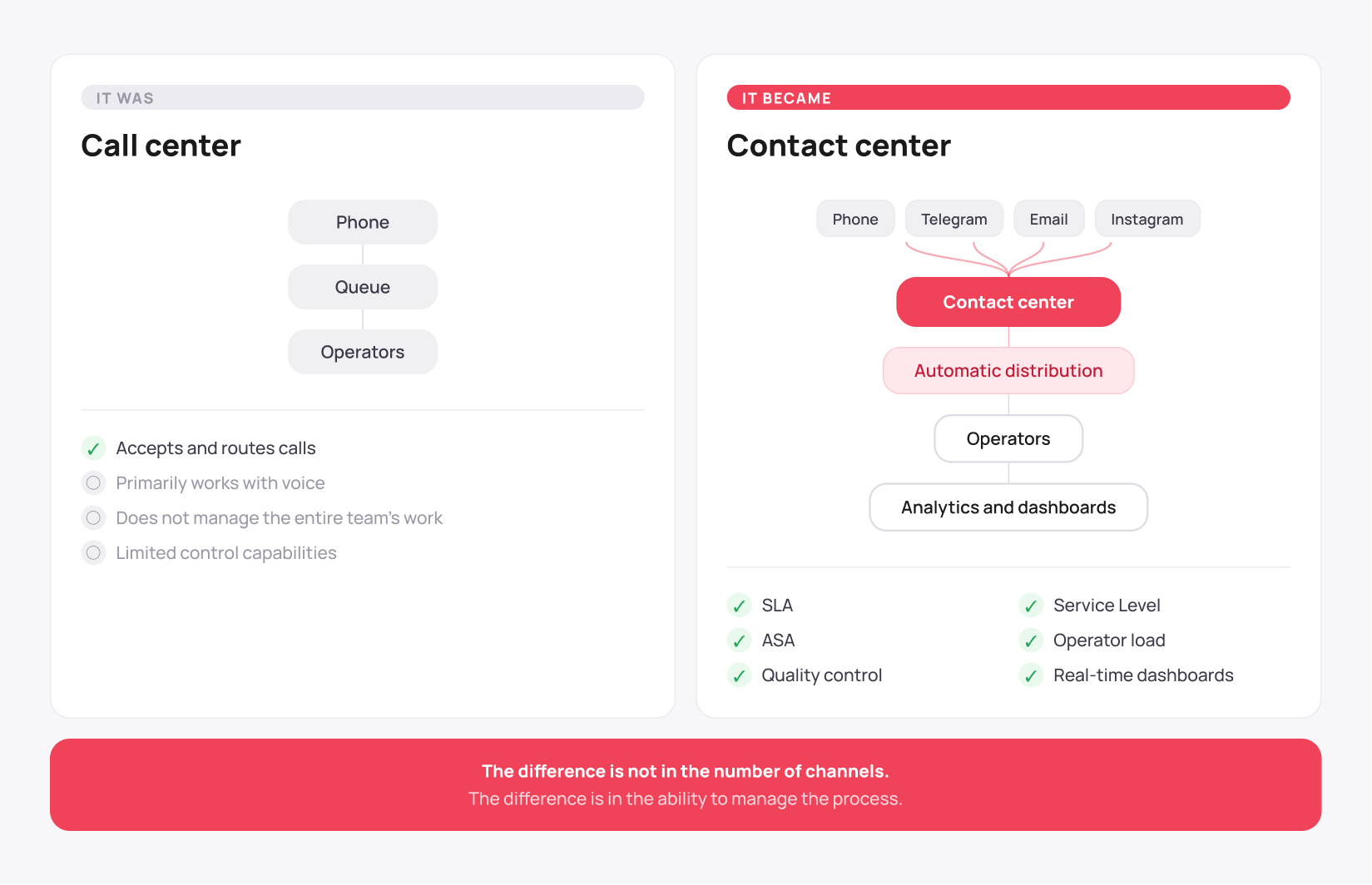
A contact center helps coordinate not individual requests, but the entire process of handling them. It automatically distributes workload across agents, tracks SLA compliance, shows Service Level and average wait time, and lets a manager spot problems before they start affecting customers.
That’s why a contact center manager isn’t just working off a call list, they’re working with performance metrics for the entire service.
Calls alone don’t deliver results. A system does.
If a call center answers the question “who picks up this call,” a contact center answers the question “how do we make sure every request gets handled on time, no matter the workload, the channel, or which agents are on shift.”
A call center helps an agent work. A contact center helps a manager manage.
That said, a modern contact center does work with phone calls as well as chats, messaging apps, email, and other channels. But supporting multiple channels is just one of its capabilities, not the main difference.
That’s why a contact center doesn’t replace a call center, it includes everything a call center does and adds what telephony alone can’t provide: tools for building processes, coordinating the team, and controlling service quality.
| Call Center | Contact Center |
|---|---|
| Answers calls | Manages all requests |
| Works mainly with voice | Brings all channels into one process |
| Helps an agent respond | Helps a manager coordinate the team |
| Monitors calls | Monitors service and business processes |
Why This Myth Costs Businesses Money
Companies rarely lose money because they have the “wrong” contact center. They lose it gradually: missed requests, overloaded agents, longer wait times, a lower Service Level, more repeat contacts, and the constant need to grow the team. All of this drives up costs, even though the real issue often isn’t the people, it’s that the system no longer matches the scale of the work.
What a Contact Center Manager Sees That a Call Center Manager Doesn’t
A call center manager sees call status: how many were answered, how many are in queue, how many were missed. A contact center manager sees all of that plus the full picture of how the service is running: where delays are actually happening, which agents are overloaded and which are underutilized, and whether the team as a whole is keeping up with the flow of requests.
These metrics are what help you understand not just what happened, but why it happened.
For a call center, a call is a standalone event. For a contact center, it’s just one part of the entire customer journey. That’s why it lets you control not individual requests, but overall service quality.
A call center simply can’t show this, because for a call center, a call ends the moment someone picks up. For a contact center, a call is just one point in a larger service process, and that’s where real management happens.
The Mistake of Judging a Contact Center by Its Feature List
Having IVR, queues, or AI analytics isn’t enough on its own. Individually, these are just features. Value shows up when they all work together as a single system: automatically distributing requests, helping control quality, and giving a manager a complete picture of what’s happening.
That’s why two companies can use identical telephony and get completely different results. One keeps growing headcount to handle the load. The other works with the same team but, thanks to a well-organized process, handles more requests and loses fewer customers.
A business isn’t buying features. It’s buying a predictable outcome and control over the process.
When It’s Time to Think About a Contact Center
The need for a system usually creeps up gradually, through small accumulated frustrations. It’s worth considering a contact center if you keep catching yourself thinking:
- “Why are some agents always overloaded while others sit idle?”
- “Why can’t we figure out exactly where we’re losing customers?”
- “Why does managing the process get harder, not easier, as we add more agents?”
- “Why do we keep hiring instead of making the current team more effective?”
If even one of these sounds familiar, the issue isn’t the number of agents or calls. It’s that nobody has organized the process into a system yet.
A Practical Example
A company started out with phone sales and worked exclusively through a call center. Over time, the number of agents grew, and so did the number of calls. At the same time, customers started reaching out not just by phone, but through the website and messaging apps too.
One customer submitted a form on the website, then messaged on Telegram, then called an hour later. To him, it was one conversation with the company. To the managers, it was three separate requests that nobody connected to each other. Situations like this kept piling up, and it quickly started affecting how the whole team worked.
Through the dashboard, the manager saw that Service Level had dropped below target, average wait time had gone up, and some calls were going unanswered during peak hours. The problem wasn’t the people or the number of requests. Nobody had a full picture of the workload and couldn’t quickly redistribute it across agents.
After switching to a contact center, requests started getting distributed automatically under a single set of rules. The metrics evened out without adding headcount, and the manager could finally see the team’s workload in real time and make decisions based on data instead of guesswork.
The Bottom Line
A call center answers the question “how do we answer calls?” A contact center answers the question “how do we organize the whole team’s work so every request gets handled well and on time?” That’s why the difference between them isn’t about how many channels are available, it’s about the approach to managing communication.
A call center hasn’t become outdated or unnecessary. It does its job well: handling phone requests. But once a team is dealing with a large flow of requests, tracking SLA, monitoring agent workload, and managing service quality across multiple channels, a call center alone isn’t enough. That’s when the next step becomes a contact center.
That’s how a modern contact center works. If you’d like to see it in action, take a look at what UniTalk Contact Center can do.
UniTalk: Manage communications. Drive results.