SL, ASA, AHT: What They Are and Why Your Call Center Can’t Work Without Them
Most contact center managers know something is off. Customers complain about long wait times. Agents say they can’t keep up. The data exists, but it’s scattered across spreadsheets, and pulling it together takes a lot of time every single time. And the most frustrating part: even when the numbers are there, it’s unclear what to do with them.
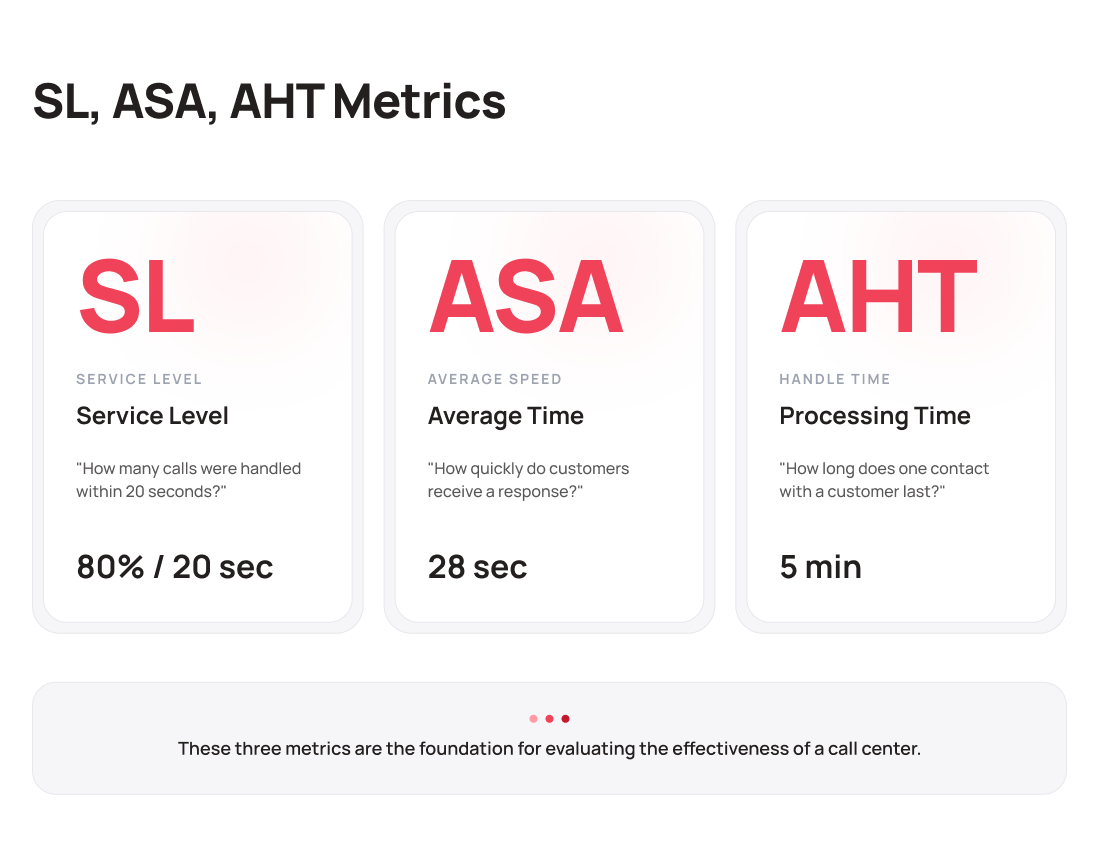
Three metrics solve this problem. SL, ASA, and AHT are not trendy acronyms from foreign textbooks. They are specific numbers that show whether your contact center’s processes are under control — or already falling apart, with no data to see it.
Why a Call Center Without Metrics Is Like a Business Without Accounting
Imagine a company that keeps no financial records. Money comes in and goes out, everyone is busy, but whether there’s a profit — nobody knows. Sounds absurd? Yet that’s exactly how most contact centers operate without basic metrics.
There’s a team of agents. There are calls. There’s a feeling that “we’re generally managing.” But how many customers hung up without getting through? How long does the average call take? Is the team handling the incoming volume within the expected timeframe?
Without answers to these questions, managing a contact center is purely intuitive. And intuition is a poor foundation for operational decisions.
SL, ASA, and AHT provide those answers. Let’s break each one down.
Service Level (SL): How Many Customers Got a Timely Answer
Service Level — or SL — is the percentage of calls answered by an agent within a set time. It’s written in the format “X% within Y seconds.”
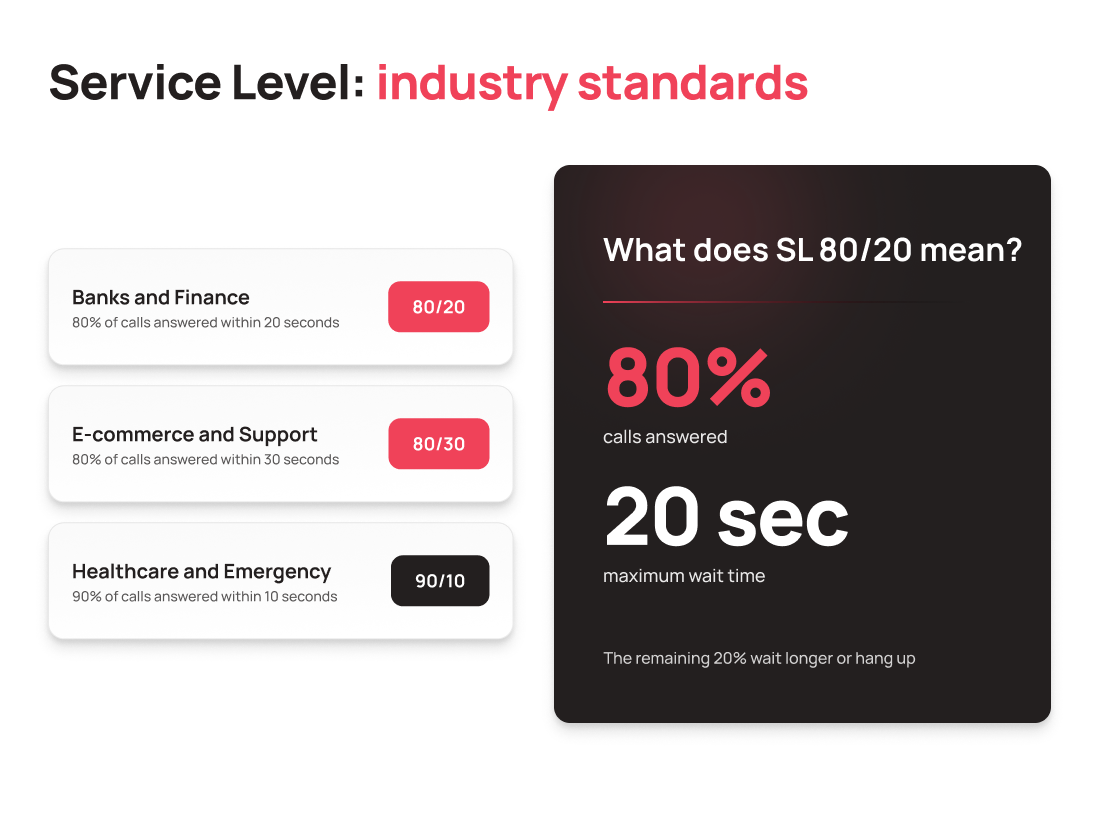
For example, SL 80/20 means: 80% of inbound calls were answered within 20 seconds. This is one of the most common industry standards, though the target varies by business type.
Why Low SL Creates a Vicious Cycle
SL is the direct answer to one question: is the team keeping up with inbound volume?
When SL drops below target, the company starts losing inquiries, leads, and repeat sales before the customer even speaks to an agent. Some callers hang up. Others call back, which adds load to the team. The result is a vicious cycle: low SL drives more calls, and the growing volume pushes SL down even further.
Industry Benchmarks
According to international industry research, SL standards vary by sector:
- Banking and financial services: 80% within 20 seconds
- E-commerce and support teams: 80% within 30 seconds
- Healthcare and emergency services: 90% within 10 seconds
- Outsourced contact centers: depends on SLA terms with the client
If your SL is consistently below target, this is not a one-day problem. It’s a systemic issue that one extra shift won’t fix.
A Common Mistake
Many managers check SL once a week or once a month. But this metric needs to be tracked by hour and by day. SL might look fine on average while being catastrophic every Monday at 9 a.m., when the queue spikes after the weekend.
ASA: How Long Customers Wait on Hold
ASA (Average Speed of Answer) is the average time a customer waits before an agent picks up. It’s measured in seconds.
The formula is simple: total wait time for all calls divided by the number of calls that were answered.
What Happens While the Customer Waits
ASA directly determines how many customers will wait for an answer — and how many will go to a competitor before ever speaking to an agent. Research in customer service shows that around 60% of people hang up if they wait more than a minute. More than a third of them never call back. They simply move on to a competitor or stay stuck with an unresolved issue and a negative impression.
ASA Benchmarks by Business Type
For most inbound contact centers, an ASA of up to 28–30 seconds is considered acceptable. That said, it depends on the type of business and customer expectations.
In e-commerce during peak sales periods, ASA can jump to 2–3 minutes. For B2B technical support, even 45 seconds of waiting is often acceptable to customers — as long as they receive a qualified answer afterward.
When ASA Starts Signaling a Problem
A sudden spike in ASA at a specific time is a signal. There are three possible causes: inbound volume increased, fewer agents were available, or the duration of each call grew. Each cause requires a different response. Without data, it’s nearly impossible to tell which one triggered the problem.
AHT: How Long It Takes to Handle One Call
AHT (Average Handle Time) is the average time spent on a single call. An important detail: AHT includes not just talk time, but also post-call work — when the agent updates the customer record, adds notes, or completes related tasks.
Formula: (talk time + hold time during the call + after-call work) / number of calls.
How Two Extra Minutes Drain Productivity
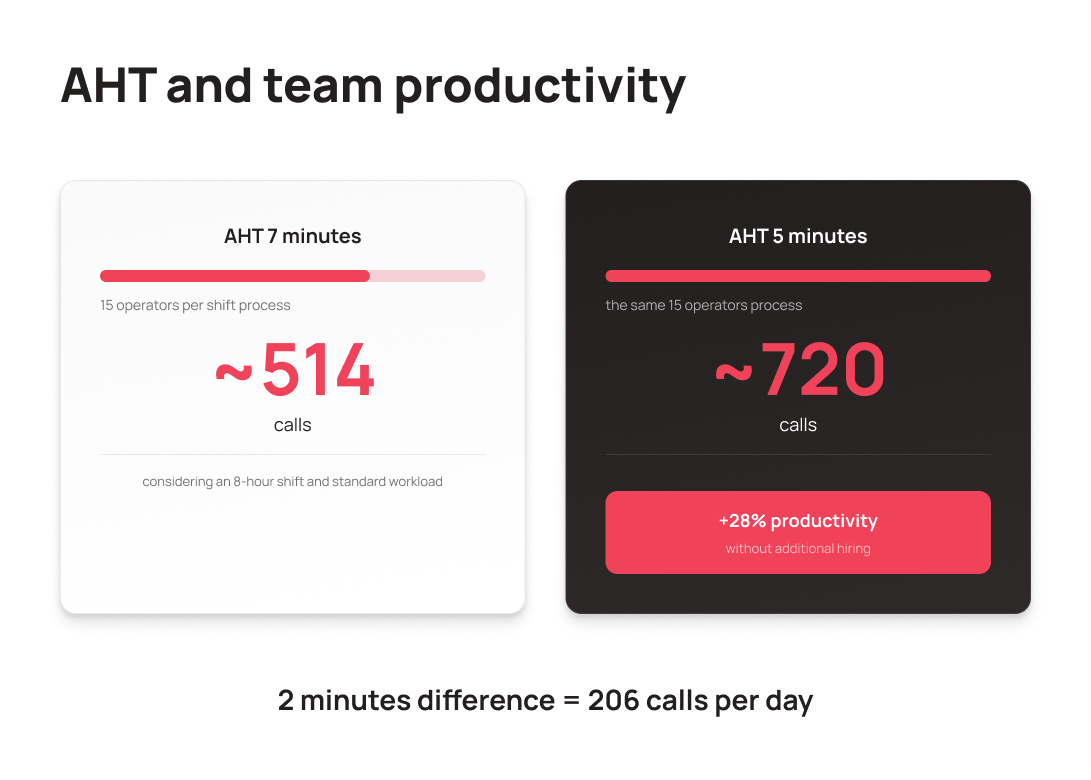
AHT has a direct impact on overall team output. If one call takes an average of 6 minutes instead of 4, an agent handles noticeably fewer calls per shift. Multiply that across 20 agents and you get a significant difference in the total capacity of the contact center.
Consider this: a team of 15 agents with an AHT of 7 minutes. If better training and more convenient tools bring AHT down to 5 minutes, effective team capacity grows by roughly 28% — with no new hires.
AHT: Lower Isn’t Always Better
There’s an important trap here. Some managers try to cut AHT by any means — pressuring agents to end calls faster. The result: customers get incomplete answers, call back again, and overall contact center load increases.
The optimal AHT isn’t the lowest possible. It’s the one at which customers get a full resolution on the first contact. That’s why AHT should always be read alongside FCR (First Call Resolution) — the share of calls that don’t result in a callback.
How the Three Metrics Are Connected
SL, ASA, and AHT are not separate indicators. They form a system where a change in one inevitably affects the others.
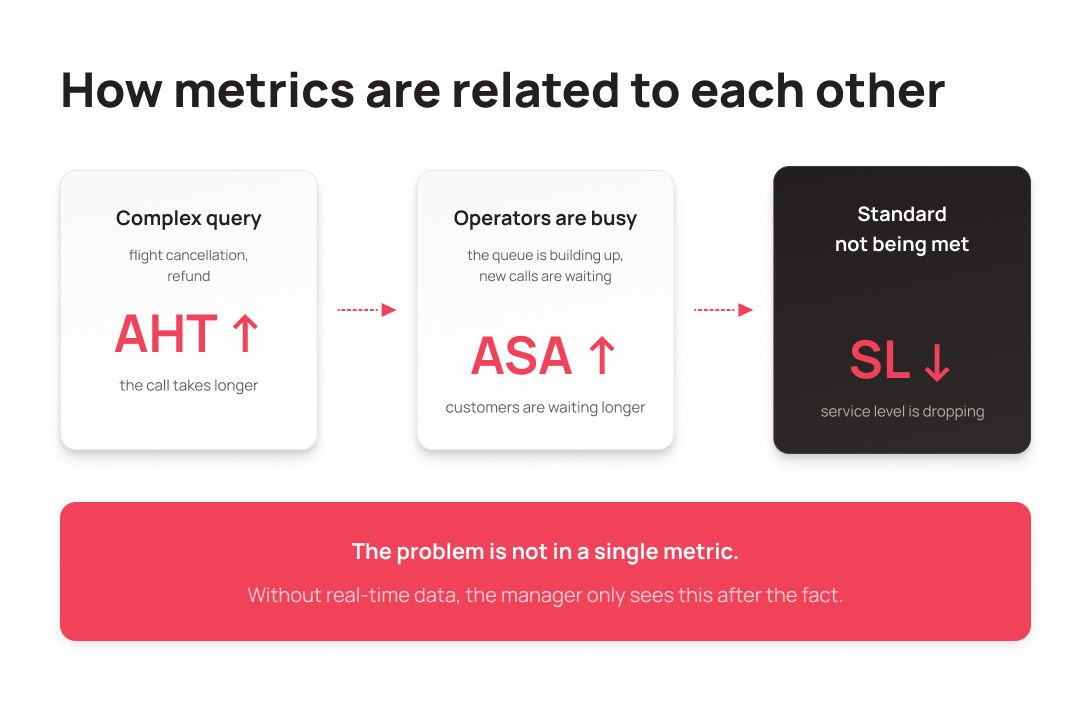
Here’s a real scenario. An airline cancels a flight. Hundreds of passengers call customer support at the same time. Here’s what happens:
AHT rises. The requests are complex: “refund my ticket,” “rebook my flight,” “what about my luggage.” Each call takes longer than usual.
ASA rises. The queue builds up because agents are occupied longer. New callers wait longer and longer.
SL drops. The team physically can’t answer calls within the target window. Most customers wait longer than they should.
The problem isn’t in one metric. The system broke down at three points simultaneously. And if the manager had seen these metrics in real time, they could have brought in extra agents or redirected the team before the crisis escalated.
What the Absence of Metrics Looks Like in Practice
A typical picture of a mid-sized company with no systematic data collection.
The supervisor evaluates team performance by feel. No complaints means everything is fine. If a customer leaves an angry review, a specific incident gets investigated. But nobody sees the bigger picture.
Workload is distributed unevenly. Some agents handled 80 calls in a shift, others handled 40. But nobody noticed, because the data isn’t there.
The monthly report takes hours to compile. Data is pulled manually from multiple sources, some numbers contradict each other, and the manager ends up with a picture of last month at a point when nothing can be fixed anymore.
The most expensive cost of this approach isn’t the time wasted. It’s the customers who didn’t wait and left — and you never found out.
Where to Start: A Minimum Set for Control
If you’re just starting to introduce measurement in your contact center, don’t try to track everything at once. Start with three steps.
Step 1. Define target values for your business. For an inbound service center, aim for SL 80/20 and ASA under 30 seconds. For a sales team, agent utilization and AHT matter more. Target benchmarks depend on your contact center type, industry, and customer expectations.
Step 2. Collect baseline data for the current month. Even if it’s done manually, you need a starting point. Without one, there’s no way to know whether things improved after any changes you make.
Step 3. Look at trends, not just averages. Your monthly ASA average might be 25 seconds, but on Monday mornings at 10 a.m. it hits 3 minutes. That detail is what drives staffing decisions.
Metrics Are a Management Tool, Not a Goal
One thing worth remembering: good numbers on their own don’t mean the business earns more. SL 90%, ASA 15 seconds, and low AHT aren’t the goal. They’re the conditions under which the team operates predictably, customers receive consistent service, and management sees a real picture.
Metrics answer the question “what’s happening.” What to do about it is a matter of processes, people, and the tools that support those processes.
A contact center where SL, ASA, and AHT are tracked regularly and with the right granularity is fundamentally different from one where management learns about problems from customer complaints. The first one manages the process. The second one fights fires.
Conclusion
SL, ASA, and AHT are three numbers without which it’s impossible to understand how your contact center actually performs. SL shows whether the team answers within the target window. ASA shows how long customers wait. AHT shows how much resource each contact consumes.
Together, these metrics provide basic visibility. Without them, managing a contact center means making every decision based on gut feeling rather than facts.
If you want to build a measurable process in your contact center, the UniTalk team will help you figure out where to start. Get in touch or book a free consultation.
UniTalk: Manage communications. Drive results.