Why Customers Are Choosing to Message Instead of Call
Three years ago, chat was a nice addition to phone support. Something for people who didn’t want to call, but not a core part of the process. Today, that has changed.
Companies where more inquiries come through Telegram and Instagram Direct than by phone are no longer the exception. Clinics where patients book appointments through Viber or an online chat widget. Online stores where a manager handles six active chat conversations alongside two phone calls at the same time.
Text-based communication isn’t “on the rise.” It has already risen. The question now isn’t whether to add it, but what to do with it once you have.
Why Text Communication Has Become the New Normal
This isn’t a Gen Z quirk or a social media trend. It’s a rational choice that people of all ages are making.
Messages are asynchronous. You can write between meetings without waiting on hold. You can send a photo, screenshot, or order number right into the conversation, no “hold on, let me write that down.” You can reread the reply. If the question isn’t urgent, a real-time conversation isn’t necessary at all.
Businesses that haven’t adapted to this logic are still building their processes around the phone call as the primary channel. Meanwhile, some customers message on Instagram, get no reply for three hours and move on.
The Real Problem: Channels Exist, but the System Doesn’t
Here’s a typical scenario.
A company connects a website chat, a Telegram bot, and Instagram Direct. On paper, they’re omnichannel. In reality, it’s three separate browser tabs, three different response patterns, and zero visibility for the manager.
One person handles Instagram, another answers in Telegram, and the website chat goes unattended because everyone assumes someone else is covering it. A customer messages all three channels with the same question and never gets a reply.
This isn’t a people problem. It’s a systems problem. The communication isn’t brought together into one unified process with a clear handling logic.
What Changes When All Text Channels Are in One Place
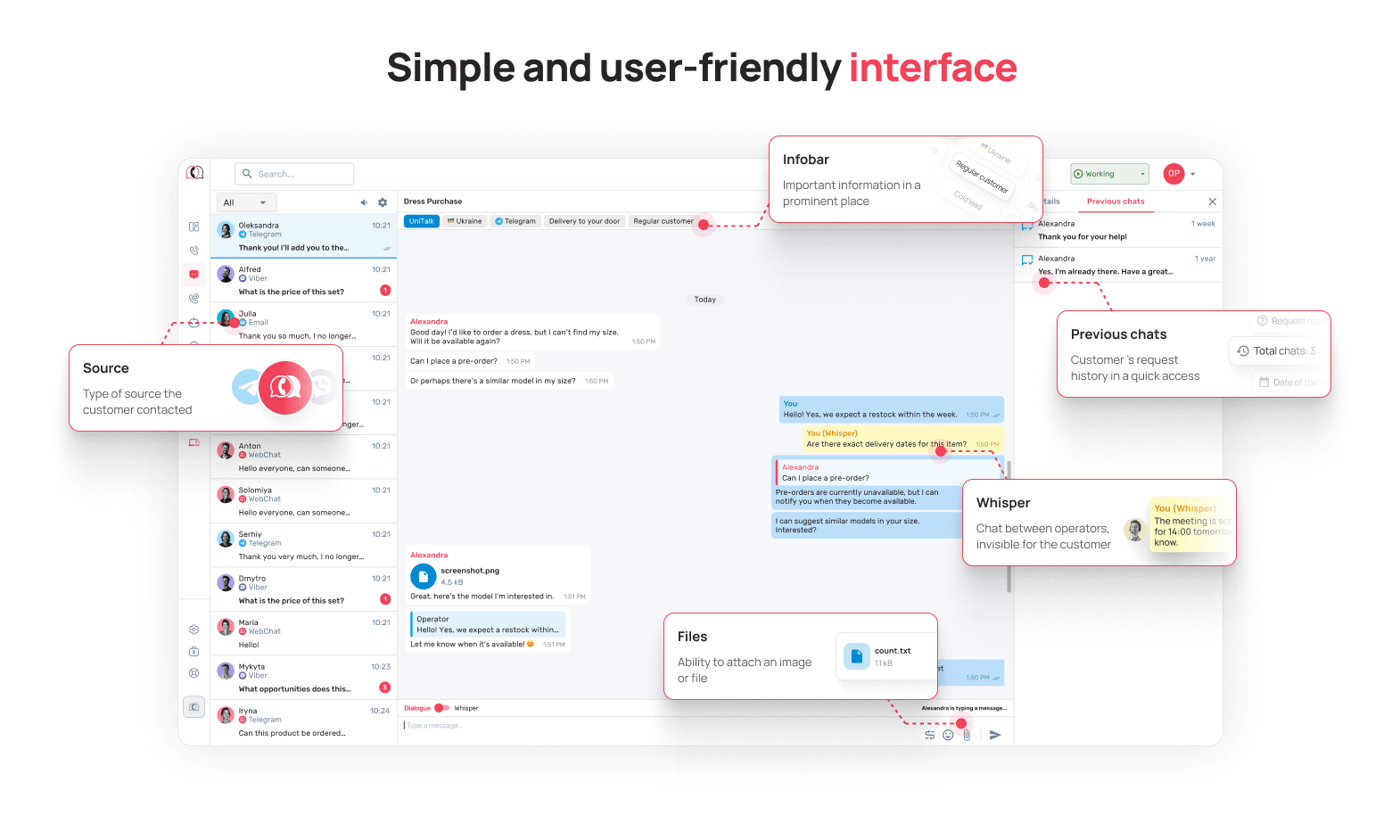
When a manager opens one interface and sees everything — Telegram, Viber, Instagram Direct, website chat, email — several things change at once.
No inquiry gets lost. It’s either being handled or in the queue, not sitting somewhere in a direct message folder no one checked.
Context is always there. If a customer wrote last week, the system surfaces that conversation automatically. No need to ask: “have you contacted us before?”
Managers see the real picture. How many inquiries came in, how many were handled, who’s overloaded, and where responses are falling behind — all without manual tracking.
This is how UniTalk Chat works inside OMNI. Telegram, Viber, Instagram, website chat, and email are all in one interface, so the team handles every text inquiry as a single process rather than switching between separate channels.
But for today’s business, seeing all messages in one place isn’t enough on its own. What also matters is understanding:
- which inquiries convert into sales;
- where the team is losing customers;
- how missed calls are being handled;
- what happens after a lead comes in;
- how advertising, calls, chats, and results connect.
In OMNI, all customer communication — calls, chats, CRM, messaging campaigns, automation, and AI analytics — works as one system. Not a collection of separate tools, but a complete process covering everything from the first contact to the sale, support, and ongoing service.
Is It Worth Investing in Text Channels If Most Customers Still Call?
This question comes up often. And the answer is usually the same: take a closer look at where your inquiries actually come from.
Some customers who “just call” tried messaging first and got no reply. Some who “came from the website” clicked the chat button, waited, got nothing, and left. Those numbers simply aren’t visible without analytics on text channels.
Text communication doesn’t always replace voice. But it almost always comes before it or runs alongside it. And if a customer doesn’t get a response at that stage, the call never happens.
The Bottom Line
Today’s customers don’t care which channel they use to reach a company. They expect one thing: fast, consistent, and clear communication.
That’s why simply connecting a few messengers isn’t enough anymore. Businesses need a system that brings together all inquiries, context, and processes into one coherent way of working.
UniTalk Chat is for teams that need a single window for all text-based inquiries. UniTalk OMNI is for businesses building a complete system for managing all customer communication.
UniTalk: Manage communications. Drive results.