Why Telephony Is No Longer Enough: 6 Tasks Only a Contact Center Can Solve
There comes a moment when a business notices: there are calls, but no control. Operators answer, but clients are still dissatisfied. The team grows, but efficiency doesn’t.
Usually, at this point, they start looking for “better telephony”. But the problem is rarely in the quality of connection. The problem is that telephony provides a tool for calls, not a system for managing the team that works with them.
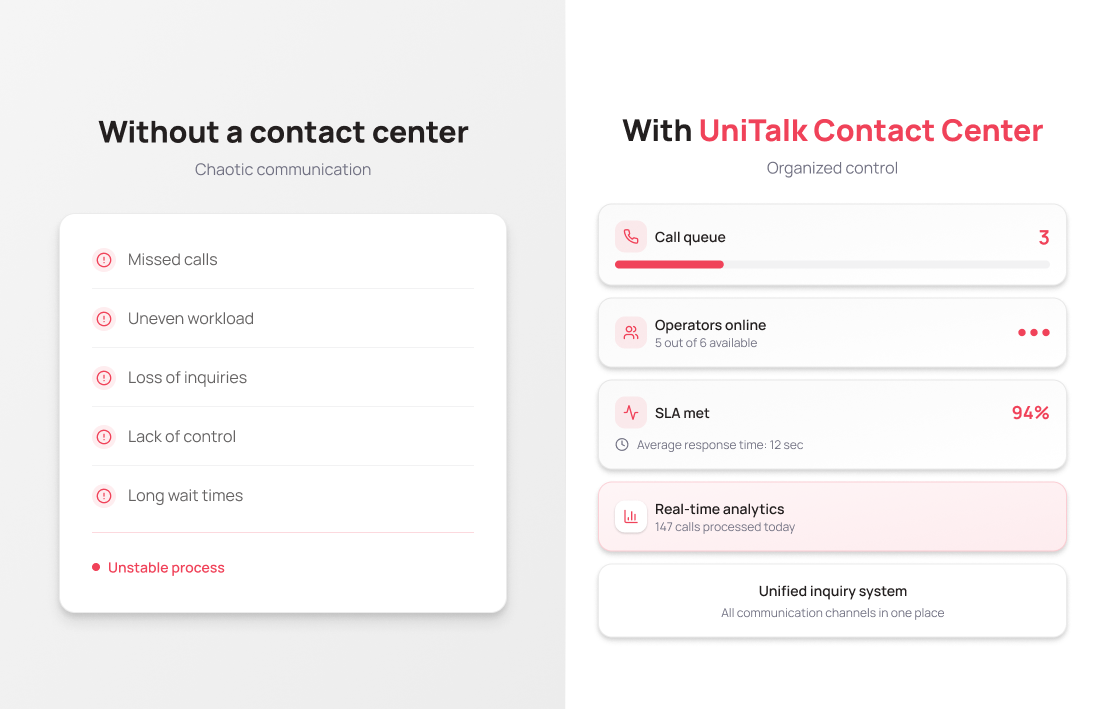
Here are six tasks that regular telephony doesn’t solve, and why it matters for your business.
1. See the Real Picture of Losses
Regular telephony shows statistics, but a contact center shows what is hidden behind them.
For example, 200 missed calls are recorded per month. But how many of them are clients who waited more than a minute and hung up? How many called back themselves, and how many just left? At which step of the IVR do most people hang up? Without answers to these questions, a missed call remains just a number rather than a clear point for optimization.
A contact center provides a detailed picture of each request, showing both the fact of loss and its cause. This allows distinguishing a systemic problem from an accidental glitch and reacting to it before the client decides to leave.
2. Manage Service Speed, Not React to Complaints
According to Freshworks, 55% of consumers stop doing business with a company if the waiting time is too long. At the same time, most companies find out about the problem after the client has expressed dissatisfaction or simply stopped reaching out.
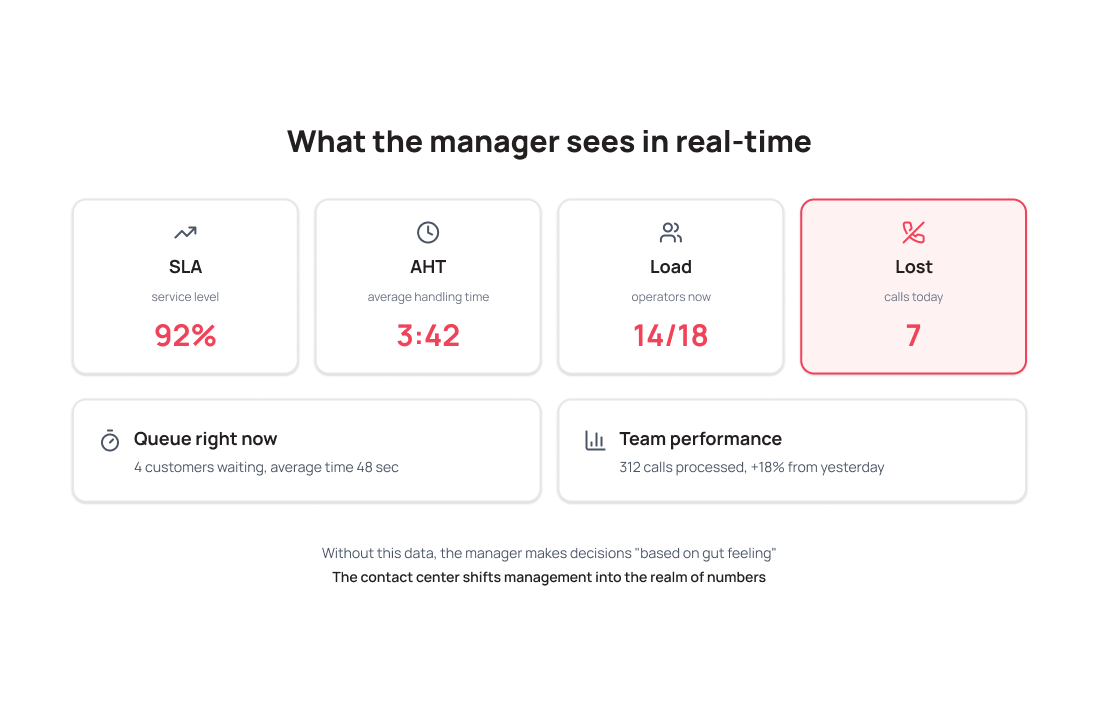
Telephony does not provide tools to manage this process in advance. A contact center does, offering queues, call prioritization, SLA settings, and real-time workload visibility. The manager sees what is happening right now and can redistribute resources before the queue grows to a critical level.
The difference between reacting to complaints and preventing them is the core difference between telephony and a contact center.
3. Increase Team Efficiency — Both Inbound and Outbound
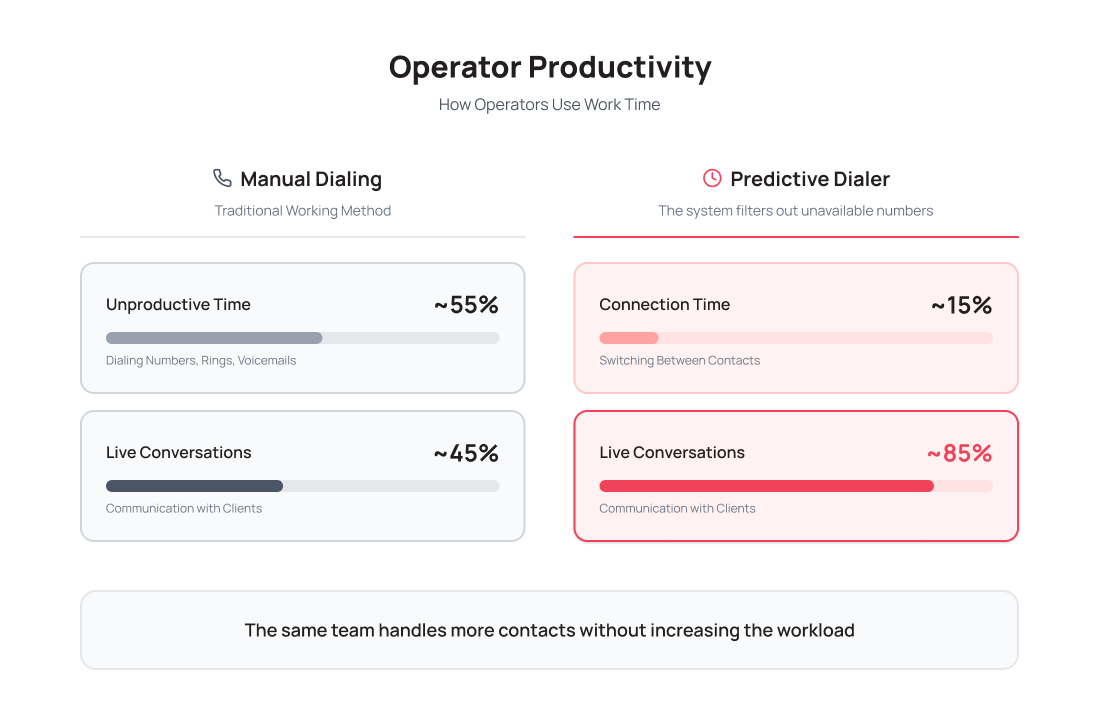
According to various estimates, an operator during manual dialing spends 40 to 60% of working time on related actions instead of conversations. This includes dialing numbers, waiting for rings, dealing with answering machines, and searching for information between calls.
Predictive dialing solves this simply: the system automatically filters out unavailable numbers and connects the operator to a live person. In practice, this means that the same team can handle significantly more contacts per shift without any staff expansion.
The same applies to inbound calls. Properly configured queues and routing reduce average waiting time and distribute the workload more evenly among operators. Without this, some are constantly overloaded while others idle, and both results are equally unprofitable for the business.
4. Make Operator Work Quality Stable
If the quality of a conversation depends on who exactly picked up the phone, it is not a standard of work but a dependency on a specific person. One operator remembers all the steps of the script, the second improvises, and the third is simply tired by the end of the shift.
Conversation scripts and logs right at the operator’s workplace change this logic. The conversation structure is set by the system, the operator follows a single logic of work, and the result is recorded and passed on. New employees enter the process much faster because they don’t need to memorize everything from scratch; the system guides them step-by-step.
In addition, call recordings and filled-out forms provide the manager with material for real quality control, rather than evaluation based purely on feelings.
5. Scale Without Operational Chaos
Transitioning from a small team to 20-30 or more operators is a critical point for most contact centers. Without a management system, growth doesn’t mean more results; it means more chaos. The manager spends more and more time on manual troubleshooting, and standards get diluted because new people see different examples of work.
A contact center provides a structure that doesn’t fall apart during growth. Queues, routes, and scripts are already configured, so a new operator simply enters a ready-made process. The logic of work is preserved regardless of how many people are in the team.
6. Make Decisions Based on Data, Not Feelings
Statements like “it seems the team is not coping” or “it feels like clients have become less satisfied” are insufficient for contact center management.
It is important for the manager to see the real picture: where the load is growing, why the SLA is dropping, which operators have an inflated AHT, where call losses occur, and how team productivity changes over time. Dashboards and analytics allow finding bottlenecks in processes and making decisions based on real data instead of impressions after a meeting.
Separately, it is worth mentioning the operation of innovative tools such as the Voice AI Agent and Speech Analytics. The UniTalk Voice AI Agent completely takes over routine calls. It can work 24/7, independently conduct initial qualification of requests, answer common client questions using the knowledge base, or record requests during peak loads. This unburdens the team and allows people to focus on complex cases and closing deals. At the same time, Speech Analytics automatically analyzes all dialogues, finds problematic conversations, and helps evaluate the quality of operators’ work without manual listening to each audio recording. For companies with a large volume of requests, such a tandem of technologies becomes a real way to scale service without increasing headcount.
Finally, consider multichannel communication. Today a client writes in Viber and tomorrow they call. If these channels are not combined, the operator has to start the conversation without context every single time. A contact center collects the entire history of interaction in one place, giving a single operator one customer card with the full picture. For the client, it looks like they are remembered and understood.
Summary
Telephony solves the connection problem, but a contact center solves the management problem by handling operators, workload, service, and quality in a single system.
If you already see that telephony is insufficient to control workload, service, and team productivity, your business has outgrown it and needs a full-fledged contact center.
That is precisely why we created UniTalk Contact Center, a comprehensive solution for managing contact center operations, operators, workload, service, and team efficiency in a single system.
Leave a request for a demonstration: we will show you how to monitor operators’ work, reduce missed requests, and increase team productivity.