What Is Abandon Rate and Why 10% of Dropped Calls Is Not Normal
Your contact center handled 500 calls today. But 60 of them went unanswered. A customer waited, gave up, and hung up. Do you know about it? Most likely not. But the competitor they called next – does.
Abandon Rate (the percentage of abandoned calls) is one of those metrics that businesses either measure and act on, or ignore and lose money. Let’s break down what it means, what number should already raise a red flag, and what happens to a customer when they hang up.
What Is Abandon Rate and How Is It Calculated
Abandon Rate is the percentage of inbound calls that entered the queue but ended before connecting to an agent. The customer called, heard music or an IVR prompt, waited, and disconnected on their own.
The formula is straightforward:
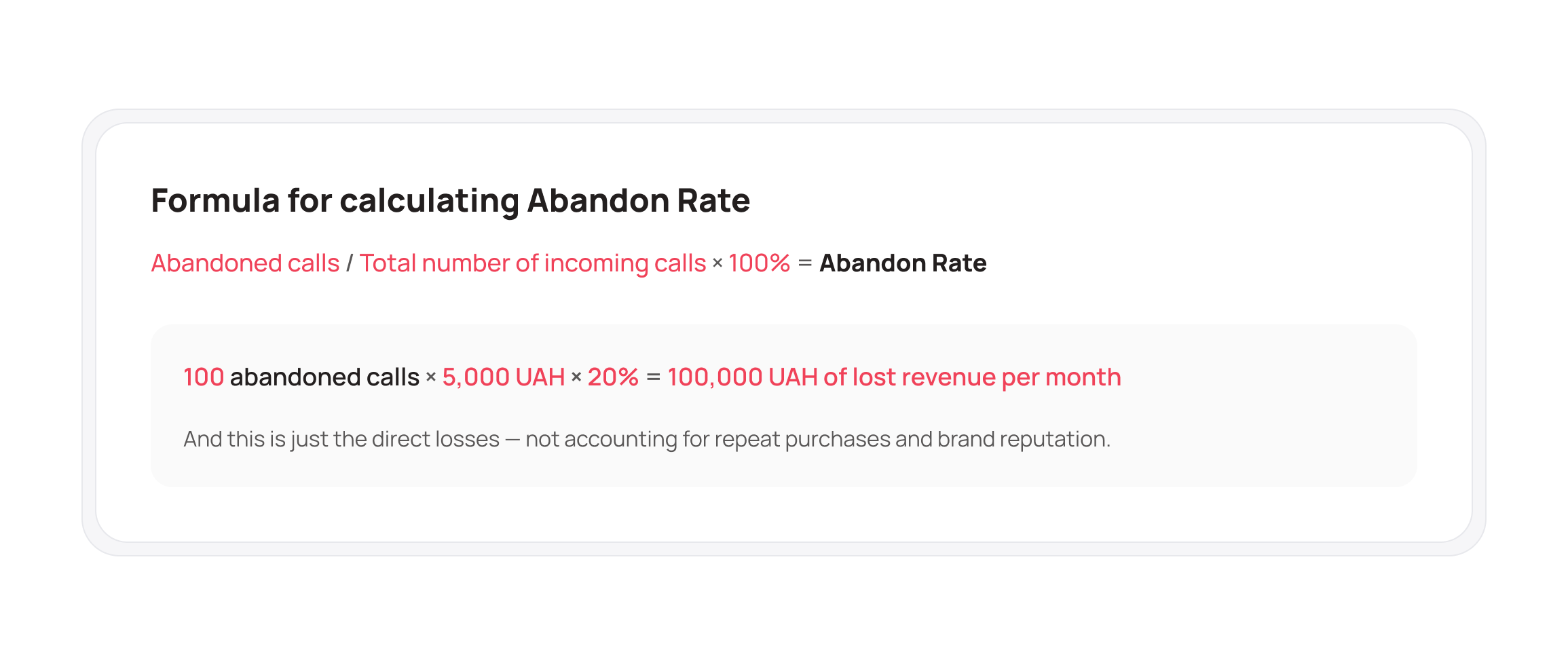
If 500 calls came in during the day and customers hung up on 50 of them, the Abandon Rate is 10%.
One important nuance: most systems allow you to exclude “instant” disconnects from the stats – calls where the customer hung up in under 5 seconds. These are usually misdials or wrong numbers. If you don’t filter them out, the metric will be inflated and won’t reflect reality.
What’s a Normal Abandon Rate: It Depends on Your Industry
There’s no single “normal” that applies to everyone. Industry, call type, and customer expectations all shape different thresholds.
General market benchmarks: an acceptable level is up to 5%, 5%–8% is a zone to watch, and above 8–10% is a problem that’s already affecting the customer experience.
But nuances vary by industry:
Financial services and banking. Customers are calling about money or their card. They’re not willing to wait long. The acceptable threshold is 2–3%, and that’s already the upper limit.
Healthcare and clinics. Someone is calling to book an appointment or get test results. The emotional stakes are higher. An Abandon Rate above 5% means real lost patients who will go to another clinic.
Ecommerce and delivery services. Customers want to check on an order status or resolve an issue. There’s a bit more patience here, but 8–10% is already a signal.
B2B and corporate support. Calls are more purposeful, and customers are generally willing to wait a little longer. But if someone is calling back multiple times, that’s already a separate problem.
Telecom and utilities. Customers traditionally expect longer wait times, but call volume is also higher. Even here, a rate of 10% and above signals a structural problem with queue management.
What’s Going Through a Customer’s Mind While They Wait
Here’s a scenario that plays out every day in hundreds of companies.
A customer calls. For the first 30 seconds they’re calm – waiting feels natural. After a minute, mild irritation sets in. If there’s hold music, it’s already annoying. If the IVR voice keeps repeating “your call is very important to us,” it produces exactly the opposite effect.
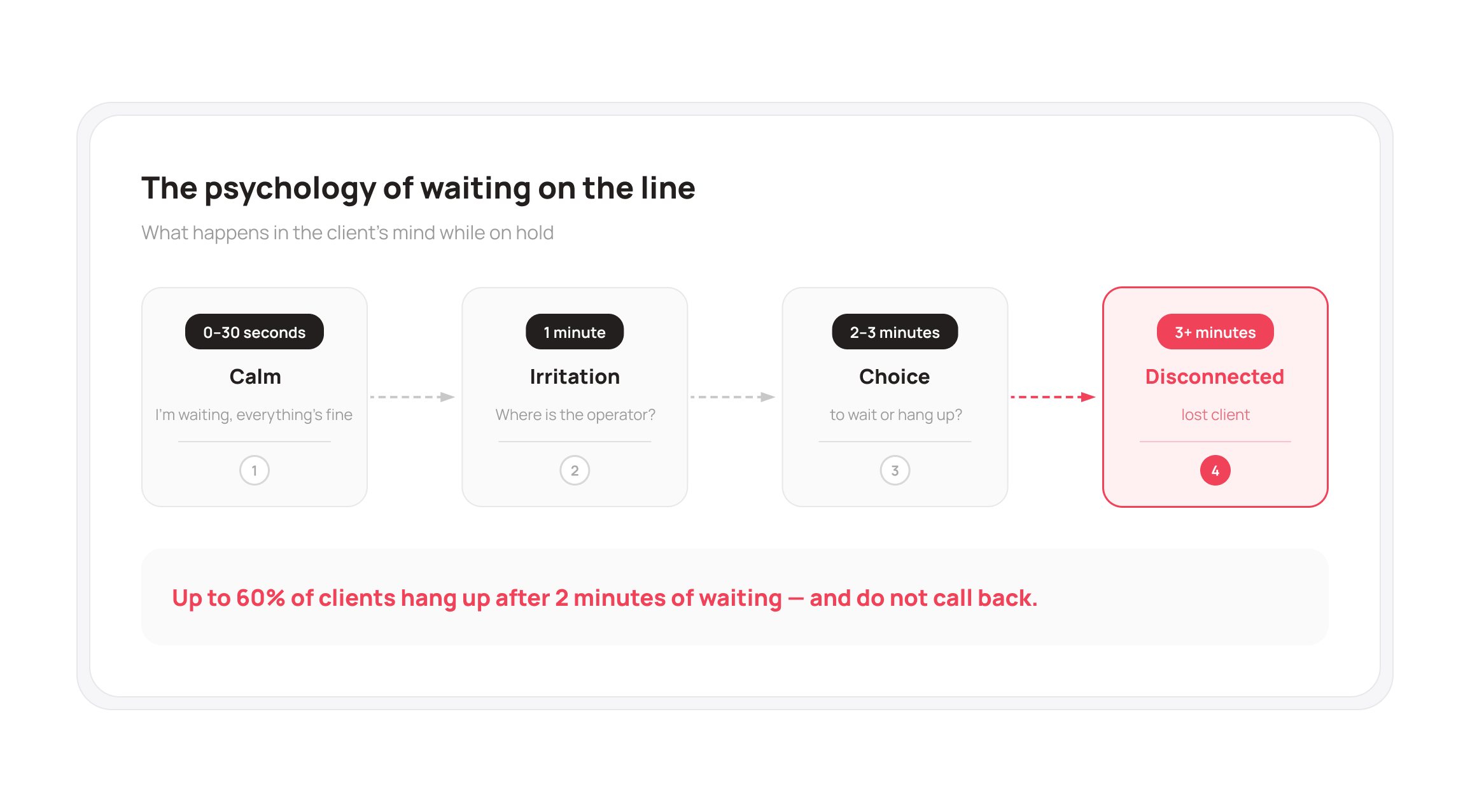
After 2–3 minutes, most customers make a decision: keep waiting or give up. The factors that influence this:
- Urgency of the issue. If a customer is calling about a flood or a blocked card, they’ll wait longer – but frustration builds faster.
- Alternatives. If switching to a competitor is easier than waiting for an answer, the customer will leave.
- Past experience. If they waited last time, they’ll wait less this time.
A customer who hangs up without an answer didn’t just leave. They left with a specific impression: “They don’t value my time.” That impression shapes their next purchase decision, their recommendations, and your NPS.
Why Abandon Rate Grows and Nobody Notices
Here’s a paradox many companies face: agents are running at 100% capacity, queues are technically “being handled,” yet Abandon Rate sits at 12–15%. Where does that number come from?
Uneven load distribution. On Tuesday between 10:00 and 12:00, twice as many calls come in as in the evening. If the agent schedule doesn’t account for this, a queue builds up with no one available to answer it.
No call prioritization. All calls are handled in the order they arrive, regardless of who’s calling or what they need.
IVR routing issues. A customer pressed “1” and ended up in the wrong place. They’re waiting for an agent to transfer them, but the right agent isn’t available for another 8 minutes.
No callback option. Instead of offering customers the chance to leave their number and receive a callback, the system simply holds them in the queue.
The worst part: if the company has no Abandon Rate report, no one sees these calls. They simply disappear. The stats only show answered calls, while 60 abandoned ones become “invisible” losses.
But even when the number is visible, it doesn’t explain the cause on its own. A high Abandon Rate can stem from understaffing during peak hours, poor shift scheduling, overloaded queues, or incorrect routing. That’s why it should be analyzed alongside SL, ASA, agent workload, and call volume by hour. Only then does it become clear exactly where the business is losing customers. For a deeper look at these metrics, see SL, ASA, AHT: What They Are and Why Your Call Center Can’t Do Without Them.
How to Measure Abandon Rate Without Complex Tools
If you have a PBX or IP telephony system with basic analytics, this metric is either already there or can be set up.
Here’s what to do:
- Check your PBX or call system reports. Look for “missed calls,” “missed calls in queue,” or “abandoned calls.”
- Filter out calls shorter than 5 seconds – that’s technical noise, not real abandonments.
- Break down the data not just as an overall percentage, but by time of day, day of week, and queue direction.
- Set a threshold alert: if the Abandon Rate exceeds 8% in any given hour, someone needs to receive a notification.
If your current system doesn’t provide this kind of report, that’s already a separate problem: you’re managing a process without a dashboard.
Abandon Rate and Money: What Each Dropped Call Actually Costs
Try to put a number on it.
Say your company receives 1,000 inbound calls per month. Abandon Rate is 10%. That means 100 calls go unanswered every month.
How many of those 100 customers will call back on their own? Research suggests that between 30% and 60% of customers who don’t get through simply stop trying. The rest call back – but with a higher level of frustration.
If your average deal size is 5,000 UAH and inbound call conversion is 20%, then 100 abandoned calls potentially represent 100,000 UAH in lost revenue every month. Not counting the impact on customer LTV.
This isn’t hypothetical math. It’s the money a company spent on marketing to get a customer to call – and never recovered.
Three Things You Can Do Today
If you’ve checked your Abandon Rate and don’t like what you see, here are the starting points.
Review the agent schedule. Look at call volume by hour and compare it with the number of agents on shift at the same time. In most cases, Abandon Rate spikes during specific time windows, not evenly throughout the day.
Launch a callback option. If the queue exceeds 2 minutes, offer customers the option to leave their number. This brings down Abandon Rate and relieves pressure on the queue.
Make Abandon Rate part of daily reporting. Not once a month at a team meeting – every day, as part of operational monitoring. That’s the only way to catch problems in time to act.
Abandon Rate Is Not a Technical Metric. It’s a Mirror of Your Service
Every abandoned call is a contact the company already paid to acquire. The customer saw an ad, visited the website, or got a referral – and never received an answer.
The biggest problem with Abandon Rate isn’t the number itself. It’s that without regular monitoring, these losses stay invisible. There’s no deal in the reports, no lead in the CRM – but the potential customer is already gone.
That’s why it matters not just to track Abandon Rate, but to analyze it alongside SL, ASA, agent load, and call volume trends. Only then can you identify the real cause of losses and address it in time.
What doesn’t get measured can’t be improved. And what doesn’t get controlled will eventually start costing the business money.