Customer Success: What It Is and How It Helps Grow Your Business
Why do some clients buy a product once and never return, while others stay for years, recommend the company to their peers, and gradually expand their cooperation? In many cases, it’s not about price, product quality, or even the sales team’s performance. The difference is made by Customer Success — an approach that helps clients achieve the expected result and see the value of the product as early as possible.
Key Takeaways
- Support solves problems. Customer Success makes sure they don’t arise in the first place.
- One client who stays for years is worth more than ten new ones. CS is responsible for exactly those clients.
- How do you know CS is working? Not by the number of calls, but by Churn Rate, NPS, and LTV.
- Improving client retention by just 5% can increase profit by 25–95%. That’s not a typo: it’s data from Bain & Company.
- CS isn’t only for SaaS: if a client uses the product for more than one session, it’s already worth thinking about.
- If a manager can’t see the full communication history with a client in one window, some signals of their departure simply go unnoticed.
What Is Customer Success in Simple Terms
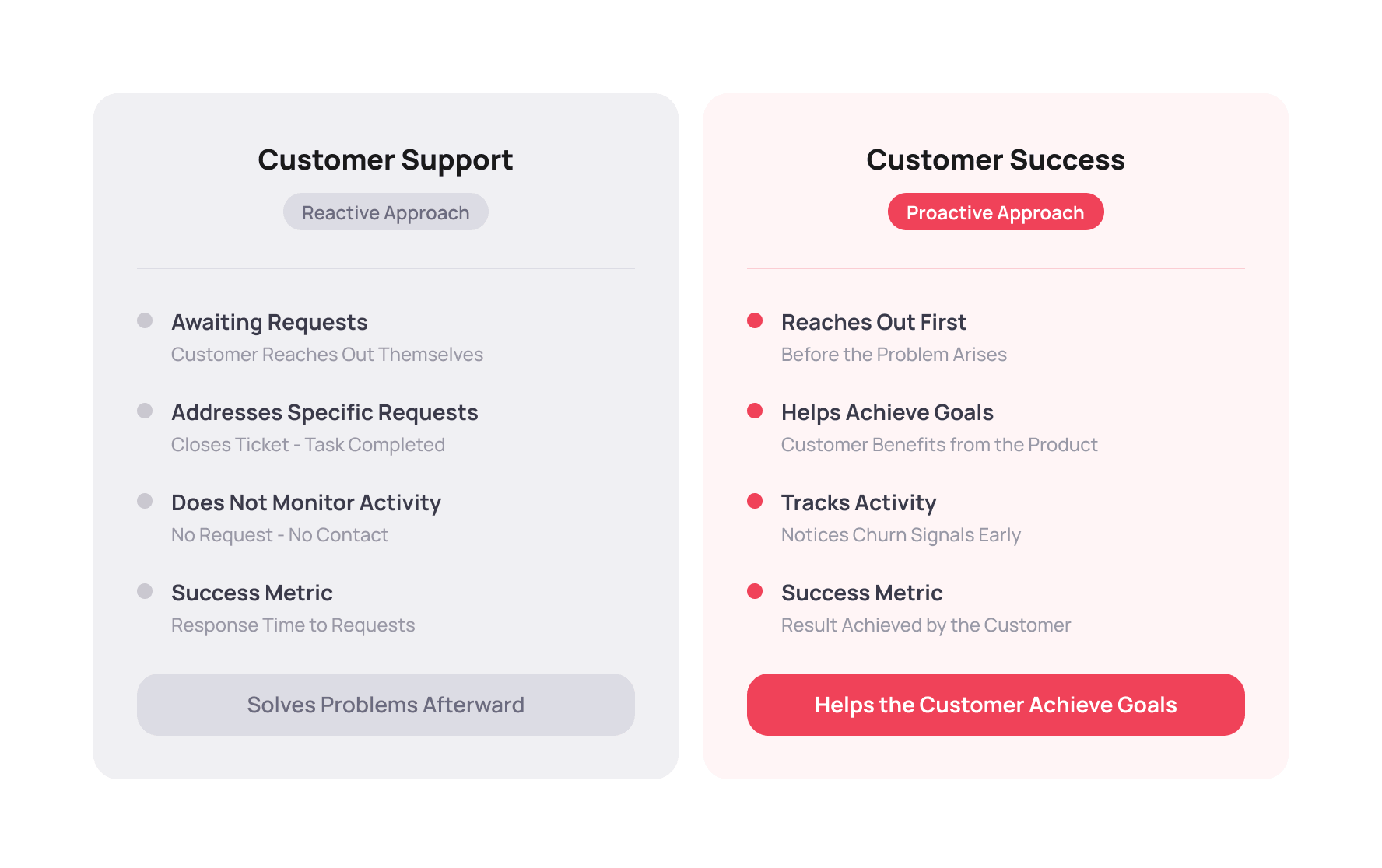
Customer Success is an approach where a company helps clients achieve the result they purchased the product for. It’s not just about selling a service and answering questions — it’s about guiding the client so they get up to speed faster, start using all the product’s capabilities, and get the expected effect.
The easiest way to understand the difference is through an example. Imagine a company has connected a new service for working with clients. If employees have questions or something stops working, support will help. Customer Success gets involved earlier: it helps the client understand the product, shows key capabilities, supports the implementation, and ensures the service is genuinely solving the business’s needs. Its goal is not just to close a request, but to help the client achieve a result.
This is exactly why Customer Success first gained momentum in SaaS companies. Companies like Salesforce and HubSpot noticed a pattern: if a client doesn’t understand how to use a product, they likely won’t renew, even if the product itself is high quality. That’s how Customer Success became a separate function responsible for the long-term success of the client.
What does a successful customer look like in this model? It’s a client who has achieved their goal using the product — for example, automated processes, reduced time on tasks, or increased sales. Subscription renewals, repeat purchases, and referrals become a natural consequence of that result.
Why Companies Need Customer Success
According to Bain & Company, increasing client retention by 5% raises profits by 25–95%. And acquiring a new client costs 5–25 times more than retaining an existing one (Churnkey, 2026).
This is where most companies make the mistake: they invest the entire budget in acquisition, without thinking about whether the client gets real benefits from the product after purchase and why some of them don’t come back.
Reducing Churn Rate
A client doesn’t leave because they found a cheaper competitor. Most often, they simply didn’t see the value of the product at the right moment. The goal of customer success is to notice that signal before the client does. This can be handled by a dedicated CS team, an account manager, or a support specialist — what matters is that someone in the company is tracking client activity and reaching out before they make the decision to leave.
In practice, it looks like this. A small team connected a service for processing inbound requests, got access, and… barely used it. Not because the service didn’t fit, but because there was no time to figure out the settings. The person responsible for customer success reached out a week later, spent 20 minutes helping configure the service to fit the team’s processes, and walked through the key features. The team started using the tool regularly and renewed the subscription.
Increasing LTV
Customer success creates the conditions for upsells that don’t feel like pressure. When a client has already received concrete benefits from the product, an offer to expand capabilities feels like a logical next step, not an attempt to sell something extra. The more real benefits a client gets, the more organically the average deal size grows.
Turning Clients into Brand Advocates
According to Nielsen, 92% of consumers trust recommendations from people they know more than any advertising. A client who has received real benefits from the product doesn’t just renew their contract. They recommend the tool to colleagues, write an honest review, and when moving to a new job, choose the same familiar solution again. This acquisition channel doesn’t require a separate budget: it works as a result of what the CS team does every day.
Sustainable Business Growth
Companies with strong customer success grow through their existing base. Expansion Revenue (revenue from upsells and cross-sells to existing clients) reduces dependence on a constant flow of new leads. When revenue from existing clients offsets churn losses, the company grows without increasing the marketing budget. This is what makes a model truly sustainable: it doesn’t collapse the moment marketing stops.
Who Is a Customer Success Manager
A Customer Success Manager (CSM) is a specialist who helps clients get maximum value from a product throughout the entire cooperation. They know the product well, understand the client’s business goals, and help achieve results faster.
That said, Customer Success isn’t always a separate position. In smaller companies, these tasks are often handled by sales managers, account managers, or support specialists. What matters isn’t the job title, but the fact that someone in the company is responsible for ensuring that after purchase, the client successfully adopts the product, achieves the expected result, and continues the cooperation.
As the business grows, this function is increasingly assigned to a dedicated role — the Customer Success Manager. This specialist accompanies the client after the sale, coordinates interaction with other teams, helps resolve emerging questions faster, and notices early signs of potential difficulties. Their goal is not just to react to requests, but to do everything possible so the client continues to get value from the product.
Customer Success Manager Responsibilities:
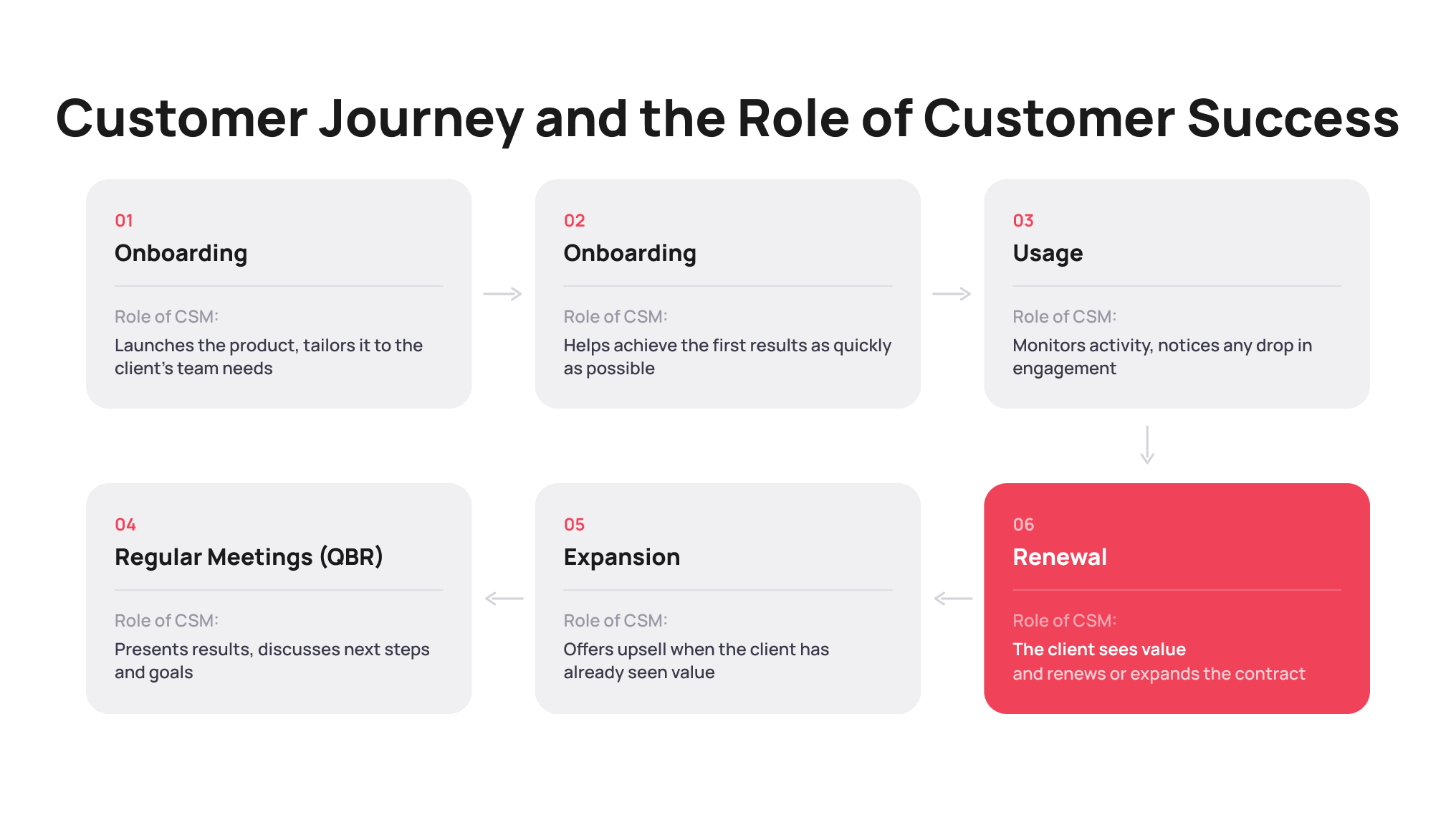
- Onboarding — helps the client launch the product, configure key features, and get the first result as quickly as possible.
- Account monitoring — tracks activity, notices the first signs of declining engagement, and reaches out before the problem becomes critical.
- Regular touchpoints — conducts quarterly business reviews (QBR), discusses achieved results, plans, and further development opportunities.
- Client development — recommends additional products, features, or plans when the client has already gotten value from the core solution and is ready to expand usage.
- Feedback collection — gathers client wishes and remarks, passes them to the product team, and helps improve the service.
Let’s picture the situation. A company connected the Virtual PBX from UniTalk for their sales department. A few weeks after launch, the Customer Success Manager noticed a troubling signal in the statistics: a significant portion of incoming calls weren’t being answered in the first minutes, and conversion remained low. Instead of waiting for complaints, he suggested connecting Speech Analytics. The system automatically analyzed call recordings and identified a pattern: managers were consistently losing clients at the objection-handling stage. The company adjusted their scripts, conducted targeted team training, and continued to develop their cooperation with UniTalk.
Key Metrics for Customer Success Effectiveness
Customer Success effectiveness is measured not by the number of calls or meetings, but by whether clients are getting a real result. What is the benefit for the client in terms of CS metrics? It’s a measurable effect: growth in conversion, reduced request processing time, increase in repeat purchases. These are exactly the results that key customer success.
| Metric | What It Measures | What It Affects |
|---|---|---|
| Churn Rate | % of client churn | Revenue stability |
| NPS | Willingness to recommend (0–10) | Loyalty and referral flow |
| Customer Health Score | Composite account “health” indicator | Early churn risk detection |
| LTV | Total revenue from a client | Retention effectiveness |
| Time to Value (TTV) | Time from purchase to first tangible effect | Onboarding success |
| Expansion Revenue | Revenue from upsells and cross-sells | Growth without acquiring new clients |
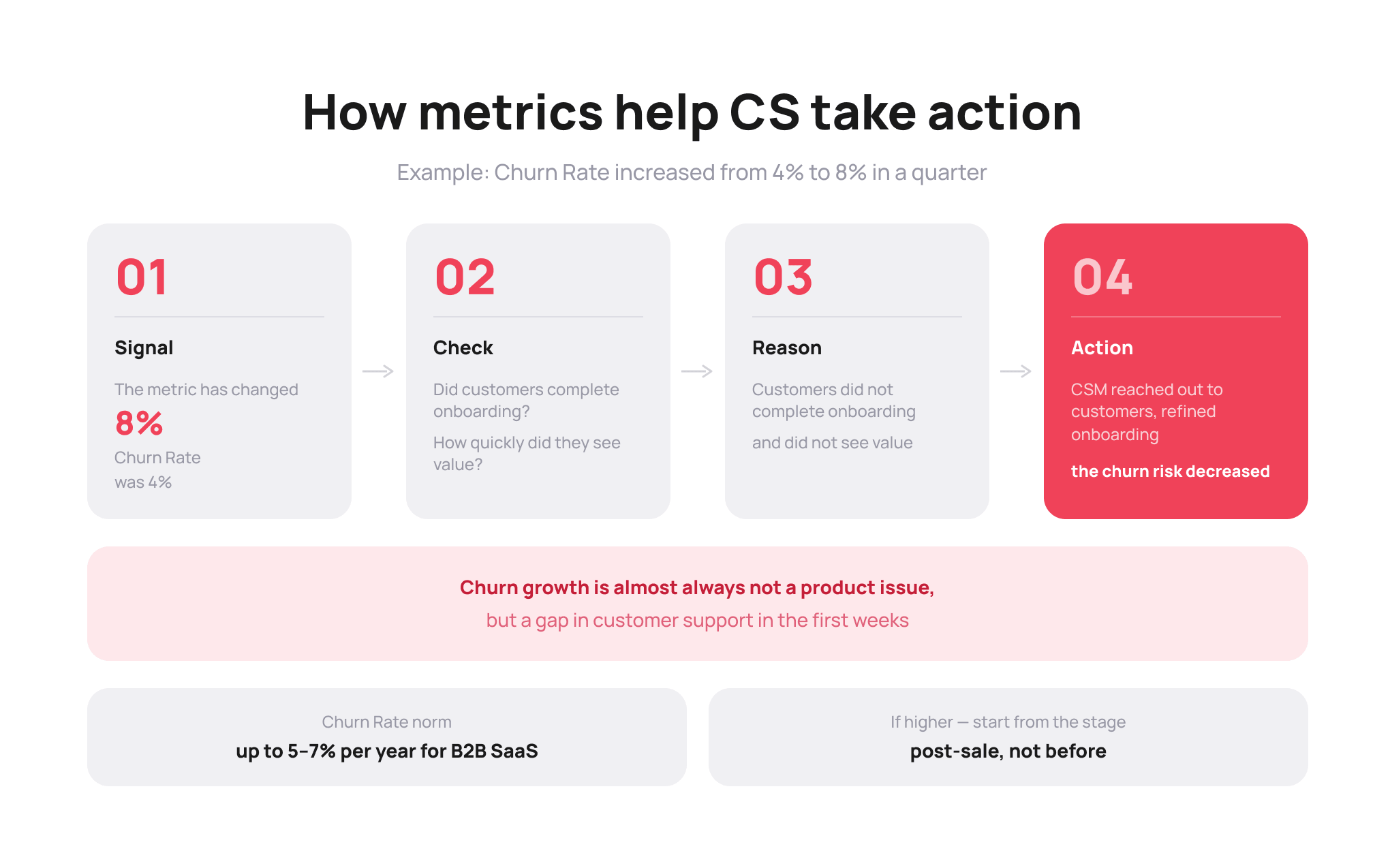
How does this look in practice? Imagine that over a quarter, the Churn Rate grew from 4% to 8%. For the CS team, this is a signal to find out at which stage the problem arose. Perhaps new clients didn’t complete onboarding, didn’t have time to learn the product’s key features, or didn’t see its value in the first weeks of use. The sooner the company finds the cause, the higher the chance of retaining the client.
For B2B SaaS, a Churn Rate of up to 5–7% per year is considered normal, according to Recurly Research. If the number starts growing, the first thing to analyze is the post-sale stage: how effectively is onboarding going, are new clients getting enough attention, and are they being helped to achieve their first result faster.
Which Businesses Need a Customer Success Department
Customer Success is rarely needed by the coffee shop down the street. The client bought coffee and left. No onboarding, no renewal, no upsell.
But it’s critically important for CRM systems, cloud services, telephony providers, or banks, where clients use the product for months and years. Every such client is a long-term asset for the business. And whether they see the product’s value quickly enough determines whether they stay with the company or leave for a competitor.
CS is needed if at least one point applies:
- Average client lifecycle is longer than three months.
- Acquisition costs are high and losing each account has a noticeable impact on revenue.
- The product requires setup, training, or integration — the client might simply not figure it out on their own.
- The business model is built on subscriptions or SLA.
- There are upsell opportunities: additional features, plans, volumes.
Even without a dedicated CS team, you can start right now: set up communication in the first days after onboarding, track client activity, and respond at the first signs of declining engagement.
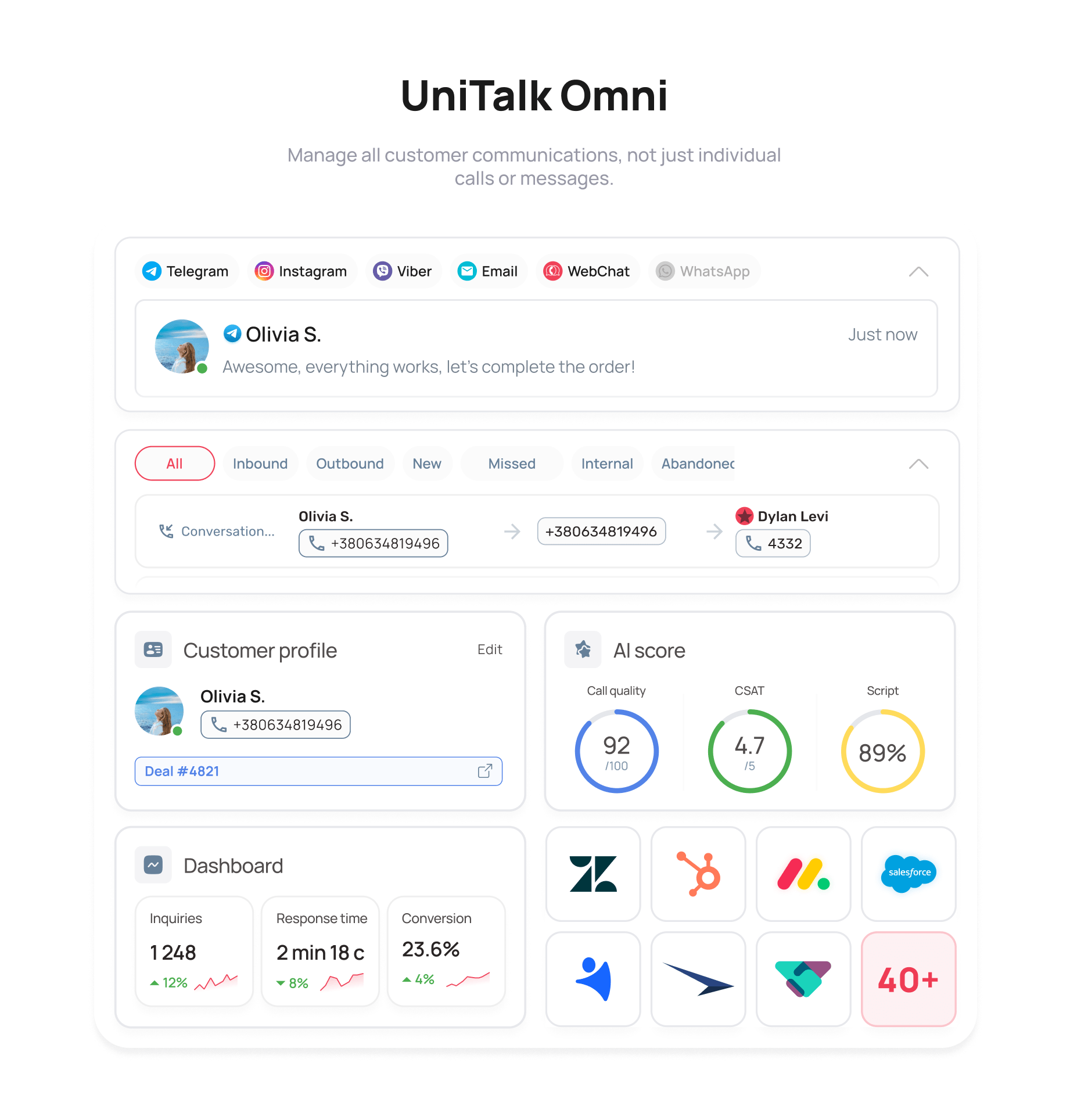
To accompany clients at every stage, the Customer Success team needs to see the full communication history regardless of the channel. When requests come in through phone, Telegram, messengers, or SMS and are stored in different services, the manager has to spend time searching for information and reconstructing context.
That’s exactly why many companies are moving to an omnichannel communication model. UniTalk Omni unites all channels in one workspace. This makes it possible to see the full interaction history with a client, respond to requests faster, and accompany the client without losing context.
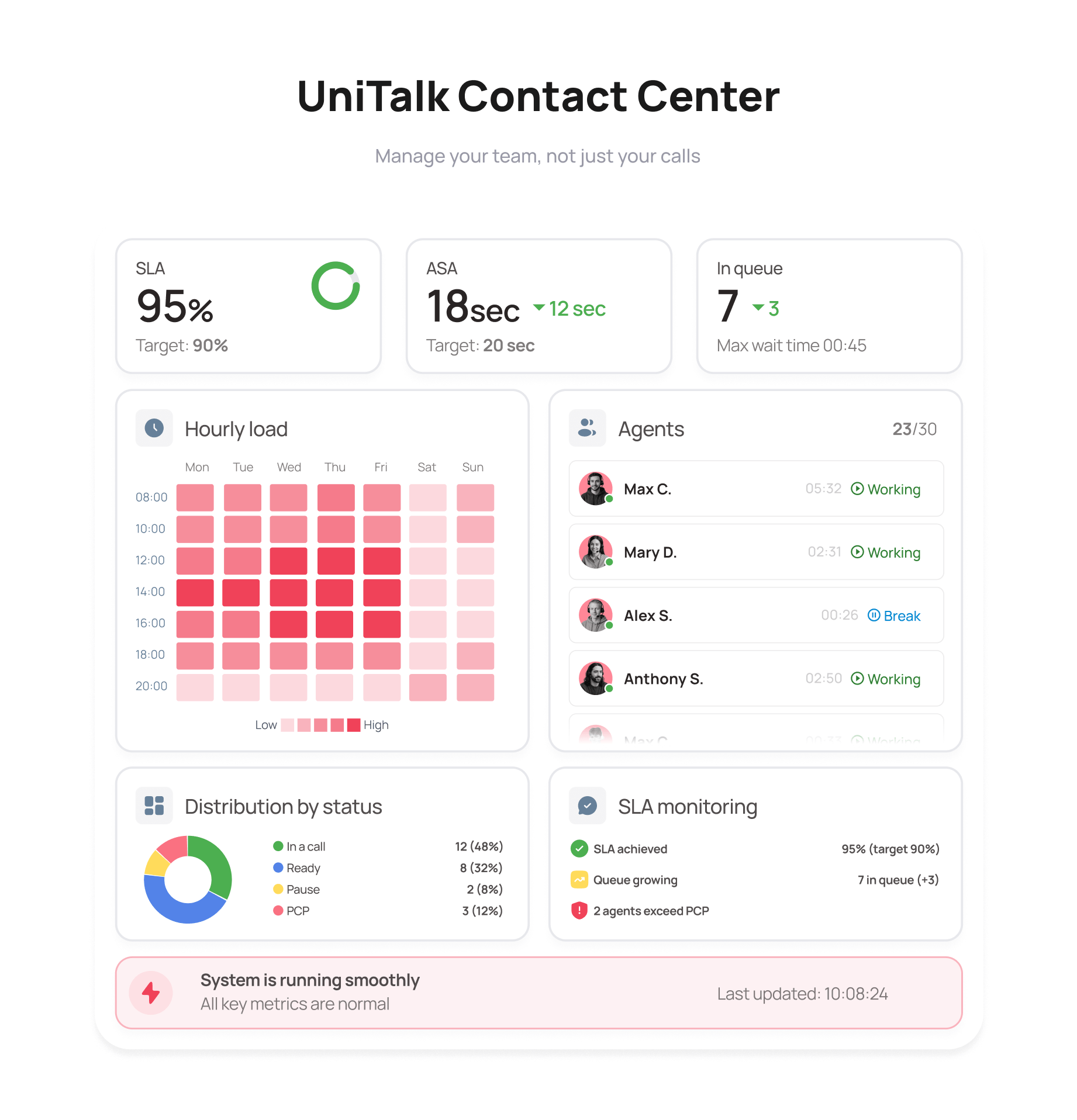
For companies where Customer Success operates as a full-scale contact center or a large operator team, UniTalk Contact Center helps organize request processing, distribute workload among staff, and monitor team performance. This is the next level — when it becomes important to manage not only client communication but also the operational work of the contact center itself.
Conclusion
As the market becomes increasingly competitive, the winner is no longer the one who first brought in the client, but the one who helped them achieve a result. That’s why customer success is gradually becoming not an advantage, but a mandatory part of modern business.
You can start right now: set up communication, build onboarding, and track the first churn signals. Everything else comes with practice.
UniTalk: Manage communications. Drive results.
A Customer Success Manager accompanies the client after purchase: conducts onboarding, monitors account activity, holds regular meetings, and offers additional opportunities where appropriate. The key difference from support is that a CSM acts proactively and is accountable for the business impact on the client, not just for closing tickets.
Customer Service reacts: the client submits a question and gets an answer. Customer Success initiates: the manager reaches out proactively to ensure the client is moving toward their goal. The former measures response speed; the latter measures the value the client received from the product.
No. Long-term client accompaniment works in any business with repeat sales: e-commerce, telecom, fintech, B2B services, and online education. The key question is simple: does the client use the product for more than one session? If yes — CS is already needed.
The minimum set: Churn Rate (attrition), NPS (loyalty), LTV (client value over the period of cooperation), Expansion Revenue (upsell revenue), and Time to Value (time to the first tangible effect). For each metric, establish baseline figures and track dynamics monthly. Rising Churn and falling NPS are the first signals that client accompaniment needs to be reconsidered.