How to Write a Cold Call Script: A Step-by-Step Guide with Examples
Cold calls are not dead, they have simply become smarter. Despite the growing popularity of email marketing, messaging apps, and targeted advertising, a phone conversation remains one of the most effective direct sales tools. According to RAIN Group research, 57% of C-suite buyers prefer to be contacted by phone. The main secret of a successful cold call is not the manager’s charisma or luck, but a well-written script. A ready-made cold call script gives the operator confidence, reduces stress, and increases conversion to the target action.

Key Takeaways
- A cold call script is a structured conversation guide that helps a manager move through all stages sequentially: from the opening to closing on the target action.
- An effective script is built on understanding the customer’s pain points, not on listing product features.
- A ready-made script should include an opening, needs discovery, solution presentation, objection handling, and a clear call to action.
- Writing a cold call script means going through five steps: defining the target segment, setting the call goal, creating the offer, writing the dialogue lines, and preparing objection responses.
- Common mistakes in sales scripts: monologue instead of dialogue, ignoring objections, and no clear next step.
- Modern tools, including predictive dialing, call recording, and speech analytics, allow you to test and improve scripts based on real data.
- There is no universal cold call template: a B2B script differs from a B2C scenario and must be adapted for a specific niche.
What Is a Cold Call Script and What Is It For?
A cold call script is a pre-prepared conversation plan that an operator uses when communicating with a potential customer who did not expect the call. The key word here is “cold.” The person on the other end of the line is unfamiliar with your company or has shown no obvious interest in your product. That is why the structure of the conversation is critically important: without a clear plan, the manager risks losing their footing, going off track, or facing an objection they are not prepared for.
The purpose of a script is not to make the manager sound like a robot. A good script is a navigator, not a fixed road: it points the direction but allows adaptation based on the customer’s reaction. The cold call text contains key phrases, responses to typical objections, the logic for moving between stages, and a clear target action at the end.
Why does a business need cold call scripts:
- Quality standardization. Every manager, regardless of experience, conducts conversations to a single standard.
- Faster onboarding. A new employee can start making calls within a few days, relying on a ready-made cold call scenario.
- Reduced operator stress. Knowing what to say in any situation, the manager feels more confident and sounds more natural.
- Measurable results. If everyone uses the same script, it is easier to identify which stage is losing customers.
- A/B testing capability. With several script variants, you can compare their effectiveness and scale the best one.
It is important to understand the difference between a rigid script (where literally every response is written out) and a flexible scenario (which sets the structure but leaves room for real conversation). For most B2B sales, a flexible approach works best: the manager knows what to do at each stage but chooses their words based on the conversation partner’s reaction.
HubSpot research shows that companies using structured sales scenarios demonstrate 33% higher conversion rates compared to those where each manager works intuitively. This confirms once more: a cold call plan is not a restriction on the operator’s freedom, but a growth tool.
The Main Stages of a Cold Call
Before writing a cold call script, you need to understand what blocks it consists of. Each stage addresses a specific task in the conversation and logically leads to the next. Skipping any of them disrupts the dialogue logic and reduces conversion.
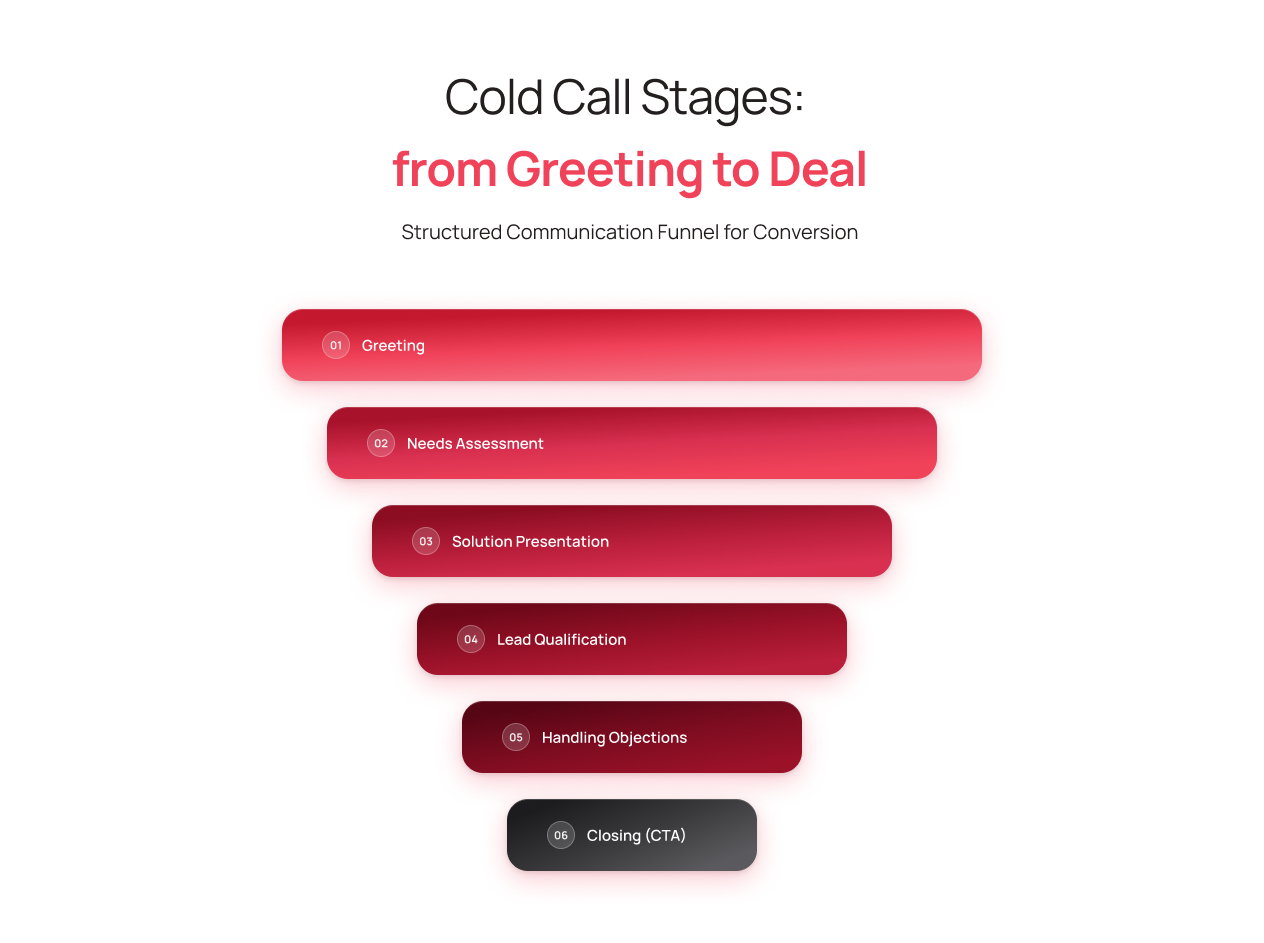
Opening
The first 10 to 15 seconds of the conversation determine whether the customer will keep listening or hang up. The purpose of the opening: establish contact, introduce yourself, and get permission to continue the conversation. A common mistake: going straight to the presentation, which creates a feeling of pushiness and triggers a defensive reaction.
An effective opening includes three elements:
- The operator’s name and the company name.
- A brief reason for the call: a neutral hook, without immediate commercial pressure.
- A question to confirm it is a good time to talk: “Do you have a couple of minutes right now?”
Example opening (B2B):
“Good afternoon, Alexander. My name is Irina, from UniTalk. We help sales teams automate outbound calling. Do you have a minute to talk?”
The phrase “Is this a good time?” is not just politeness. It is a micro-commitment technique: someone who says “yes” once is psychologically inclined to continue the dialogue. Skipping this question is a mistake.
Needs Discovery
Once the customer agrees to continue the conversation, the manager’s task is not to sell but to listen. This stage is often skipped by newcomers eager to talk about the product. However, it is precisely the needs discovery that makes it possible to personalize the subsequent presentation and show the customer that you are solving their specific problem, not just selling whatever you have.
Use open-ended questions:
- “How do you currently handle the process of working with inbound customers?”
- “What challenges do you run into when organizing outbound calling?”
- “What is most important to you when choosing a solution in this area?”
The two-question rule: do not ask more than two questions in a row without pausing for an answer. In a cold call dialogue, this turns the conversation into an interrogation and causes irritation.
It is important not just to listen but to actively confirm that you are hearing the other person: “I see,” “Yes, that is a common situation,” “Interesting.” This signals to the customer that they are talking to a real person, not receiving a lecture.
Solution Presentation
Only after you have heard the need should you move to the presentation. The key word here is “solution,” not “product.” The customer is not interested in technical specifications; they want to know how their business or life will change after using your offering.
Use the formula Problem – Solution – Result:
“You mentioned that managers spend a lot of time on manual dialing. Our Predictive Dialer automatically calls customers and connects the operator only with those who pick up. On average, this allows you to triple the number of completed conversations with the same team size.”
The presentation within a cold call script should take no more than 60 to 90 seconds. If you talk longer, you are already delivering a monologue.
Lead Qualification
Not every person you speak with is your potential customer. Qualification is the process of checking how well a lead matches your ideal buyer profile. It is better to spend 30 seconds on qualification than 20 minutes presenting to someone with neither the budget nor the authority to make decisions.
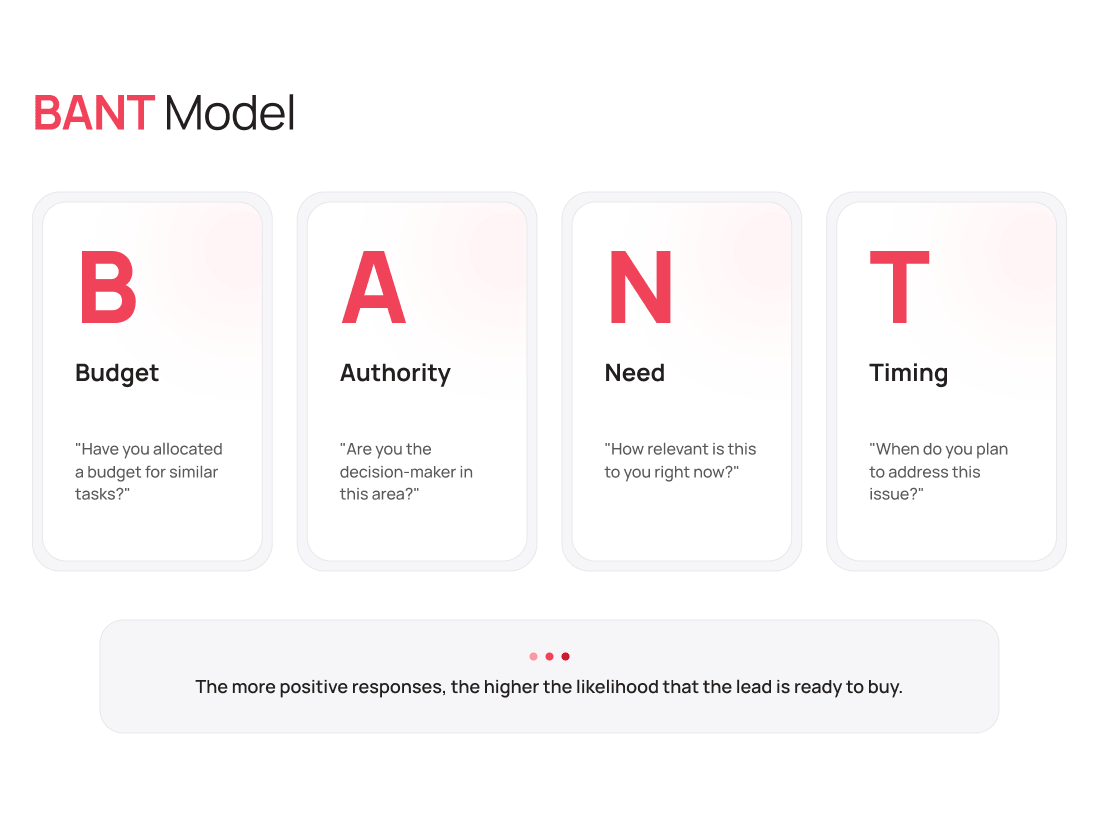
Important: qualification questions should not sound like a survey. Weave them naturally into the conversation.
Handling Typical Objections
Objections are not a rejection but a request for more information. A manager who takes “We don’t need that” as a final answer loses a significant portion of potential customers. According to Cognism data, 80% of sales require five or more interactions with a customer, yet most operators give up after the first objection.
A good cold call scenario must include 5 to 7 of the most common objections with response options for each:
| Objection | Response Technique |
|---|---|
| “We don’t need that” | Clarify: how do they currently handle this task? |
| “Send me a proposal” | Arrange a call to discuss the proposal together |
| “We already have a supplier” | Ask what works well and what they would like to improve |
| “No budget” | Find out when the next budget cycle is |
| “I am not the decision-maker” | Ask to be connected to the right person |
| “Now is not a good time” | Agree on a specific date for the next cal |
Closing on the Target Action (Call to Action)
Every cold call must end with a specific next step. Not “I’ll call you back” or “think about it,” but a clear commitment: a meeting, a demo, or sending a proposal with a specific follow-up date. Vague commitments are not kept by either the customer or the manager.
Closing examples:
“Let me schedule you for a 20-minute demo on Wednesday at 11:00 so you can see everything in action.”
“Great, I will send you the materials today. Would Thursday or Friday work better to discuss them?”
Offer a choice between two options rather than an open question like “When is convenient for you?”, as this reduces evasive responses like “I’ll reach out myself.”
How to Write a Cold Call Script: Step-by-Step Instructions
Now that you understand what stages a conversation consists of, let’s look at how to properly write a cold call script from scratch. Five steps: from audience research to a finished working document.
Step 1. Defining the Target Segment and Customer Pain Points
A script written “for everyone” works for no one. The first step: clearly define who you are calling, taking into account job title, industry, company size, and typical problems. The more precise the profile, the more personalized and compelling the cold call dialogue will be.
Ask yourself:
- Who makes the purchasing decision at companies in your target audience?
- What tasks does this person handle on a daily basis?
- What pain points and frustrations do they experience in their work?
- What language do they use when describing their problems?
Sources for learning about your audience: online reviews, professional forums and communities, conversations with existing customers, CRM data on reasons for refusals.
The outcome of this step is 2 to 3 customer personas with specific pain points, goals, and objections. Ideally, each persona should have its own script variant, or at minimum a tailored offer.
Step 2. Setting the Call Goal
Before writing a cold call script, answer the question: what do you want to achieve by the end of the conversation? A common mistake is setting “the sale” as the goal: a cold call rarely ends in an immediate deal.
Realistic goals for a first cold call:
- Schedule a meeting or product demo.
- Send a proposal.
- Qualify the lead and hand it off to the pipeline.
- Invite to a webinar or professional event.
- Get agreement on a callback at a convenient time.
The goal determines the entire script logic: what you say, what questions you ask, and how you close the conversation. A script for scheduling a demo and a script for qualification are fundamentally different documents, even if they share a similar opening.
Step 3. Creating the Offer
An offer is a brief, concise explanation of your proposal’s value that you can deliver in 20 to 30 seconds. It is not a list of product features but an answer to the question: “Why does this matter specifically to you?”
Formula for a strong offer: We help [type of client] solve [problem] so that they can [achieve a specific result].
Examples:
“We help heads of B2B sales teams reduce time spent on manual dialing and increase the number of completed conversations without growing the team.”
“We help clinics avoid missing patient inquiries by providing automatic callbacks and appointment booking outside of working hours.”
Test the offer on 5 to 10 calls before finalizing it in the cold call script template. The reaction of real customers tells you more than any internal discussion.
Step 4. Writing the Lines
Now you can move on to writing specific phrases for each stage. A few rules that make the cold call text natural and effective:
- Write the way people speak, not the way they write. Read each phrase aloud: if it sounds unnatural, rewrite it.
- Use short sentences. Long constructions are hard to absorb when listening.
- Avoid clichés and corporate jargon. “With regard to,” “in connection with,” “I would like to offer you the opportunity to consider” – all of this reduces trust and makes it obvious that someone is reading from a script.
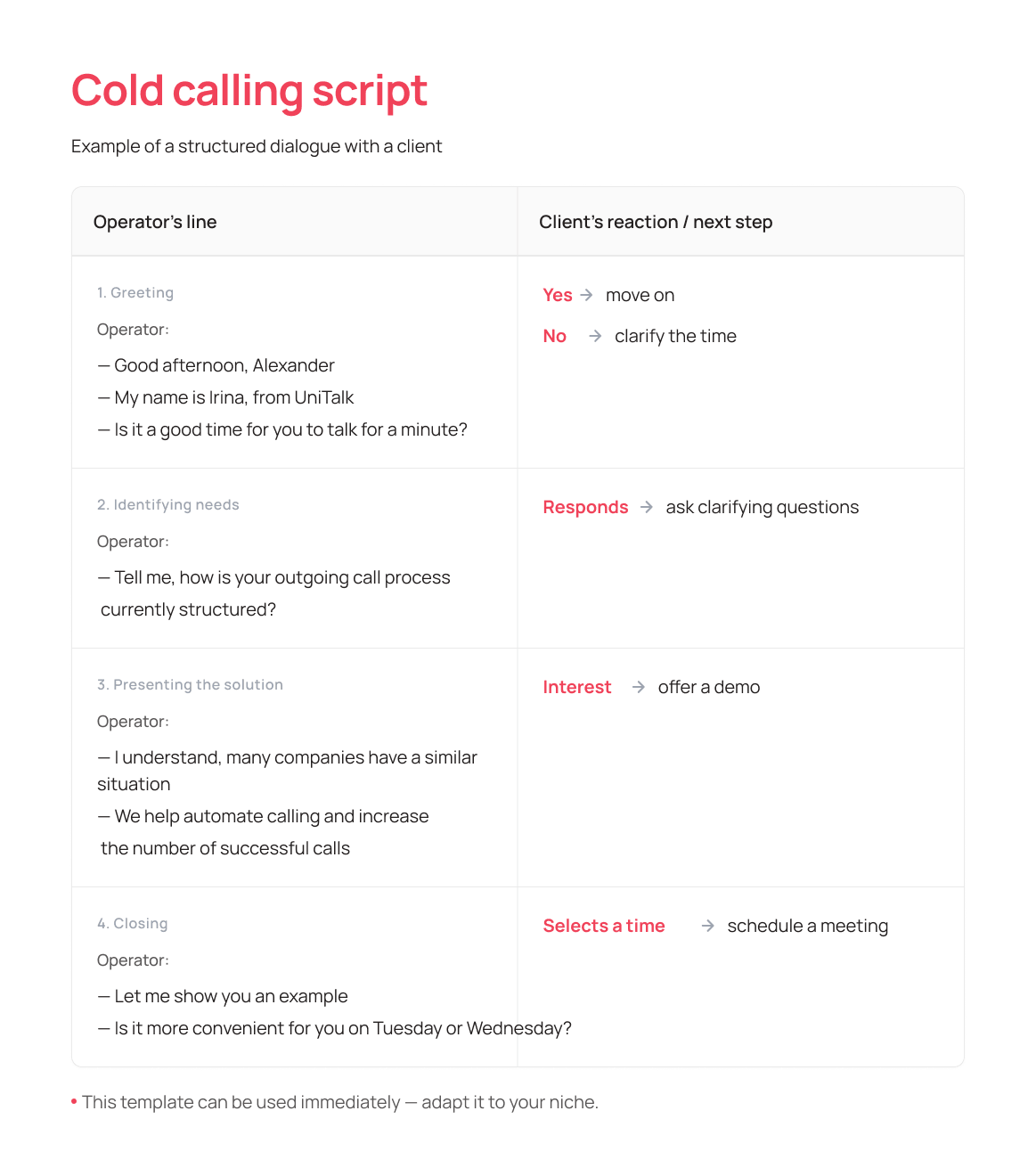
- Build in branches. A telephone sales script is not a monologue but a decision tree. Every customer reaction should have its own branch in the scenario.
It is recommended to format the finished script as a table with columns “Operator’s line” and “Possible customer responses / next step.” This format is practical to work with and easy to update.
Step 5. Preparing Objection Responses
Collect a list of 10 to 15 of the most common objections; these can come from recordings of previous calls or from experienced managers. For each, write 1 to 2 response options using the “Acknowledge – Clarify – Propose” technique:
- Acknowledge the customer’s right to have this view (do not argue or pressure them).
- Clarify the nature of the objection (behind “we don’t need it” something else is often hiding).
- Propose a specific argument or next step.
Example response to the objection “We don’t need that”: “I understand, many managers feel that way initially. Could you tell me how you currently handle outbound calling? I just want to check whether your situation is actually different from the ones we typically work with.”
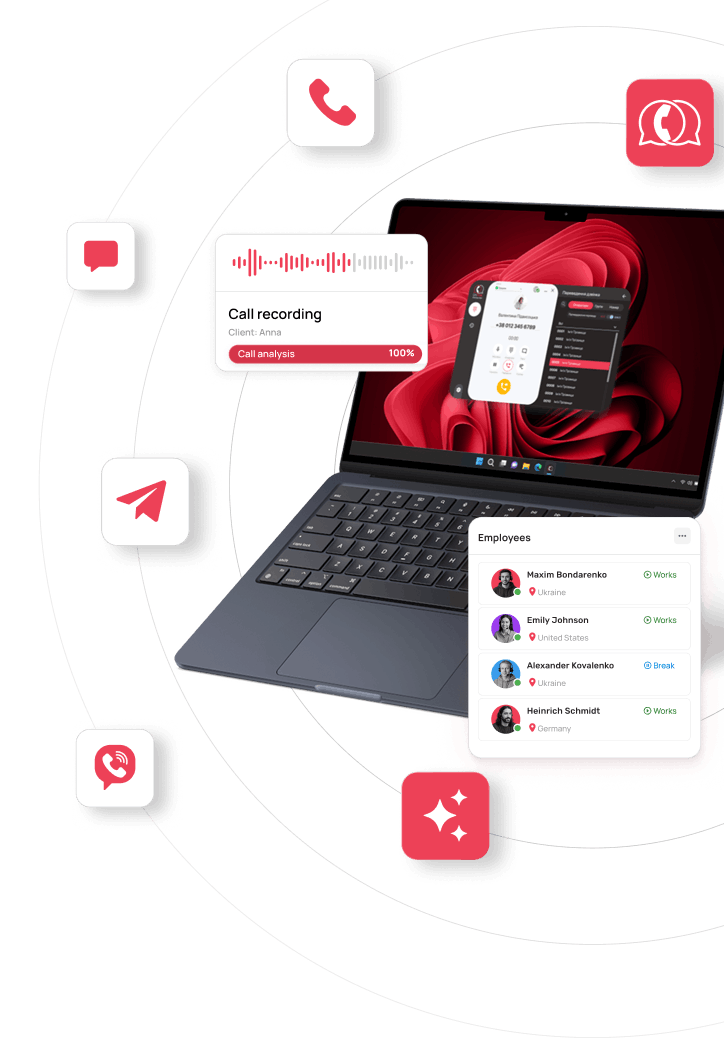
After writing the script, make sure to test it: role-play several scenarios with colleagues before going live. Call recording with automatic saving allows you to analyze real calls and identify weak points in the scenario.
To speed up this process, you can use UniTalk Speech Analytics: the system automatically analyzes all calls in seconds, identifies frequent objections, logs key phrases, and shows at which stages managers most often lose dialogue effectiveness. This allows you to quickly find problem areas in the script and improve objection responses based on real data rather than manually listening to recordings.
Cold Call Script Template
A universal framework for quick adaptation to any niche. Replace the placeholders in brackets with your product and audience details.
This script template is not a text to be read out word for word. Its purpose is to set the structure of the conversation and remind the operator what needs to be covered at each stage. In a real dialogue, the operator speaks in their own words, reacts to the customer’s responses, and adjusts the order of blocks as needed. A good cold call script sounds like a natural conversation, not a formal presentation. The more practice, the more natural it becomes.
Common Mistakes When Creating a Sales Script
Even a well-written cold call template may not work due to systematic errors in the approach. Here are the most common ones.
1. Monologue instead of dialogue. The script turns into a long story about the company that the manager reads out without stopping. The customer feels like they are watching an advertisement and tunes out. Rule: no more than 30 to 40 seconds without asking the other person a question.
2. Ignoring structure. The manager goes straight to the presentation without finding out the customer’s needs. Result: a conversation about a product the customer does not actually need, or a poorly constructed argument.
3. A vague target action. The call ends with “well, think about it, feel free to reach out.” No commitment, no next step, no sale. Every cold call script example should end with a specific CTA.
4. The script is never updated. Written once and forgotten. The market changes, objections evolve, but the scenario stays the same. Updating the script once a quarter is the minimum standard.
5. No personalization. The same cold call plan is applied to all audience segments. A manufacturing director and an IT startup manager require fundamentally different approaches.
6. The manager “reads” the script. This is audible on the phone: a monotone pace, no natural intonation, mechanical pauses. A good operator uses the script as a foundation but sounds natural. The script needs to be practiced out loud.
7. No branch for rejection. The scenario only accounts for positive customer responses. When the customer says no, the manager gets stuck and simply ends the call. A soft “no” can often be converted into an agreement for a future contact.
8. Price mentioned too early. The manager states the product cost in the first minutes of the call, before the customer has understood the value. A price without context always seems too high.
Tips for Improving Cold Call Effectiveness
Even the best cold call script is only part of the equation. Results depend on how it is applied in practice and what tools support the operator’s work.
- Personalize before the call. Spend 2 to 3 minutes researching the company or person you are calling: their website, LinkedIn, recent news. One specific detail (“I saw you recently opened a new office in Kharkiv, congratulations, looks like you are scaling up!”) makes the call noticeably warmer and lowers the barrier of distrust.
- Work on your voice. Pace, intonation, and pauses are tools just as important as the words themselves. Speak a little more slowly than in a normal conversation, especially at the start. A smile is audible over the phone, and this is not a metaphor but a physiological fact: smiling changes the shape of the mouth cavity and affects the vocal tone.
- Best time to call. Cognism research shows that calls made between 10:00 and 11:00 AM and between 4:00 and 5:00 PM have a higher rate of connections and agreements. Avoid the first hour of the working day and the time immediately after lunch: during these periods people are least receptive to conversation.
- Constant testing. A script is a hypothesis, not a constant. Test different versions of the opening, offer, and close. Use UniTalk Speech Analytics to automatically analyze keywords, tone, and stop-phrases in conversations: this helps identify problem patterns without manually listening to hundreds of recordings.
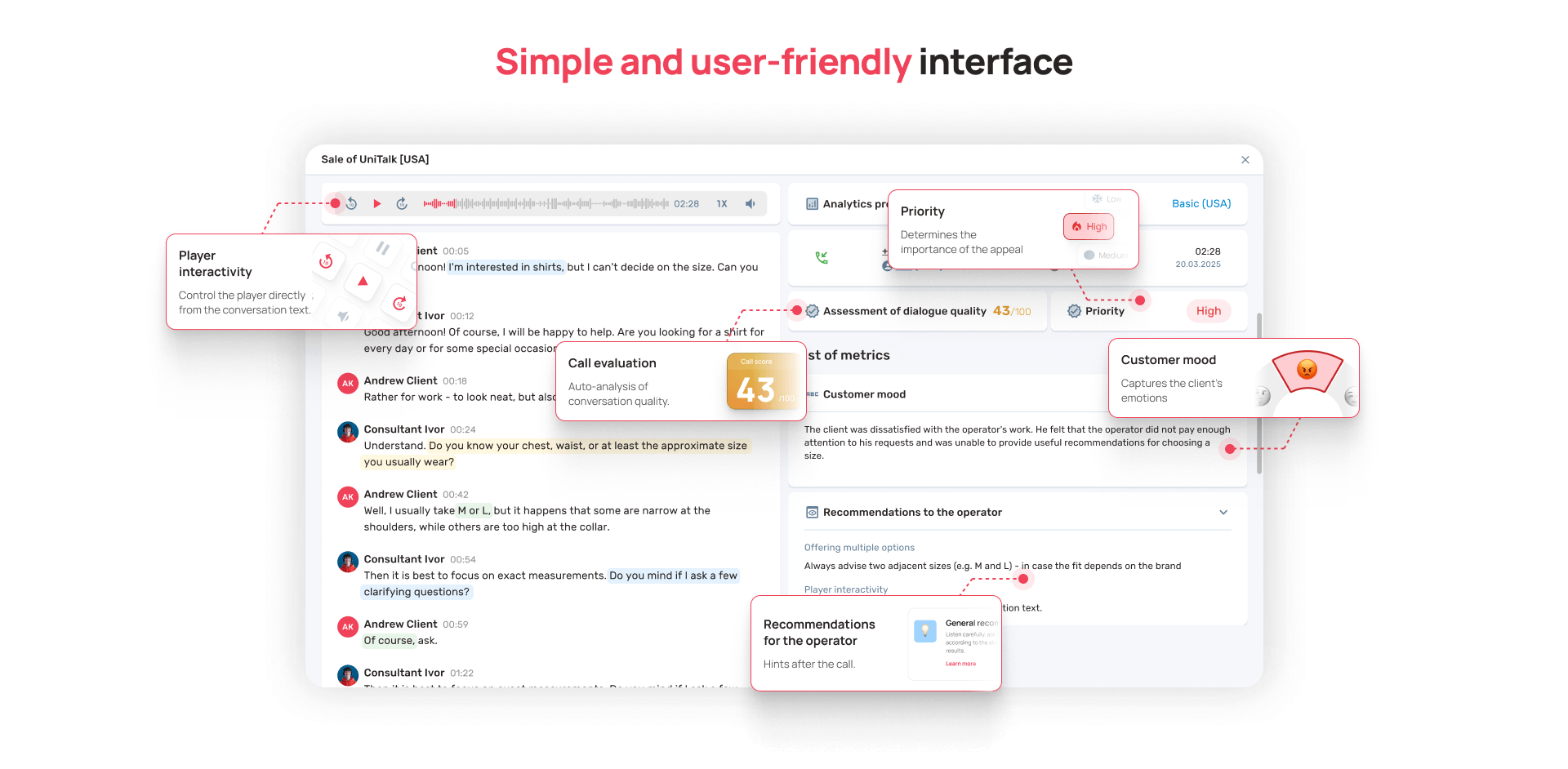
- Automating routine tasks. Manual dialing and waiting for an answer take up to 70% of an operator’s working time. UniTalk Predictive Dialer automatically calls customers and connects the manager only to answered calls, which allows you to triple the number of useful contacts without increasing the team.
- Automating initial contact. For large-scale cold calling campaigns, the UniTalk Voice robot can handle initial lead qualification: find out relevance, the name of the decision-maker, and the best time for the next conversation, then hand a “warm” contact to the live operator.
- Regular call reviews. A weekly joint review of 3 to 5 recordings with the team is the best way to simultaneously improve the script and operator skills. UniTalk Call Recording with automatic cloud storage makes this process systematic and accessible from anywhere.
- Use IVR for filtering. If you are making a high volume of outbound calls, an Interactive voice response menu (IVR) can help pre-segment the audience and route only interested callers to the live operator.
Cold Call Script Examples for Different Niches
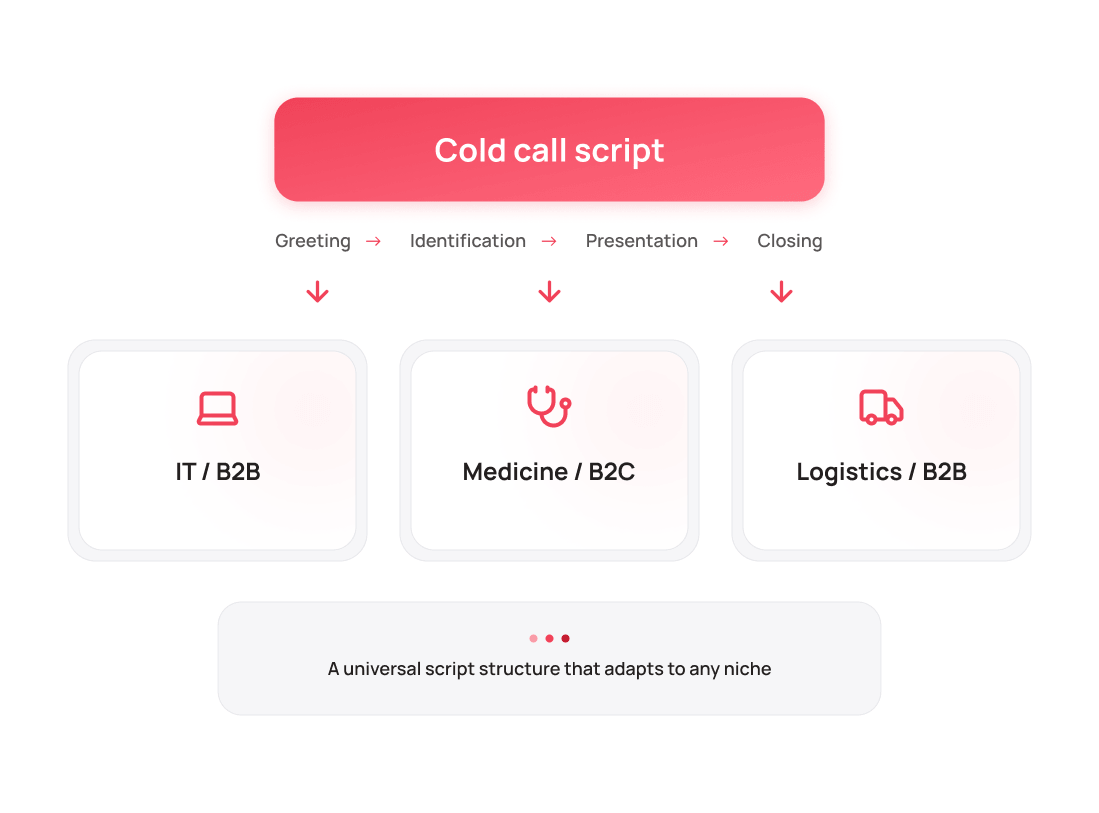
Below are cold call scenario examples for different niches. Notice that in every case the manager’s task is not just to sell, but to build clear and manageable communication with the customer and guide them toward the next step.
All scenarios follow the same logic: the manager first asks questions and understands the customer’s situation, then presents a solution and gently moves the conversation toward the target action.
These examples show how the same dialogue structure adapts to different segments, from B2B sales to working with end customers.
Niche: IT Solutions for Business (B2B)
Goal: schedule a demo
Segment: head of sales department, company with 50 to 500 employees
Operator: Good afternoon, Oleg. My name is Sergiy, from UniTalk. We help companies build and manage customer communication in a single system, from calls to analytics. Do you have a couple of minutes?
Customer: Yes, go ahead.
Operator: Oleg, could you tell me how your outbound calling process currently works? Do your managers call manually or do you use any tools?
Customer: Mostly manually through the CRM.
Operator: I understand. A lot of teams are in the same situation: too much time goes into dialing and waiting, and the number of actual conversations ends up lower than you would want.
Customer: Yes, that is true.
Operator: We address this comprehensively. We help build a managed customer communication process and automate outbound calling so managers only speak with people who have already picked up. As a result, the team spends less time on routine work and more time on real conversations. I would like to show you how it works in practice in about 20 minutes. Would Tuesday or Wednesday work better for you?
Niche: Medical Services / Clinics (B2C)
Goal: schedule an initial consultation
Segment: potential patient who visited the clinic’s website
Operator: Good afternoon, Elena. My name is Marina, from Health Plus Medical Center. You visited our website yesterday and were looking at information about an orthopedic specialist. Is that still relevant for you?
Customer: Yes, I was looking for information.
Operator: Great. Is this for yourself or for someone close to you? I want to make sure I point you to the right specialist.
Customer: For myself, my knee has been bothering me.
Operator: Got it. We have an orthopedist who specializes specifically in joint problems. We currently have slots on Thursday at 10:00 AM and Friday at 3:00 PM. Which time would work better for you?
Niche: Logistics / Transportation Services (B2B)
Goal: qualify the lead and send a commercial proposal
Segment: director or logistics manager of a manufacturing company
Operator: Good afternoon. My name is Maxim, from FastLog, freight transportation across Ukraine and Europe. Could you tell me whether you currently work with logistics contractors or use your own transport?
Customer: We work with contractors.
Operator: I see. What challenges come up most often: deadlines, costs, or paperwork?
Customer: Sometimes they miss deadlines.
Operator: Yes, that is something many companies in logistics deal with. We address that specifically through fixed timelines and transparent terms. Let me send you some project examples and estimates so you can assess the fit. What email should I send them to, and when would be a good time to discuss?
Conclusion
A cold call script is not a magic pill or a template for robots. It is a working tool that reduces uncertainty, structures the conversation, and helps the manager focus on what matters most: the customer’s needs. The best sales scenario is one that is constantly improved based on real calls, new objections, and market changes.
It is worth keeping in mind: the effectiveness of a script depends directly on how manageable the overall customer communication is. When all calls, inquiries, and interactions are in a single system, the business gains transparency, control, and data for decision-making.
UniTalk Virtual PBX provides stable telephony and call management, Predictive Dialer automates outbound calling and eliminates wasted time, and Speech Analytics helps quickly identify weak spots in conversations and improve scripts based on real calls. This approach allows you not just to use scripts but to systematically develop sales performance and communication quality.
Start with one good scenario for your key segment and refine it every week. That is what the best cold call script looks like: not perfect from the first attempt, but constantly improving.
A cold call script is a structured conversation guide for speaking with a potential customer who did not expect your call and is unfamiliar with your company. It includes an opening, needs discovery, solution presentation, objection handling, and closing on the target action. The purpose of a script is to give the manager clear navigation through the conversation and improve conversion rates to target actions such as meetings, inquiries, and purchases.
In most countries, cold calling is permitted subject to certain conditions. In Ukraine and Europe, GDPR requirements and local personal data protection laws apply: you must have a legal basis for processing contact data. For B2B calling, the restrictions are considerably more lenient than for B2C. Always respect a customer’s request to be removed from your calling list, as this is both legally required and professionally appropriate.
A cold call is the first contact with someone who knows nothing about your company or has shown no clear interest in the product. A warm call is a call to a customer who has already interacted with your brand: submitted an inquiry, downloaded a file, visited the website, or attended a webinar. A warm call is significantly easier: the person is already primed and expecting contact, so conversion rates are typically 3 to 5 times higher. That is why tools like a callback widget are so valued: they turn cold traffic into warm leads.
No. A manager who has memorized the script verbatim sounds like a voicemail system, and this is clearly audible over the phone. The script should be known well enough that it does not need to be read during the call, but the words should be the operator’s own. This comes with practice: 20 to 30 calls with a new script is usually enough for it to feel natural.
Fear of cold calling is a normal reaction, even for experienced salespeople. Several effective methods: role-playing with colleagues before real calls; warm-up calls (starting the day with familiar, lower-stakes contacts); reframing rejection not as a personal failure but as neutral data. A well-prepared cold call script reduces anxiety on its own: when you know what to say in any situation, the uncertainty disappears.
For a first cold call, the ideal length is 2 to 5 minutes. This is enough to introduce yourself, discover the need, and agree on a next step. A longer conversation usually indicates either strong engagement from the customer (in which case it is not a problem) or that the manager moved into a long presentation without being asked. If the goal of the call is a demo or a meeting, do not try to complete the entire sale within this conversation.