How Much Does One Missed Call Cost? Calculating the Losses Nobody Tracks
Imagine your manager steps away for 10 minutes. A client calls, hears the ringing, and hangs up. No big deal? Actually, that’s the exact moment your business spent money and, most likely, never logged it as a loss.
A missed call seems like a minor thing. But when there are dozens of these every week, it’s no longer an operational hiccup — it’s a steady revenue drain. In this article, we break down how to calculate the real cost of a missed call and why that number is almost always much higher than business owners expect.
Why a Missed Call Is More Than Just “Not Picking Up”
When a client calls, they’ve already done half the work for you: found your number, decided to reach out, and carved out time to talk. This is a hot lead — not a form submission that still needs nurturing. The person is ready to talk right now.
And then the call goes unanswered.
What happens next depends on the client. Some will call back. But a significant portion will simply open Google and find the next number on the list. Your competitor picks up, and the deal happens there.
According to various customer service research, up to 85% of clients who don’t get an answer on the first call never try again.
How to Calculate the Cost of One Missed Call
The formula is simple, but the resulting numbers often end up far larger than businesses expect.
Step 1. Define your inbound call conversion rate
What percentage of people who call actually end up buying? Even 10-15% is a significant number.
Step 2. Calculate your average order value
Or the average customer LTV if your business relies on repeat purchases.
Step 3. Multiply
The formula looks like this:
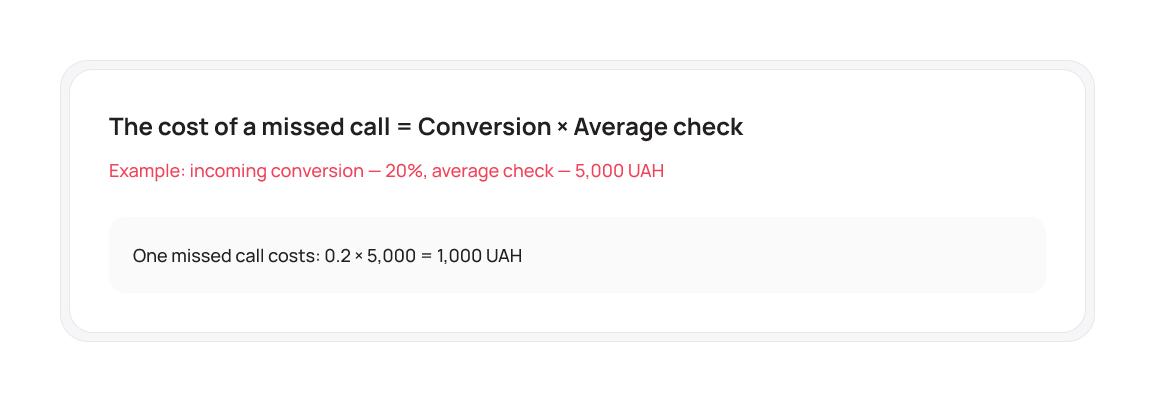
Now imagine you miss 5 calls per day. That’s 100 per month. That’s $2,500 every month that simply never made it into your revenue.
Abandon Rate: The Metric That Spots Losses Before Sales Do
Professional contact centers track a metric called Abandon Rate — the percentage of callers who hang up before reaching an agent. It often signals hidden revenue losses before they show up anywhere in your sales numbers.
Here’s how it plays out: a client calls, enters the queue, waits 40 seconds, and ends the call. That contact won’t appear in your CRM. It won’t show up in your sales report either. But the money is already gone.
A healthy Abandon Rate for an inbound contact center sits below 5%. Once it crosses 10%, it’s a clear sign your queue is out of control and clients are leaving in large numbers without ever being served.
Most companies without a queue management system have no idea what their current Abandon Rate actually is.
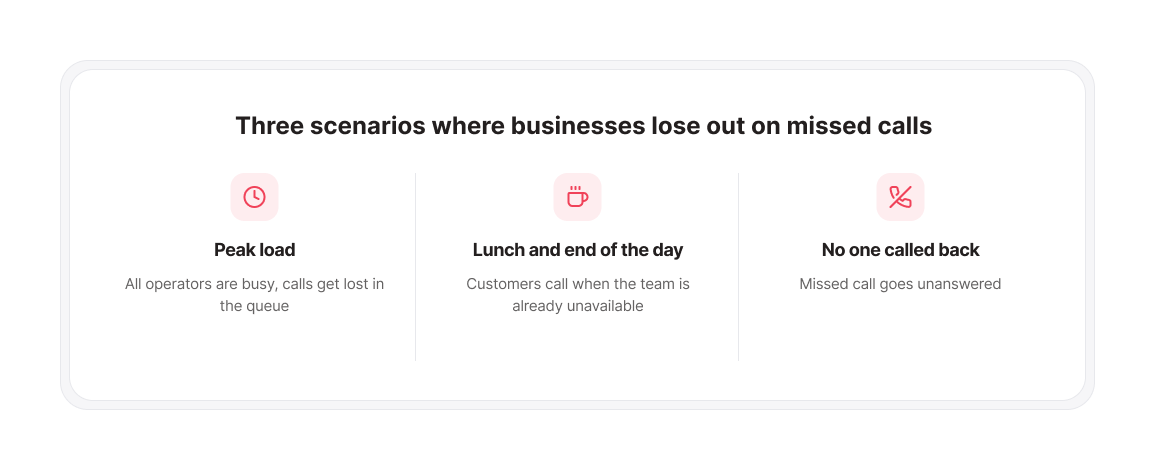
Three Scenarios Where Businesses Lose the Most on Missed Calls
Peak Load With No Queue Management
Monday, 10 AM. Every agent is busy. New calls come in and either get stuck or drop. The clients calling at this exact moment have very little chance of getting through.
Two metrics start climbing at once here: ASA (Average Speed of Answer), meaning the average wait time before an agent picks up, and Abandon Rate. The longer a client waits, the more likely they are to end the call themselves.
Meanwhile, the business doesn’t even know how many calls were missed during peak hours. If the team can’t see the data, the problem stays invisible — but the losses are still very real.
Lunch Break and End of Day
A common situation for smaller teams: nobody’s available from 1 PM to 2 PM. Or calls stop being answered after 6 PM. Clients call when it’s convenient for them, not when it’s convenient for your team.
Even if you call back the next morning, the client may have already made their decision.
Missed Calls Nobody Follows Up On
This is probably the most painful scenario. A call comes in, an agent doesn’t answer, and the system just logs it as “missed.” Nobody is assigned to follow up. Nobody checks whether it was done. The client is gone for good, and the team never even notices.
The Hidden Part of the Iceberg: Losses That Never Show Up in CRM
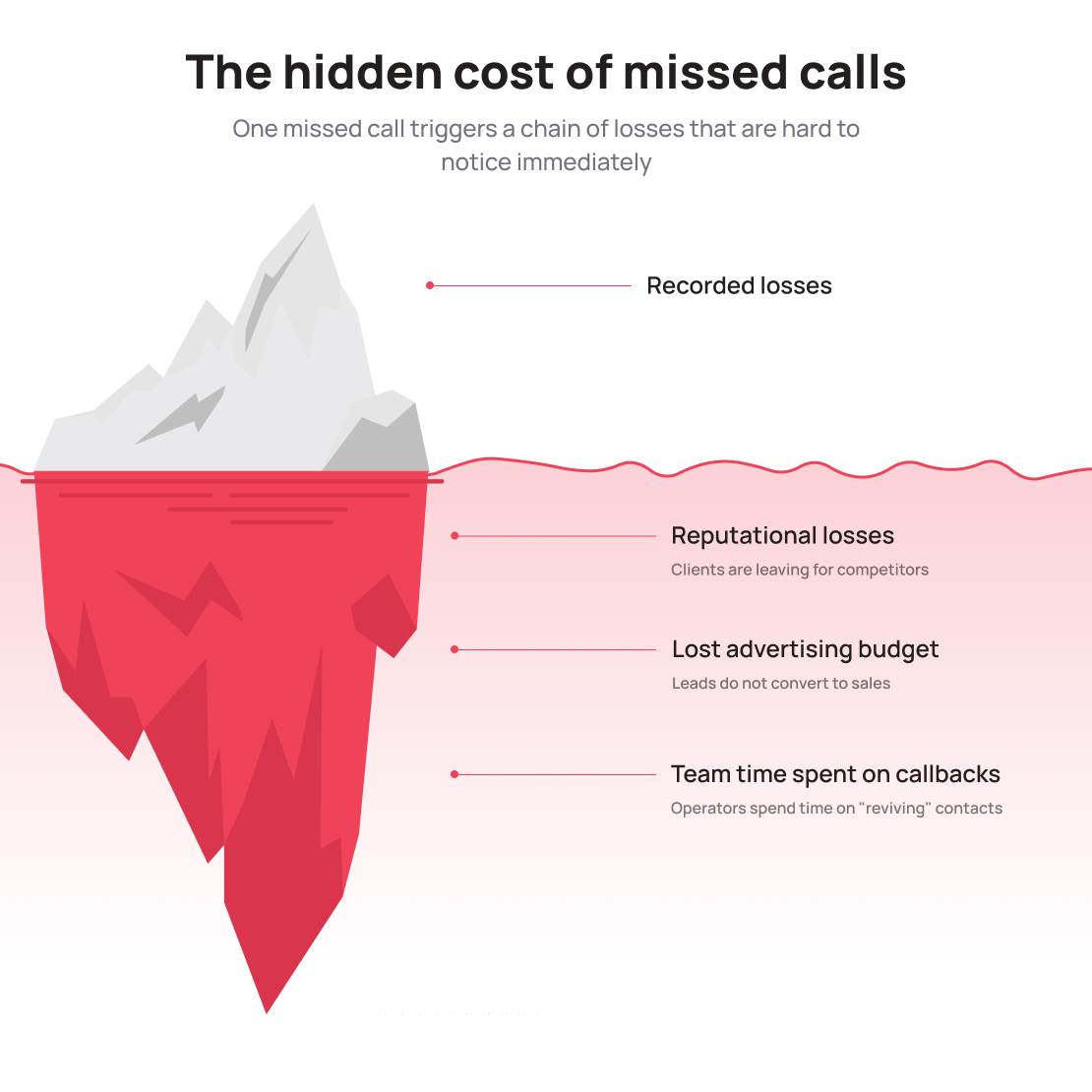
Most companies only track deals that actually close. But there’s an entire layer of losses that never gets recorded anywhere.
Reputation damage. A client who didn’t get an answer rarely leaves an angry review. They just tell their colleagues or quietly never call again. This is “silent churn,” and it’s extremely hard to measure.
Acquisition cost waste. If the client came through paid advertising, you already paid for that click or impression. A missed call means the marketing budget was spent, but the lead never converted.
Time spent on recovery. If a client does wait for a callback, the agent then has to spend time apologizing, explaining the delay, and rebuilding rapport. That’s a less efficient interaction than simply answering in the first place.
How Many Missed Calls Do You Actually Have?
This is the question worth asking yourself right now.
Most managers guess around 5%. But when they actually look at the data, it turns out to be 15%, 20%, sometimes even more.
The problem usually isn’t the agents. It’s the absence of a system: nobody owns the follow-up on missed calls, the team doesn’t check whether callbacks were made, and managers have no visibility into how many calls are being lost during peak hours.
Try running a quick calculation: pull your missed call data from the last month, multiply by your conversion rate and average order value. The result will likely surprise you.
When Missed Calls Are a Symptom, Not the Root Cause
Missed calls on their own are not the root cause of revenue loss. They’re a symptom.
The actual cause is the absence of a system in how the team operates.
Missed calls are almost always the result of a deteriorating SLA (Service Level) and growing queue wait times. SLA measures what percentage of calls the team answers within a set time limit — for example, 80% of calls within 20 seconds. When that number starts dropping, Abandon Rate climbs, and with it the number of clients your business will never see again.
When there’s no clear call routing logic, no queues, no rule for who picks up when the first agent is busy — missed calls are inevitable. Even if your agents are skilled and your team is large enough.
You might have one overloaded agent and one free agent at the same moment, and the call still gets lost. Not because there aren’t enough people, but because there’s no system directing the flow.
That means hiring more people won’t fix the problem. If the process is broken, more people just create more chaos.
What to Check in Your Business Today
If you want to understand the scale of the problem, start with a simple checklist:
- Do you know the exact number of missed calls from the last 30 days?
- Do you track Abandon Rate and ASA, or do you only look at total call volume?
- Do you have a rule for who follows up on missed calls and when?
- Do you monitor which hours see the most unanswered calls?
- Do you calculate the dollar cost of a single missed call?
If you answered “no” to at least two of these, you have a hidden revenue drain that’s easy to measure but hard to fix without the right system in place.
Takeaway
A missed call isn’t a minor inconvenience. It’s a specific amount of money that should have become revenue but didn’t. And that amount is almost always much larger than it first appears.
Start by measuring the scale of the losses. Then identify where calls are most often being dropped: during peak hours, over lunch, due to missing queue logic. Only after that does it make sense to build a process where incoming requests don’t go unanswered.
If you want to figure out how to organize your team so that every call reaches the right agent at the right time, the UniTalk team is ready to walk you through how it works in practice. Leave a request and we’ll set up a free consultation.