24/7 Night Support: How the AI Agent Answers Calls Without a Night Shift
A call that goes unanswered rarely ends in a complaint. According to Zendesk Customer Experience Statistics 2026, 52% of customers are willing to switch to a competitor after a single negative experience. A missed call can easily become that experience, especially when the customer is calling about something that can’t wait. The business never even finds out it lost a customer: no complaint, just silence.
You’ve probably been on the other side of that silence yourself. You get home, remember you wanted to ask about a product or service, dial the number, and hear: “We’re open from 9 AM to 9 PM.” Polite, correct, and completely useless, because the question came up right now, not on the company’s schedule.
For the business, that’s not just a missed call. It’s a lost sale, booking, or potential customer.
Calling back in the morning feels awkward. A question that felt urgent last night either loses its urgency by morning, or the customer finds an answer somewhere else, often with a company that happened to pick up first.
Here’s the paradox of night support: businesses invest heavily in getting a customer to call, then go dark right when the customer finally does.
Why “just hire more people at night” doesn’t work
The first instinct is to set up a night shift. But at most companies, call volume drops noticeably after hours. It’s not enough to justify a full team, but it’s enough to lose customers if no one picks up. That’s exactly why businesses need a way to stay reachable 24/7 without keeping a separate night shift on payroll.
This dilemma comes up most often for online stores, delivery services, medical clinics, and financial services, since their customers call whenever it’s convenient for them, not on the business’s schedule. If you also serve customers across time zones, the same situation repeats daily, just at a different hour each time.
Staffing a night shift is expensive. Staying silent means losing customers without ever knowing how many. So a third option emerges: some night calls get answered not by a person, but by a Voice AI Agent.
A night receptionist, not a voicemail machine
Picture a hotel. During the day, a full team is on duty: front desk staff, concierges, a floor manager. At night, it comes down to one person at the desk. They don’t handle everything the day team does, but the hotel doesn’t stop running either. Someone’s always there to check in a guest or answer a simple question, and if something serious comes up, to pick up the phone and call whoever can actually handle it.
A Voice AI Agent works on the same principle. Think of it as the contact center’s night receptionist: it picks up when operators have gone home, handles routine questions, and passes anything more complex on to the team. When a customer calls in the evening to ask about a product, the agent answers within seconds, drawing on the knowledge base the company prepared in advance: price, availability, terms.
If the customer gets confused, asks for special terms, or describes a complicated situation, the agent doesn’t try to play a role it wasn’t built for. It captures the essentials, gathers context, and hands the conversation to an operator in the morning. That’s what makes a good night receptionist: knowing when to handle something yourself and when to call the manager.
What if the night receptionist gets the booking wrong
That’s a fair concern, and it’s usually the first thing people ask about Voice AI agents. A phone call is harder than a chat: the answer comes out instantly, and mistakes cost more.
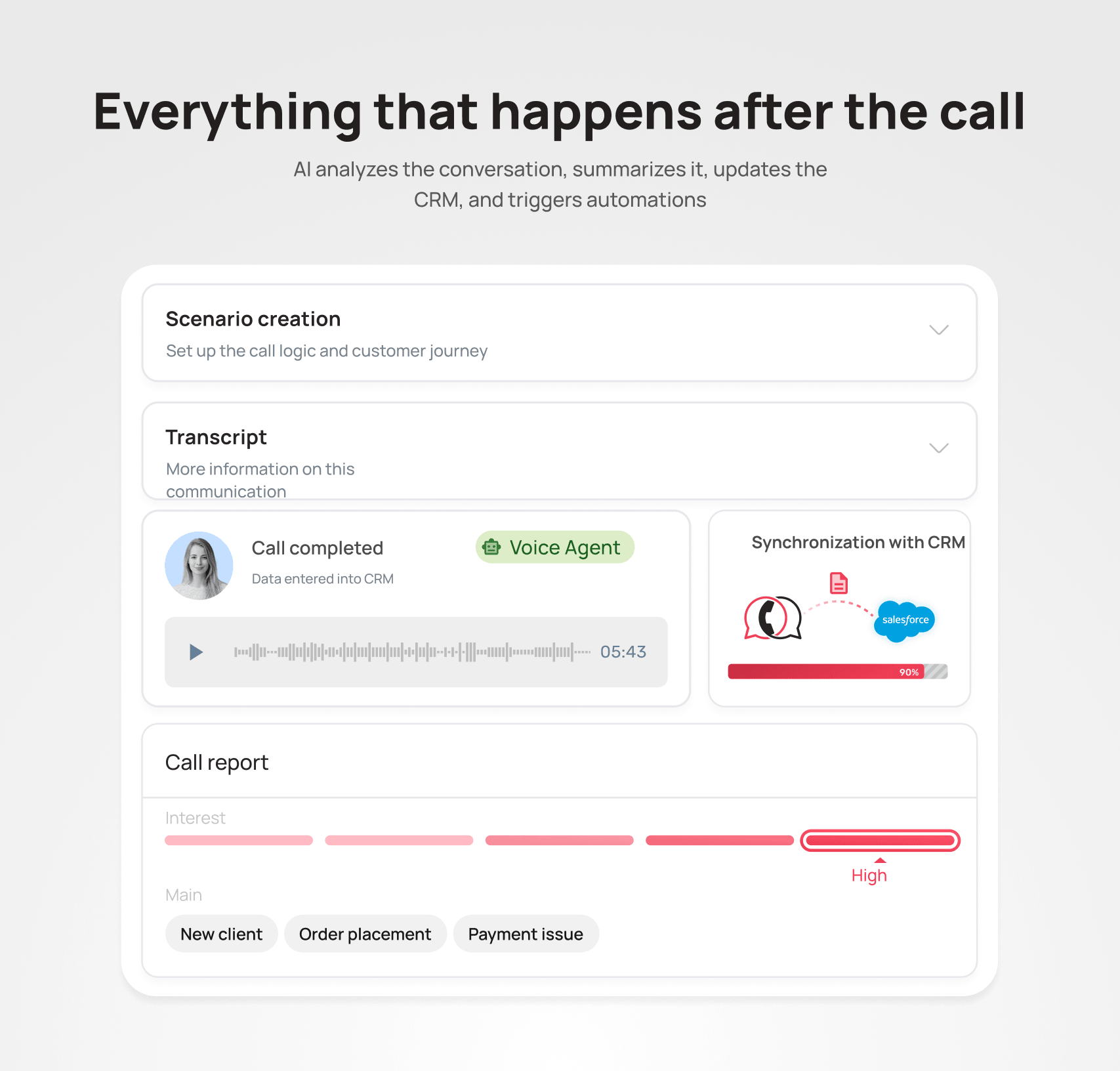
That’s why the agent doesn’t improvise when it’s unsure. If it doesn’t catch a detail or the question falls outside its script, it says so directly: “I’ll pass this along to a colleague, and someone will call you back,” then logs the call for the operator. Every agent call is recorded and transcribed, so an operator or manager can always check exactly what happened and review the quality if needed.
That doesn’t mean mistakes never happen. But control over what the agent can and can’t decide on its own stays with the business, not chance.
An AI agent is only as good as your knowledge base
The agent doesn’t make things up. It works with what it’s been given: delivery terms, return policies, business hours, internal instructions. If that information is outdated, the agent will confidently repeat the outdated answer, and technically be right.
So rolling out night support turns out to be a good excuse to finally do something you’ve been putting off: cleaning up the knowledge base your operators already rely on during the day. Outdated information causes the same damage whether a person or an agent repeats it.
The agent lives in the same system as your operators
At a hotel, the night receptionist doesn’t appear out of nowhere. They work the same desk, with the same keys and the same booking system, as the day team. It works the same way here: the Voice AI Agent runs inside UniTalk Contact Center, not as a separate service bolted on from the outside.
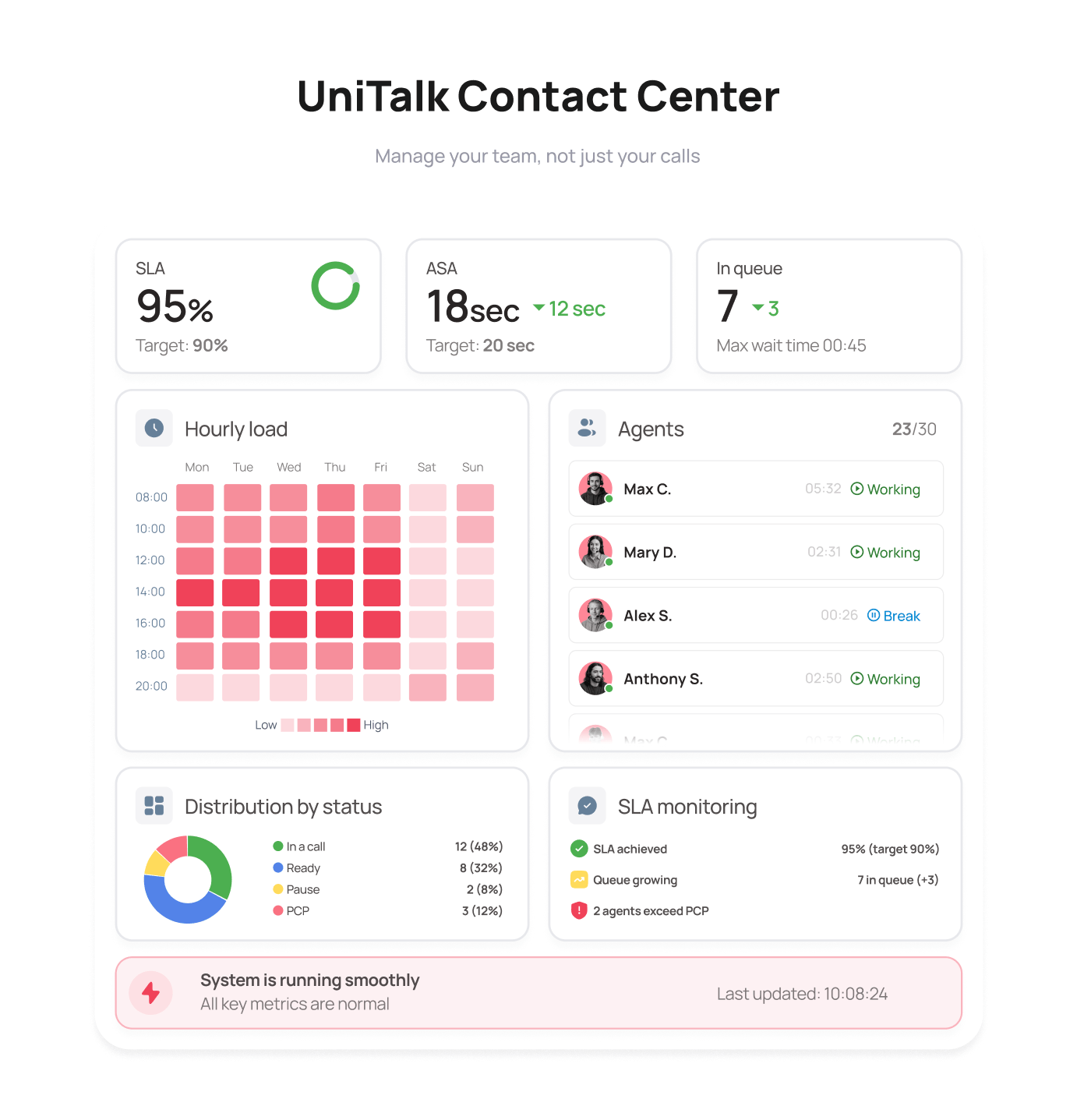
In UCC, you set the rules for who gets each call and when: operators during business hours, the agent at night, a different scenario on weekends. You can go even further. For example, product availability questions always go to the agent, while anything that sounds like a complaint goes straight to a person, even at 3 AM. In other words, the business decides what to hand off to AI and where a human needs to step in right away.
This approach isn’t limited to night support. The same logic lets the AI agent help during peak hours, when call volume spikes. It takes on routine questions while operators focus on the harder ones. That means you can use AI flexibly, depending on the time of day, current load, or whatever scenario your contact center is running.
Back to the call from the beginning
The person who called in the evening to ask about a product now gets an answer right away: availability, price, terms, everything they wanted to know. The call takes a minute instead of getting pushed to tomorrow.
If the question had been more complex, say, they needed a custom consultation or a discount outside the standard terms, the operator wouldn’t see an empty “missed call at night” line the next morning. They’d see ready-made context: who called, what they wanted, what’s already been figured out. No need to start from scratch, which is exactly what frustrates people most after a long wait for support.
There’s no single right model for night support
For some businesses, that means fully automated support at night. For others, the agent handles the first line while an on-call operator covers anything complicated. Some only turn the agent on for weekends, or keep it as backup for when the team is temporarily unavailable. There’s no universally right answer, only the one that fits your call volume.
The call at the start of this article could have simply disappeared into silence, one more lost contact the business would never even know about. Instead, someone, even if it wasn’t a person, picked up. That’s what 24/7 support actually means: not necessarily a round-the-clock shift of operators, but the ability to be there for a customer exactly when they need you.
UniTalk: Manage communications. Drive results.