Holiday season 2026: how an online store can answer every customer from Black Friday to January
- The holiday season lasts about 10 weeks, and in 2026 the busiest stretch falls between November 27 and December 6.
- At peak times, orders are often lost on the front line: a customer who couldn’t get through or didn’t get a reply in chat rarely waits until morning.
- Inside: a formula for calculating your team’s workload, a checklist with deadlines and a list of requests worth handing over to automation.
Before Black Friday, online stores count their stock, prepare banners and plan the ad budget. Far fewer count how many calls and messages the team can handle at seven in the evening, an hour after a big mailing. That is exactly when a customer has already chosen a product and wants to check the size or delivery time, or find out why the promo code didn’t work. If nobody picks up the phone and the Viber message stays unread, the customer buys the same discounted item from another store.
Here is how to estimate the workload in advance, what to prepare for each peak and which requests to hand over to automation so the team can keep up with the rest.
Why orders get lost on the front line during the season
The season brings a store the most customers and the most questions at the same time. According to Promodo and eSputnik, during Black Friday week 2025 the number of orders in Ukrainian online stores grew by 25% and revenue in US dollars by 33% compared with 2024.
Peak-season shoppers are impatient. They see the same discount in three stores and buy where they get an answer faster. According to a CallRail survey, 41% of people hang up after just 1–2 minutes on hold. The survey covered US consumers, but keeping a Ukrainian shopper on the line on Black Friday is hardly any easier.
The worst part is that these losses are almost invisible. Sales are growing, the plan is on track, and nobody counts the requests left unanswered. A missed call shows up in the telephony statistics at best, while an unanswered Instagram message often shows up nowhere, especially when every channel is open in a separate tab. And during the season there are more of these requests: more customers, but the same number of people on the front line.
That is why the front line needs the same preparation as the warehouse: calculate in advance how many requests will arrive at the peak and how many of them the team can handle. To do that, all channels need to be in sight at once. In UniTalk Omni, calls, chats and messengers are gathered in a single window, so both the manager and the team lead see the whole queue of requests.
Holiday season calendar 2026–2027: when to expect the peaks
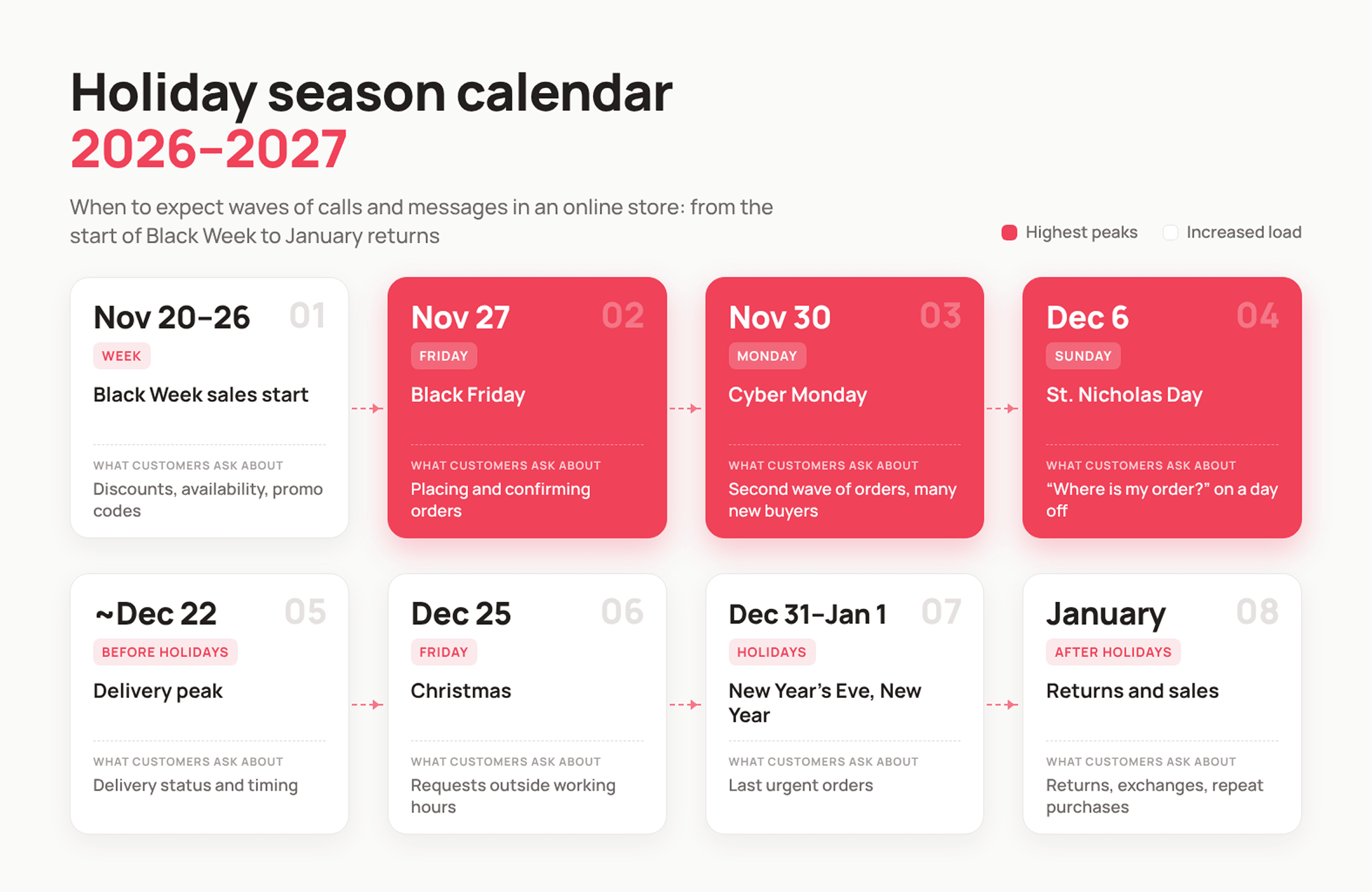
This year the busiest stretch runs from November 27 to December 6. Cyber Monday comes three days after Black Friday, and a week later it is St. Nicholas Day, when Ukrainian children get presents. It falls on a Sunday, so the wave of “Where is my order?” calls and messages will arrive on a day off, when the fewest people are usually on the line.
Closer to the holidays, the pressure shifts to delivery. According to Forbes Ukraine, in December 2025 Nova Poshta, Ukraine’s largest delivery company, processed a record 2.41 million shipments in a single day and brought in more than 1,000 extra staff for sorting. For a store, this means more questions about delivery times and delays, even if it shipped everything on time.
How many requests can your team handle: a 5-minute calculation
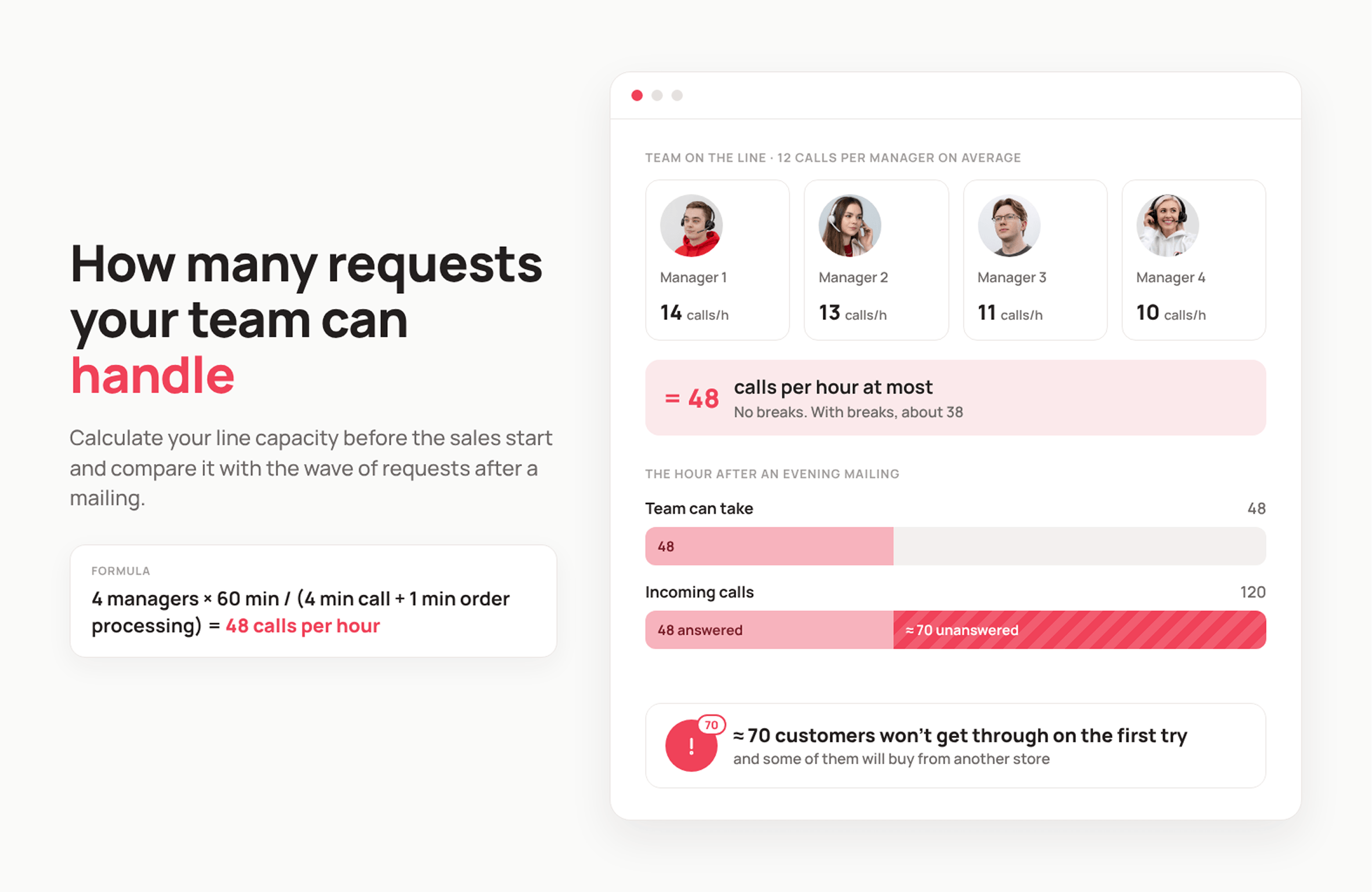
You can calculate your line capacity without any complex tools. You need two numbers from your telephony statistics: the average call length and the time a manager spends after the call processing the order.
Calls per hour = managers on the line × 60 / (call length + after-call time)
For example, there are 4 managers on the line, a call lasts 4 minutes on average, and another minute goes to processing the order. One manager can take up to 12 calls per hour, the whole team up to 48. If 120 calls come in within an hour after an evening mailing, about 70 customers won’t get through on the first try.
One more adjustment: 48 calls is the ceiling when managers talk without a single break. Even the strongest team doesn’t work like that, so plan for about 80% of the result, which in our example is around 38 calls per hour.
The same logic applies to chats, except a manager handles several conversations at once. Check your statistics for how many chats one manager closes per hour and compare that with the wave of messages a mailing brings. If the same people answer both calls and chats, don’t count their hour twice: while a manager is on the phone, messages are waiting.
How much missed calls cost
Now let’s turn this into money. Take three hypothetical stores of different sizes. Each misses 15% of calls (the UniTalk calculator gives an average of 12–18%), every fifth call ends in an order, and the average order value is UAH 1,320.
| Calls per day | Missed (15%) | Lost orders (20%) | Lost revenue per day | Over Black Week |
|---|---|---|---|---|
| 200 | 30 | 6 | UAH 7,920 | ≈ UAH 55,440 |
| 1,000 | 150 | 30 | UAH 39,600 | ≈ UAH 277,200 |
| 3,000 | 450 | 90 | UAH 118,800 | ≈ UAH 831,600 |
These amounts don’t yet include unanswered chats or customers who won’t come back after a failed attempt to get through. You can calculate the numbers for your own store in the calculator below.
Calculate your store’s losses in the missed call calculator.
Calculate ROIThree types of requests to sort out before the sales start
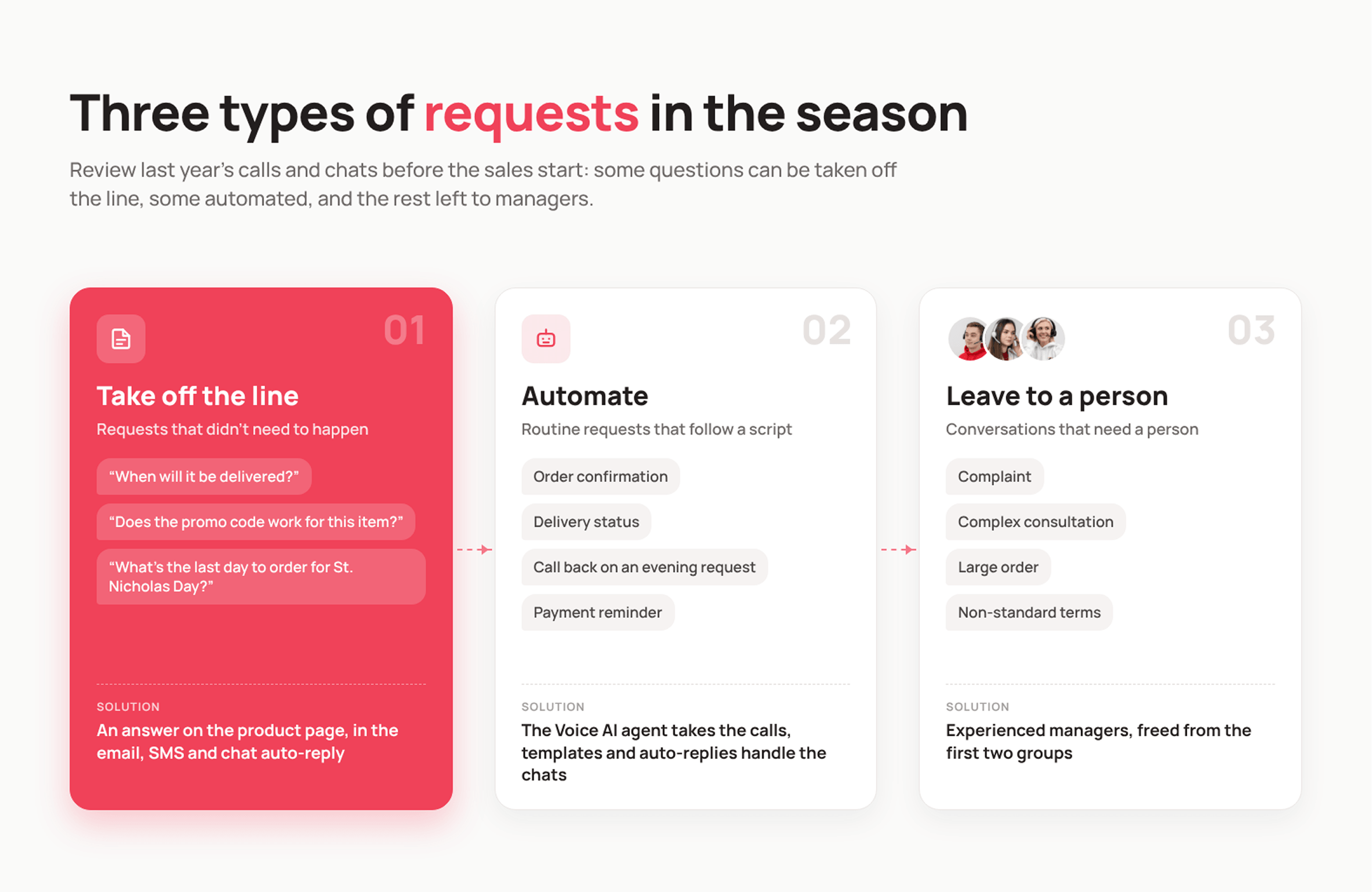
You can hire extra managers for the season, but you have to find them, train them and pay them, and after the holidays the workload drops. So it pays off more to reduce the number of requests that need a person. To do that, it helps to split the season’s calls and messages into three groups, each with its own solution.
Requests that didn’t need to happen
“When will it be delivered?”, “Does the promo code work for this item?”, “What’s the last day to order to get it by St. Nicholas Day?” The answers to these questions should be on the product page, in the confirmation email, in the shipping SMS and in the chat auto-reply. Every answer placed there in advance takes some of the requests off the line before the peak.
Routine requests that follow a script
These are order confirmations, delivery status updates, call-backs on evening requests and reminders about unpaid orders. The conversation follows the same script every time, so these are the easiest requests to automate: calls go to the Voice AI Agent, while chats are handled by reply templates and auto-replies.
Conversations that need a person
These are complaints, complex consultations, large orders and non-standard terms. This is where your experienced managers should go, freed from the first two groups.
To see the proportions in your own store, listen to 30–50 calls and read as many chats from last December. Often, after such a review, it becomes clear that some of the questions can be answered with text on the website.
Doing this manually takes a long time, and the sample is still small. UniTalk Speech Analytics does this review automatically for every call: it turns conversations into text, analyzes them against the criteria you set and shows which topics customers call about most often. You can set up a separate metric, such as “delivery status question” or “promo code didn’t work”, and see how many of these calls come in every day. At peak times, the analytics will also highlight conversations where the customer was unhappy or the manager went off script, so problems become visible while the season is still in full swing.
Online store holiday season preparation checklist
The deadlines are set so that everything is ready by the start of sales on November 20, with a week left for testing.
- By November 10: stock. Compare your stock with last year’s sales, choose the products for the main promotions and agree on restocking with suppliers. Mark low-stock items on the website, otherwise customers will call to ask “when will it be back?”.
- By November 15: website. Go through the customer journey from banner to payment on several smartphones. According to Promodo, 78% of purchases in November 2025 were already made from smartphones, so a slow mobile cart costs you the most. Test promo codes and payment under load.
- By November 15: delivery. Find out your carriers’ last shipping dates for December 6 and December 31 and show them on the website and in emails. This is one of the simplest answers, and it takes some requests from the first group off the line.
- By November 20: mailings. Prepare email, Viber and push campaigns for the whole sales period: an early announcement, a message on launch day, a reminder midway and a final message before the sale ends. Schedule sends for hours when managers are on shift: after every mailing, customers call and write, and someone has to answer them. In UniTalk Omni, mailings work in the same system as calls and chats, so the manager can see which message the customer is replying to.
- By November 20: front line. Calculate your line capacity using the formula above, build a schedule with extra staff on November 27–30, December 6 and December 21–23, and update scripts for the sale terms. Decide who handles chats so that messages don’t wait while a manager is on the phone: in Omni, requests from calls and messengers are distributed among managers automatically according to a scenario. Plan your after-hours setup separately: voice menu, callback and chat auto-reply.
- By November 20: automation. Decide which routine requests from the second group you will hand over to automation, and test the scenarios before the sales start, while the workload is still normal.
- By December 20: plan for January. Returns come after the holidays. As a benchmark, the US National Retail Federation (NRF) expected online shoppers in the US to return about 19% of their holiday purchases in the 2025 season. Train managers to offer an exchange before a refund, and prepare a campaign for first-time Black Week buyers while they still remember your store.
Where the Voice AI Agent helps and when you don’t need it yet
The UniTalk Voice AI Agent takes over the second group: routine calls that follow a script. It works inside UniTalk telephony, so the agent’s calls, chats, mailings and customer history stay in one system. In Omni, the agent is included in the Max plan. The table below shows typical situations of the season: what the agent does in each and when it hands the conversation over to a manager.
| Situation | What the agent does | When the conversation goes to a manager |
|---|---|---|
| A wave of orders after a mailing | Calls customers, confirms the order, address and delivery, offers add-ons. Sends a confirmation SMS and updates the status in the CRM | The customer wants to change the terms or has a non-standard question |
| The customer didn’t pick up | Logs the attempt, sends an SMS and calls again | The customer doesn’t answer after several attempts, and the manager decides what to do with the order |
| Typical questions on weekends and holidays | Answers 24/7 using the store’s knowledge base: delivery status and timing, availability, sale terms, working hours | The customer complains or something went wrong with the order |
| Evening requests | Calls back right away and clarifies what the customer needs | The customer is ready to buy and needs a consultation |
| January returns | Explains the rules and registers the request | The customer wants to exchange an item or the case is disputed |
The agent’s main advantage in the season is speed. It calls back on a request within minutes, even at ten in the evening on a Sunday. You can see how this works in practice in the Jooble case. For their Ready2Recruit service, we set up a Voice AI Agent that calls candidates right after they register. The time to first contact dropped from the next business day to 2–3 minutes. And the speed of that first call determines whether the person answers at all: the difference in answer probability exceeded 20%. “You need to call instantly after the candidate registers, while their interest is at its peak. With human resources alone, doing this quickly 24/7 is impossible,” says Yevhen Bielokobylskyi, team lead of Ready2Recruit at Jooble. A store has the same task: call back on an evening request before the shopper buys somewhere else.
We launch the agent step by step: first on part of the calls, then we scale once the results are visible in real conversations. You can listen to every conversation the agent has and read its transcript, and we set up Speech Analytics for its calls free of charge. The agent passes complex requests to a manager right away, together with the context, so the customer doesn’t have to explain everything again. The agent works only according to agreed scenarios and a knowledge base built from the store’s documents, so you always know exactly what it tells customers.
When you don’t need the agent yet
- You get a few dozen calls a day, and your team handles them. For the season, a reinforced schedule and a callback option are enough.
- Most of your calls are complex consultations, such as choosing equipment for a project. Here the agent can help only with initial lead qualification.
- Your CRM has no open API. The agent won’t be able to update order statuses, and part of the work will still have to be done manually.
Not just online stores: who else gets peaks in November–January
The line capacity formula and the three types of requests work for any business whose customers call and write. And seasonal peaks in November–January aren’t limited to e-commerce.
- Beauty salons. Before the holidays, everyone wants to book the same dates, and the line is busy with bookings and rescheduling. The routine part, booking free slots and sending reminders, can be automated, while the administrator takes care of clients in the salon.
- Restaurants and event venues. Guests call to book a table or a corporate party and to check the menu or holiday opening hours. The knowledge base covers typical questions, while bookings for large events stay with a manager.
- Delivery services. In December, most calls are about status and timing. These are routine scripted conversations, and they can be automated if your telephony is connected to the shipment tracking system.
If your business is on this list, start with the same steps as a store: calculate your line capacity and sort last year’s requests into three groups.
What to do this week
There are less than four weeks left until Black Friday, and that is enough if you start now.
- Calculate your line capacity using the formula above and compare it with the number of requests on last year’s peak days.
- Listen to 30–50 calls from last December, read as many chats and sort the requests into three groups.
- Decide who will answer calls and messages on November 28–29, December 6 and in the evenings after mailings.
If these steps show that your line won’t handle the peak, we will work out together, using your data, which requests to automate first. Until December 1, 2026, you can get a year of UniTalk Omni for the price of 9 months: when you order Omni Max for 6 or 12 months, we develop and set up a Voice AI Agent scenario for your store free of charge. The sooner we start, the more calls the agent can take over before the December delivery peak.
4–6 weeks before the sales start. It’s best to have stock and the website sorted by mid-November and leave the last week before November 20 for testing scripts, mailings and the front-line schedule. Sales start growing before Black Friday itself, so leaving preparation until the last few days is risky.
Take the number of calls in the busiest hour of last season and divide it by the number of calls one manager can take per hour (60 minutes divided by the call length including order processing). Add a buffer of about 20%, because nobody works without breaks.
At a minimum, set up an after-hours scenario: a voice menu, a callback option and a chat auto-reply. If there are many calls, the Voice AI Agent can handle routine conversations, since it works 24/7. It will log complex requests, and a manager will call back on the first working morning already knowing what the issue is.
Yes, this is one of the typical scenarios: the agent checks the items, address and delivery, sends an SMS and updates the status in the CRM. This requires a CRM with an open API. The agent immediately passes changes to the terms, complaints and non-standard questions to a manager.
During the peak, shoppers are usually more annoyed by a busy line and a few minutes on hold. The agent answers right away and resolves simple questions quickly. If the customer wants to talk to a person, the agent transfers the call to a manager.
Write up your return and exchange rules before the holidays and publish them on the website and in confirmation emails. Train managers to offer an exchange before a refund. Return requests can be accepted automatically, leaving people to handle exchanges and disputed cases.