Why communication should be embedded into CRM business logic
In most companies today, CRM has already become the center of customer operations. Deals are managed there, statuses are tracked, conversions are calculated, and the pipeline is controlled.
But customer communication often lives separately.
Managers respond in Telegram, Viber, Instagram, email, phone systems, and website chat widgets. A significant part of this interaction either does not enter the CRM at all or is only partially recorded. As a result, the business sees the deal, but not the full history of how it was formed or why it was lost.
CRM knows that the customer is “in progress” but it does not understand:
- what exactly stopped the customer;
- what questions were asked;
- whether communication was effective;
- who promised what;
- why the customer stopped responding;
- at what stage the team lost contact.
That is why it is no longer enough to simply connect communication channels to CRM. Communication itself must become part of CRM logic and the business process instead of existing separately.
What happens when CRM and communication exist separately
In many companies, CRM is formally integrated with communication channels. But in practice this often means only partial data exchange.
For example:
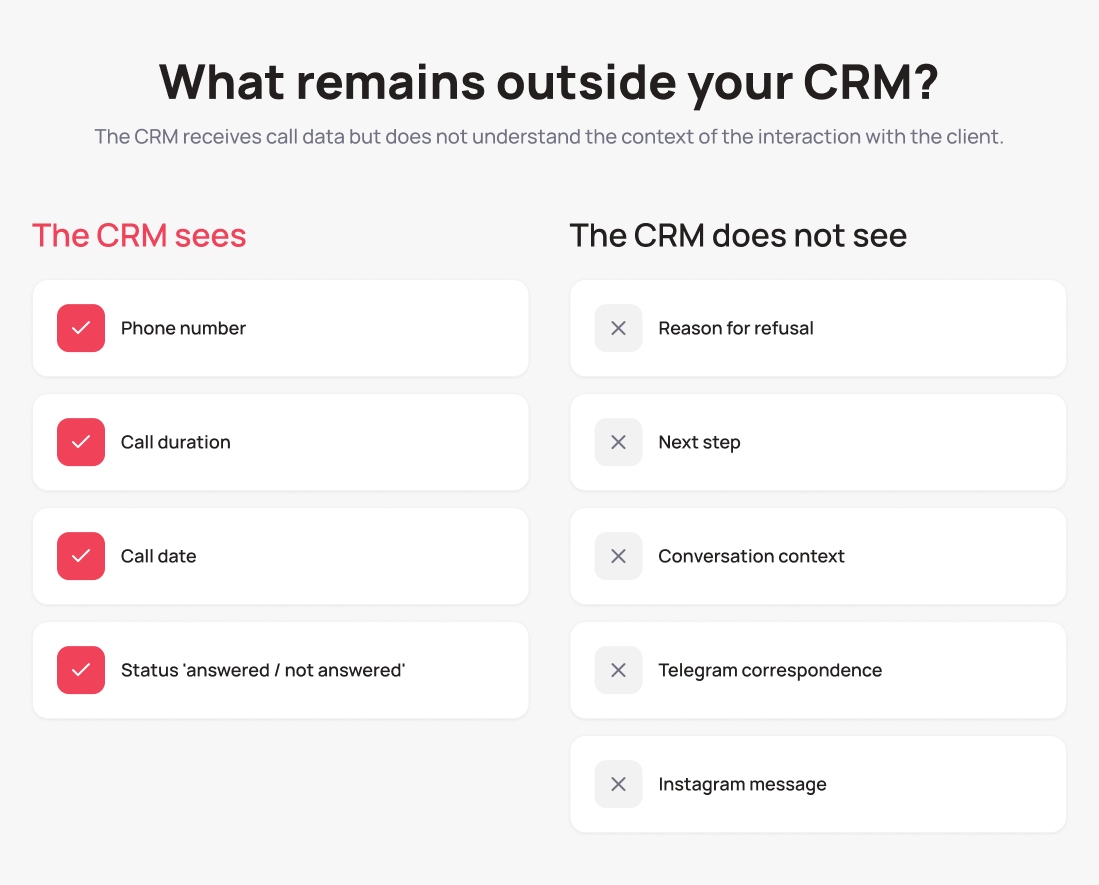
- after a call, CRM creates a record with a phone number and duration;
- after a website form submission, a contact is created;
- an email is attached to the deal.
But the full context of interaction is still scattered across different tools.
A manager may discuss order details in Telegram, send clarifications in Viber, call the client, and then manually update the final status in CRM. Part of the information is lost, and part never reaches the system at all.
As a result, CRM stores only fragmented pieces of communication, not a complete customer journey.
What fragmented communication leads to
Here are several situations familiar to anyone who has worked in sales or customer support.
First situation. A customer calls again and reaches a different manager. The manager opens CRM, sees the customer card and only one call record from a week ago. Nothing else. The manager starts the conversation from scratch. The customer repeats everything again and feels that the company does not remember them.
Second situation. The sales team made 200 calls in a week. Out of 180 of them, there was either a rejection or a “we will think about it.” But the reasons were never recorded. Marketing launches new campaigns without knowing what blocks customers at the negotiation stage. Budget is spent, but conversion does not grow.
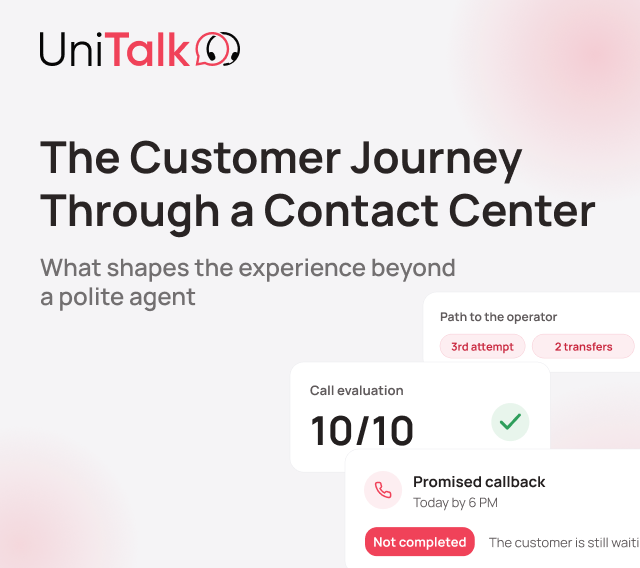
Third situation. A manager promised to call the client back on Thursday. Wrote it down in a notebook. On Thursday, the call did not happen because the note was forgotten. CRM did not know about the promise and no reminder was triggered. The client waited and eventually went to a competitor.
Each of these situations is not a human mistake. It is a systemic issue. Communication happens outside of CRM business logic.
Difference between integration and embedded communication
Most companies already have integrations between CRM and communication channels. But integration alone does not mean that the entire customer interaction becomes part of the business process.
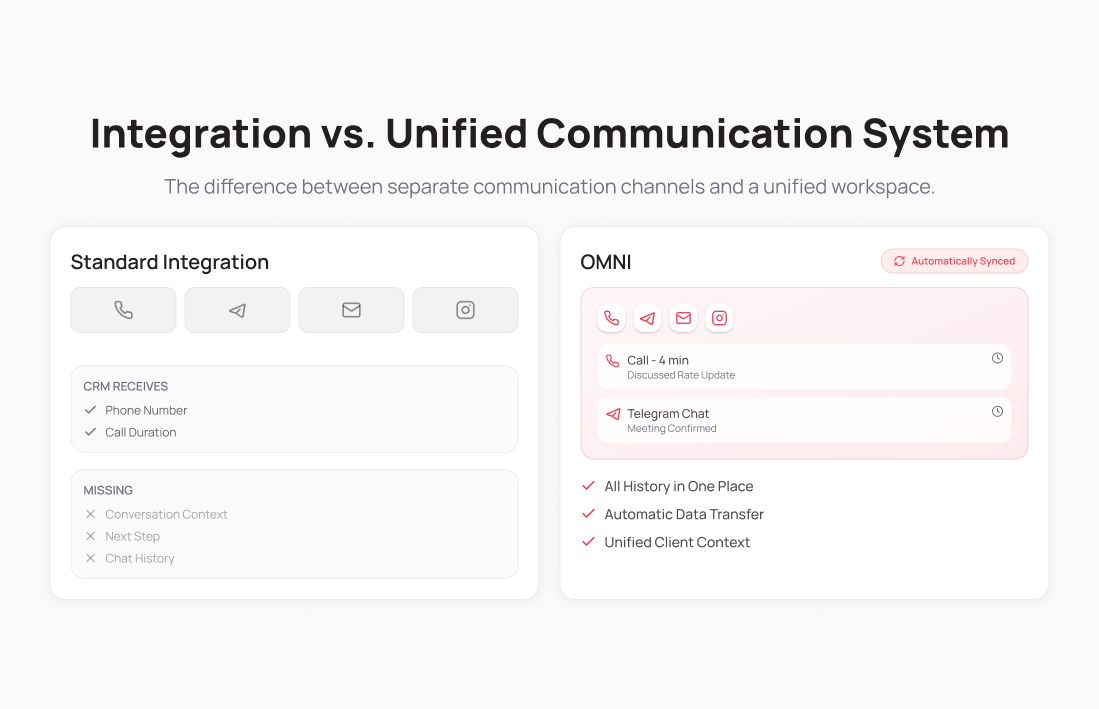
In a classic scenario, CRM receives only part of the data such as call logs, customer numbers, call recordings, or chat messages. But the context remains outside the system.
Managers still switch between messengers, manually update statuses, and separately record agreements.
Embedded communication works differently. All channels, interaction history, statuses, and next actions are combined into a single process. Managers work in one environment and see the full picture of customer interaction.
In this model, CRM stores not only the fact of contact but also the context: what was discussed, what was agreed on, and what should happen next.
The difference is simple. Integration shows what happened, while embedded communication shows what happened and what to do next.
How UniTalk OMNI embeds communication into CRM processes
UniTalk OMNI is a customer communication management system that is embedded into business process logic instead of existing alongside it. UniTalk processes over 100 million calls per month and offers more than 40 ready integrations with popular CRM systems, including KeyCRM, NetHunt, Pipedrive, HubSpot, Salesforce, and Zoho CRM.
How it works in practice.
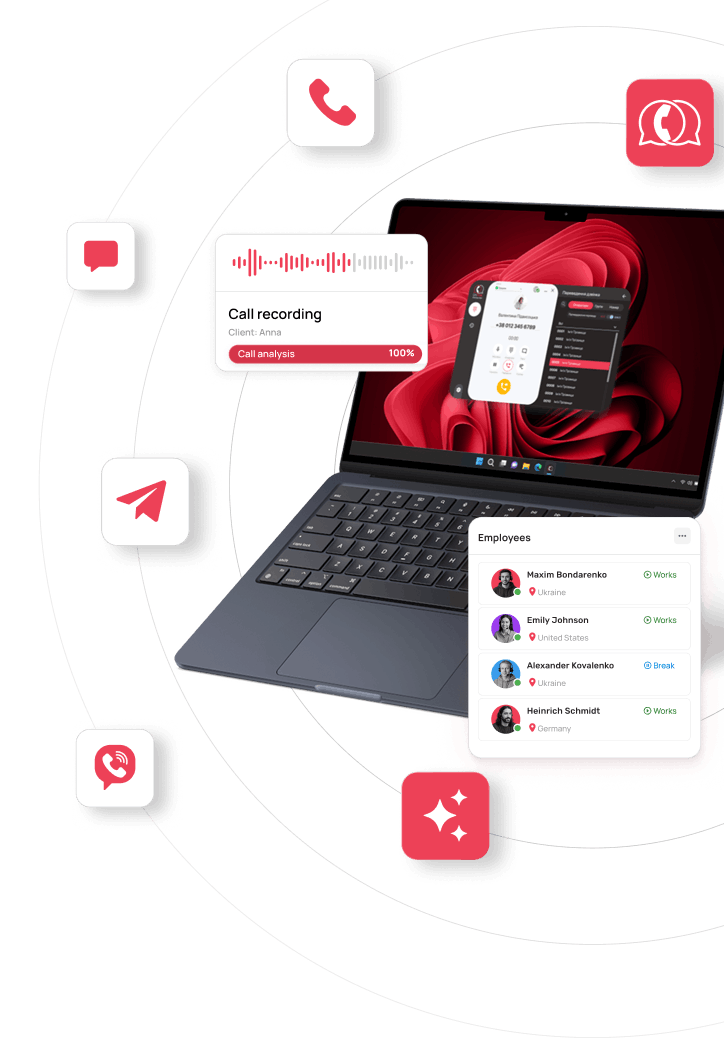
A manager opens a single workspace and sees everything in one place, including calls, Telegram chats, Viber messages, Instagram, website, and email communication. The manager responds and handles all requests in one interface without switching between tools. All communication, both voice and text, is recorded and sent to CRM in a structured format.
When a call ends, CRM does not just receive a call log with duration. On Medium and Full plans, Speech AI analytics is activated. The conversation is automatically transcribed, and the system evaluates call quality, identifies topics, and detects tone. This data becomes immediately available in CRM without any manual input.
Another important element is IVR. If a customer selects a menu option before reaching a manager, such as technical support or order inquiry, this tag is already available in CRM before the conversation starts. The manager immediately understands the request and does not waste time clarifying basic details.
Automation can be configured for any scenario using event handlers and webhooks. For example, when a customer sends a message in chat for the first time, a contact or lead is automatically created in CRM. When a conversation ends, a task is generated for the next step. For companies with custom CRM systems or non standard architecture, a REST API is available with advanced functionality.
What the business gets as a result
For managers, less manual work and more context. During repeat interactions, they see the full customer history including calls, messages, and deal status.
For sales leaders, visibility into call quality without manual listening. Where managers deviate from scripts. Where customers most often drop off. How many interactions are lost and at which stage.
For marketing teams, a clear link between advertising channels and real lead outcomes. Call tracking identifies the source of each call, AI analytics shows conversation quality, and it becomes clear not only where the customer came from but what happened next.
Overall, less manual data entry and more useful data in the system. Teams spend less time on administrative tasks, and the full interaction history is stored in one place.
Key takeaway
CRM integration with communication channels is only a basic level of automation. On its own, it does not solve the problem of lost context, fragmented interactions, or manual work.
CRM helps manage deals. But communication is what determines whether a deal will actually succeed.
That is why it is no longer enough to simply connect channels to CRM. Communication must become part of a unified customer interaction process. This is exactly the approach used by UniTalk OMNI.