SPIN Selling: What It Is and How to Use It
Neil Rackham spent 12 years proving that everything salespeople are taught does not work in complex deals. Sometimes it actively makes things worse.
His team analyzed over 35,000 sales calls and negotiations across 23 countries. The participants included IBM, Xerox, AT&T, and Kodak — companies where every deal was worth millions. The findings were uncomfortable: classic closing techniques, pressure-based objection handling, and early product presentations are not just useless in complex sales. The harder a salesperson pushes to “sell,” the more resistance they create.
The best salespeople shared one common trait. They asked questions.
That is how SPIN was born: a sales methodology that transformed the industry and is still used by half of the Fortune 100 companies today.
Key Takeaways
- SPIN stands for four question types: Situation (S), Problem (P), Implication (I), and Need-payoff (N).
- The methodology was created by Neil Rackham based on analysis of 35,000+ real negotiations — the most comprehensive sales research study ever conducted.
- SPIN works best in complex B2B deals with long sales cycles, high deal values, and multiple decision-makers.
- A client who articulates their own pain and the value of a solution is far more likely to buy and far less likely to object.
- The most powerful question types are Implication and Need-payoff. They create urgency and demonstrate value without applying pressure.
- The technique requires preparation: without understanding the client’s business, situational questions turn into an interrogation.
- Companies with a formal sales methodology earn up to 28% more than those working by instinct.
What Is the SPIN Selling Technique
In the late 1970s, a common belief in the US was that “selling peaches is no different from selling power plants.” A good salesperson can sell anything. The key was thought to be the ability to handle objections, create urgency, and deliver a polished product presentation.
Rackham was skeptical.
In 1974, he founded Huthwaite and launched a research project no one had attempted at that scale before: observing real negotiations, coding salesperson behavior, and statistically analyzing what actually drives results.
12 years. 35,000 calls. 23 countries.
The findings dismantled several “ironclad” rules of selling:
Aggressive closing in large deals backfires. The classic “are you buying or not?” approach works fine for low-value purchases decided in minutes. In complex B2B deals, that pressure triggered irritation and caused prospects to pull back.
Top salespeople talk less than weak ones. In successful negotiations, the buyer does most of the talking. The salesperson asks questions and listens.
Questions matter more than answers. High performers asked 60% more questions than their less successful colleagues. But volume is not the point — the type of question is what matters.
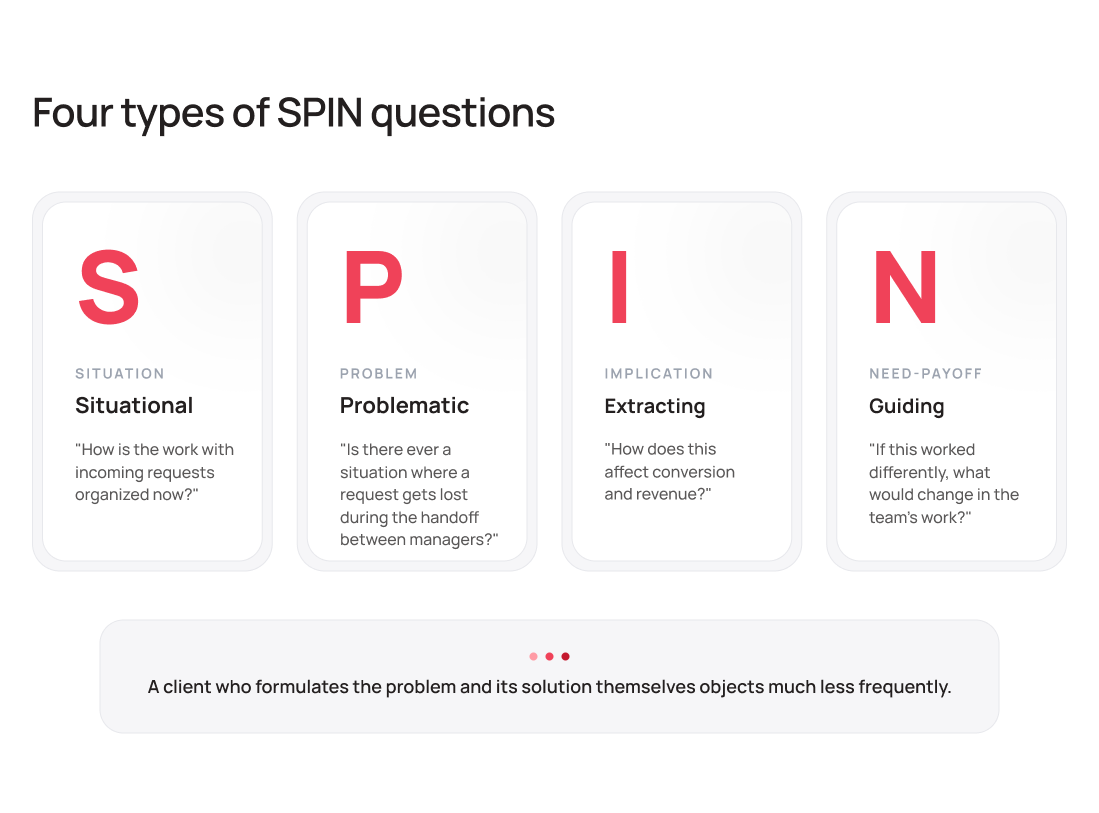
This is how Rackham identified four question types that distinguished top salespeople in major deals. He named them SPIN, after the initials: Situation, Problem, Implication, Need-payoff.
The book “SPIN Selling,” published in 1988, became a global bestseller translated into 50 languages. Today, half of Fortune 100 companies use SPIN to train their sales teams, including IBM, Xerox, Google, and MasterCard.
The Four SPIN Question Types
The most important thing to understand about SPIN is that it is not a list of questions to read out in sequence. It is a conversational logic. Each question type serves its own purpose and sets the stage for the next one.
S — Situation Questions
Purpose: gather context. Understand how the client’s business works — their processes, tools, and team.
Situation questions are the most obvious, and most salespeople start with them. That is where the main trap lies: too many of them and the client starts to feel interrogated.
Rackham found that weak salespeople ask too many situation questions because they did not prepare for the conversation. Strong salespeople arrive already knowing the basics and ask only what they genuinely cannot find out in advance.
Examples:
- “How many people work in your sales team?”
- “How does your current process for handling inbound leads work?”
- “What tools do you use to monitor the team’s performance?”
- “How long have you been using your current setup?”
Rule: do your homework beforehand. Anything you can find on the company website or in public sources, find it before the call. Keep situation questions to a minimum — only what you genuinely need to move forward.
P — Problem Questions
Purpose: help the client recognize and articulate their problems. Not to impose a pain point, but to surface something they already feel and may not have put into words.
This is a critical distinction: you are not inventing a problem. You are helping the client see something that already exists. A client who says “yes, that is a concern for us” opens a completely different conversation than one who has the problem described to them by a salesperson.
Examples:
- “Does it ever happen that a lead gets lost when it’s passed between team members?”
- “How easy is it for your manager to quickly see where each deal stands at any given moment?”
- “Has it ever occurred that two salespeople contacted the same prospect at the same time without knowing?”
- “Is it difficult to track whether the team is following the call script?”
Rule: use open questions. Not “do you have problems with oversight?” but “how do you currently monitor call quality?” Closed questions give a yes or no. Open questions give a story.
I — Implication Questions
Purpose: reveal the consequences of the problem. Show that what seemed like “a minor inconvenience” is actually costing the client money, time, reputation, or opportunity.
This is the most powerful question type in SPIN and the hardest to master. Implication questions shift the conversation from “there is a problem” to “here is what that problem is actually costing us.”
This is where the client experiences what Rackham called “constructive discomfort” — the recognition that the situation needs to change.
Examples:
- “When a lead gets lost, how does that affect your overall conversion rate?”
- “How many hours a week does your manager spend manually reviewing calls?”
- “If a client receives two different answers from two different team members, how does that affect their trust in your company?”
- “Do your salespeople call clients from their personal phones? If someone leaves, the company loses access to those contacts and the entire communication history — how does that affect you?”
- “When a strong salesperson resigns and takes all their undocumented client arrangements with them, what does that cost the business?”
Rule: do not let these questions sound like threats. “Do you realize you’re losing money?” is pressure. “How does this situation affect your results?” is helping the client reach the conclusion themselves.
N — Need-payoff Questions
Purpose: shift the client’s attention from the problem to the solution. Help them articulate the value a change would bring — in their own words.
This is the final, “turning” question type. Once the client has grasped the scale of the problem, need-payoff questions help them paint the picture of what they want instead. The key: they describe that picture themselves.
The difference is fundamental. If the salesperson explains the benefit, it is a presentation. If the client articulates it, it is conviction from the inside. Objections at this stage drop significantly.
Examples:
- “If every call were scored automatically, without manual listening, how much easier would it be for your manager to keep track of quality?”
- “How important is it to you to have a tool that shows exactly where clients are being lost in the process?”
- “If a new hire performed as well as your top salespeople within their first two weeks, what would that mean for the team?”
- “Imagine you had data on which questions clients ask most frequently. How would you use that to improve training?”
Rule: avoid questions that are too obvious. “Would it be useful to save time?” is condescending. Be specific — link each question directly to something the client has already told you earlier in the conversation.
SPIN Questions in Action: A Live Dialogue
The theory makes sense. But SPIN is best understood in the context of a real conversation. Here is what the technique actually looks like in practice.
Scenario: a salesperson is selling a communication management platform. The client is an e-commerce business owner with a sales team of eight people.
Salesperson (Situation): How do you currently handle incoming leads? Is there a system in place, or is it mostly manual?
Client: Mostly spreadsheets and messengers. Some leads come through the website, others come directly through Instagram and Telegram.
Salesperson (Situation): Got it. Who handles the messenger conversations — does everyone take turns, or are there dedicated people?
Client: Everyone takes turns. There is no real system. Whoever sees the message first responds.
Salesperson (Problem): Does it ever happen that a client messages you on Instagram, then calls in, and the person who picks up has no idea about the previous conversation?
Client: All the time. Clients get frustrated when they have to explain everything from scratch.
Salesperson (Problem): What about leads simply falling through the cracks? Someone messages on Telegram late at night, nobody sees it, and by morning they have already bought from a competitor?
Client: pause Yes. And honestly, I suspect it happens more often than we realize.
Salesperson (Implication): If you had to estimate — how many leads might be lost like that in a month? And what is your average deal value?
Client: Maybe 10 to 15. Average deal is around 3,000 hryvnias.
Salesperson (Implication): So we are talking about roughly 30,000 to 45,000 hryvnias a month going to competitors simply because there is no unified system. Over a year, that is close to half a million.
Client: When you put it that way… yes, that is uncomfortable to think about.
Salesperson (Need-payoff): If all your messages from Instagram, Telegram, your website, and incoming calls came into one place, and every team member could see the client’s full history before responding — what would that change for the team?
Client: We would process requests faster, without asking the same questions twice. A client calls back, and the team member already knows the context. That genuinely builds trust. And yes, the lost leads would largely disappear.
Notice what does not happen in this conversation. The salesperson never says “we have a great product” or lists any features. The client calculated their own losses. The client articulated the value of the solution. The salesperson only guided the process with questions.
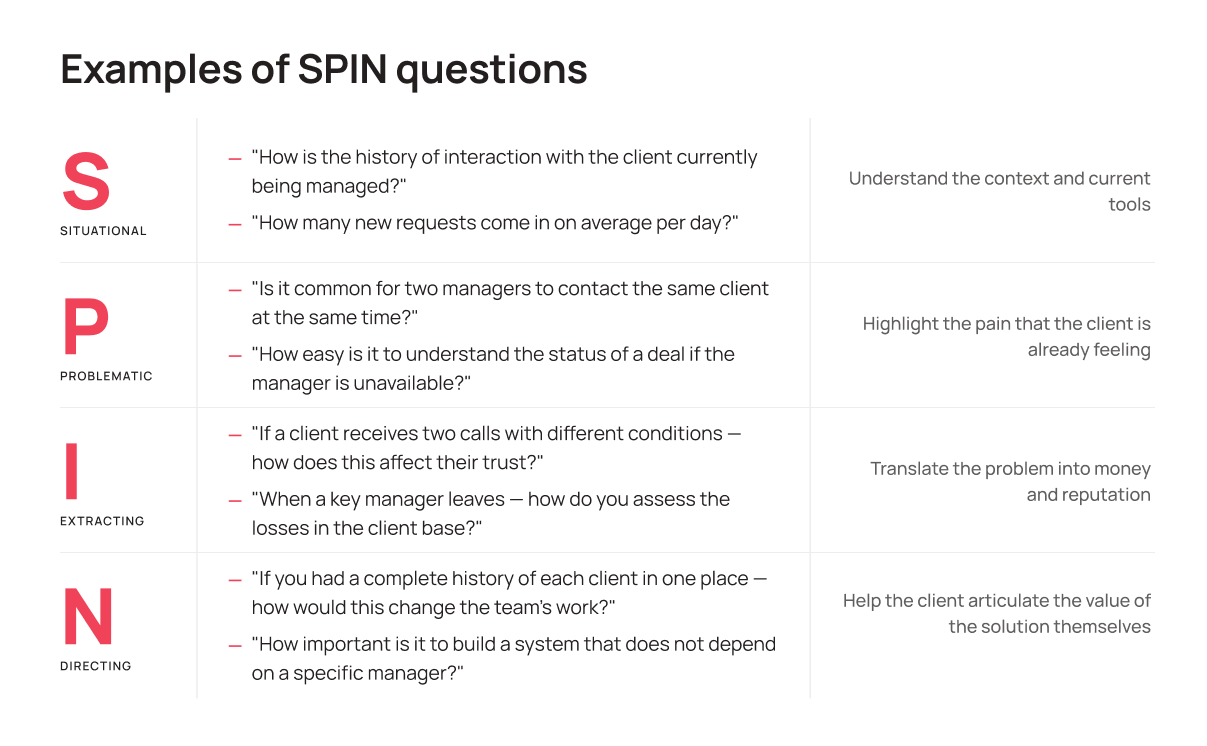
SPIN Question Examples by Type
How to Implement SPIN in Sales
Reading about SPIN and actually applying it are two different things. The methodology requires preparation and a deliberate approach to every conversation.
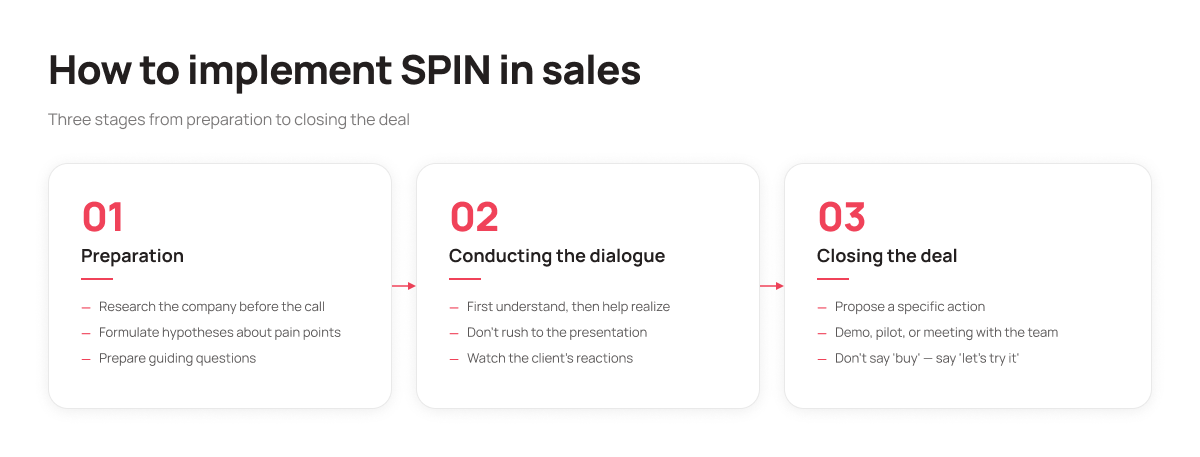
Stage 1. Preparation
Before every call or meeting, answer three questions:
What do I already know about this client? Research the company: their industry, size, how they acquire customers, and what problems are typical for businesses like theirs. The more you know in advance, the fewer situation questions you need to ask live — and the more professional you appear.
What problems do I expect to find? Based on the industry and company size, form hypotheses about where the pain is likely to be. Problem questions are best prepared in advance, not improvised on the spot.
What value does my solution offer this specific client? SPIN is not built around what the product can do. It is built around what will change in the client’s life once they start using it. Prepare need-payoff questions tied to the specific concerns of this particular person.
Stage 2. Conducting the Dialogue
During the conversation itself, hold onto a simple logic: first understand, then help them recognize, then help them visualize a solution.
Do not rush to move to Implication and Need-payoff questions. If you have not surfaced a genuine problem at the Problem stage, implication questions will fall flat and sound forced. Move deeper gradually.
Listen carefully to every answer. SPIN is not a script to work through. It is a conversational structure. If the client brings up something important, follow that thread — even if it does not match your planned sequence.
Watch for the signals. A good sign: the client starts elaborating on their own, adding detail, or doing mental calculations out loud. That means you have found a real pain point.
Stage 3. Closing the Deal
SPIN deliberately avoids aggressive closing techniques. Rackham found that in major deals, pressure at the close (“so, are you in or not?”) causes irritation more often than it helps.
Once the client has articulated the value of the solution themselves, the right next step is to propose a specific action: a demo, a pilot, a meeting with the wider team. Not “buy this” — but “let us see how this works for your specific situation.”
SPIN in Phone Sales: Channel-Specific Rules
Many people assume SPIN is for in-person meetings. In practice, the methodology works just as well over the phone and in video calls — but each channel has its own rules.
More situation questions means more irritation. On a phone call, you have less time to earn the right to ask a lot of questions. Prepare twice as thoroughly: limit yourself to two or three situation questions, only the most critical ones.
Implication questions hit harder. In a face-to-face meeting, the client reads your body language and can relax. On a call, there are fewer distractions — they hear only your words. A well-framed implication question creates a pause in which the client genuinely starts calculating their losses.
In cold calls, start with problem questions. In a first cold call, you have 30 to 60 seconds to earn attention. Skip the situation questions and open with one strong problem question about a pain that affects most businesses in that sector. If the client says “yes, that is relevant to us,” you have earned the right to continue.
Take notes. It is easy to miss an important detail from a client’s answer on a call. The best implication and need-payoff questions are the ones that connect directly to something the client said a few minutes earlier.
Chat is not the right place for full SPIN. The S-P-I-N sequence requires live dialogue. In a text conversation, each question feels like a form. Use one or two sharp problem questions to move the exchange toward a call or meeting.
Advantages and Limitations of the Method
SPIN is a powerful methodology. But it is not universal — and Rackham himself was honest about that.
When SPIN Works Well
Complex B2B deals. Selling telephony, CRM, ERP, consulting, or equipment — any situation where the decision involves multiple people, the cycle takes weeks or months, and the stakes are high. This is exactly what SPIN was designed for.
Long sales cycles. When the client needs more than a day to decide, SPIN helps build value gradually, from one conversation to the next.
High deal values. The more expensive the product, the more important it is for the client to convince themselves the purchase is worthwhile. A coerced expensive purchase is far more likely to result in cancellation or dissatisfaction.
Multiple decision-makers. When the client articulates the value themselves, they become an internal advocate within their own organization.
When SPIN Works Less Well
Transactional and simple sales. When a client comes in knowing exactly what they want, the price is clear, and the decision is already made, SPIN questions will seem out of place and slow things down.
Clients who have no problems. Sometimes a company is genuinely satisfied with the way things are and is not looking for change. No implication question will manufacture a problem out of thin air — nor should one try.
Short-cycle B2C purchases. The methodology was built for corporate negotiations, not retail buying decisions.
Inexperienced salespeople without preparation. SPIN requires skill. Someone asking implication questions mechanically from a list will come across as unnatural and generate frustration rather than trust.
| Criterion | Good fit | Poor fit |
|---|---|---|
| Type of sale | B2B, consulting, SaaS, equipment | Retail, simple products |
| Sales cycle | Weeks or months | Single visit or call |
| Deal value | High | Low |
| Number of decision-makers | Several people | One person |
Mistakes When Using SPIN
Most problems with SPIN implementation come not from lack of theory knowledge, but from how the method is applied in practice.
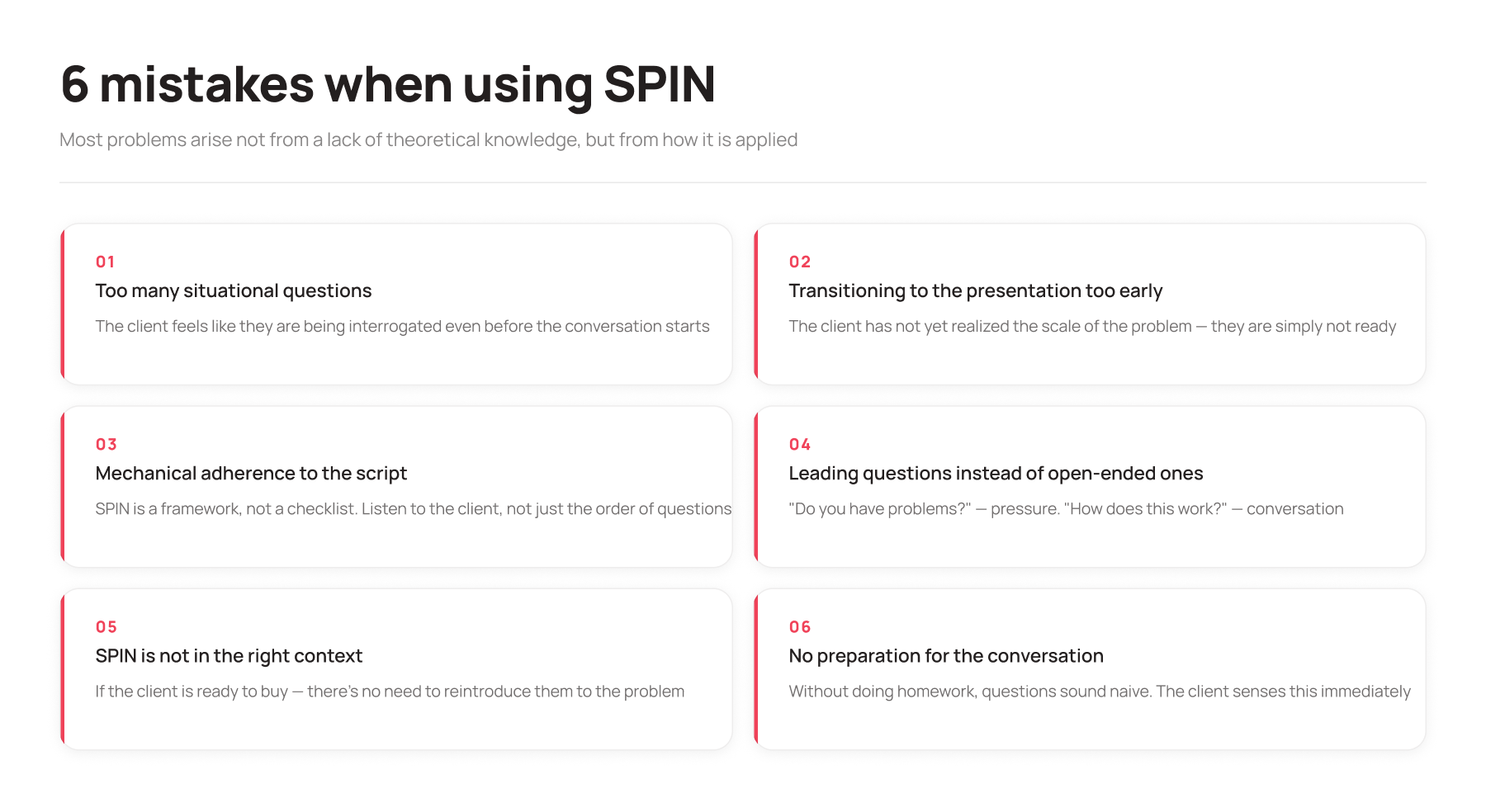
Too many situation questions. This is the most common mistake. The salesperson arrives at a meeting and spends ten minutes asking about the company’s structure — information that was on the website. The client is already irritated before the real conversation has even started.
Jumping to the presentation too soon. A hint of a problem appears and the response is “we have a solution for that.” This is one of Rackham’s primary identified mistakes: moving to a presentation before the client has grasped the scale of the problem significantly weakens the impact. The client simply is not ready yet.
Following the script mechanically. SPIN is a framework, not a checklist. If the client raises something important, follow it — even if it breaks the planned order. The goal is to understand the real situation, not to work through a sequence of question types.
Leading questions instead of open ones. “You surely have problems with reporting, right?” is pressure. “How is your reporting currently set up?” is exploration. The first triggers a defensive reaction; the second opens a conversation.
Using SPIN in the wrong context. If the client has arrived with a clear request and is ready to buy, pulling them into implication questions wastes their time. The skill is in sensing when the methodology is needed and when a straightforward answer is enough.
Arriving without preparation. SPIN without homework turns into an interrogation. If you do not know who you are talking to or what problems are typical in their industry, your questions will sound naive. Clients sense that immediately.
How to Know Whether SPIN Is Actually Working in Your Team
You ran the training. You explained the technique. You distributed example questions. A month later, the numbers have not moved. What went wrong?
The likely answer: salespeople revert to familiar patterns the moment they are in a live conversation on their own. This is not bad intent — it is simply how the brain works under the pressure of a real interaction. Research shows that even experienced salespeople skip key script steps in 30 to 40 percent of calls.
Monitoring conversation quality manually across a team of five or more people is not realistic. Listening to 50 to 100 calls per week is a full-time job on its own.
This is where a practical tool comes in: Speech Analytics. The system automatically transcribes every call, evaluates it against set criteria, and flags conversations that need a manager’s attention.
In a SPIN context, this means configuring metrics for each stage of the methodology: did the salesperson ask problem questions, did they reach the implication stage, at what point did the conversation lose momentum. Not assumptions — data, for every call.
UniTalk Speech Analytics is part of the UniTalk Omni system. Managers configure the evaluation criteria to match their methodology and receive a ready breakdown of every call without listening to any of them manually.
Learn more: UniTalk Speech Analytics.
What Happens When SPIN Is Implemented Systematically: A Real Case
Skeptics often say: “This is all theory. It does not work in real teams.” Here is a concrete example.
Scientifica, a British manufacturer of neuroscience equipment, implemented SPIN through Huthwaite International’s program for their EMEIA sales team. The goal was standard for most B2B teams: improve the quality of conversations, reduce objections, and grow revenue.
Results from several months after implementation were shared by Dan Metcalf, Sales Manager EMEIA at Scientifica:
“Our conversion rate from won versus lost deals improved from 10% to 23%. Our overall pipeline conversion improved from 15% to 18% — despite all the challenges we faced during the Covid period. We also saw improvements in internal communication and in the accuracy of our sales forecasting, because the team now had a shared language.”
What is notable is that a 2.3x improvement in conversion came not from hiring new salespeople or changing the product. Only the approach to the conversation changed.
Similar results are documented by Huthwaite in their SPIN ROI whitepaper: a medical equipment company increased revenue by 43%, a software company achieved a 50% uplift in sales, and a healthcare provider increased the success rate of sales calls by 150%.
All three are B2B companies with complex products and long sales cycles — exactly the territory where SPIN delivers in full.
One important point: none of these companies implemented SPIN through a single training session. Research shows that 60 to 70 percent of SPIN implementations fail because salespeople revert to old patterns without ongoing coaching and feedback on real calls. Scientifica approached it differently: leadership was involved throughout, calls were reviewed regularly, and the skill was reinforced iteratively.
Conclusion
SPIN is not a magic formula or a script. It is a philosophy of conversation, one where the client — not the product — sits at the center.
Rackham spent 12 years and 35,000 calls proving one simple thing: the best salespeople do not persuade. They ask questions that help buyers reach the right decision on their own.
The context of 2026 makes this approach more relevant than ever. According to Forrester, 71% of B2B buyers today are millennials and Gen Z professionals who arrive at meetings having already done their own research. They do not want to be “sold to.” They want a partner who understands their problem more deeply than they do themselves.
SPIN delivers exactly that.
A client who bought because they understood the value themselves will be loyal. A client who was pushed into a purchase becomes a source of returns and complaints.
If your team works with complex products, long sales cycles, and high deal values, SPIN is worth implementing — not as theory, but as practice. Start with the next conversation: try asking three implication questions where you would normally move straight to the presentation, and watch how the client responds.
UniTalk: Manage communications. Drive results.
SPIN is a sales technique where instead of presenting a product, the salesperson asks four types of questions: about the client’s current situation, their problems, the consequences of those problems, and what value a solution would bring. The goal is to help the client reach the conclusion that the product is what they need.
Neil Rackham, a British sales researcher and consultant and founder of Huthwaite International. The methodology is based on a 12-year study in which the team analyzed over 35,000 real negotiations across 23 countries. The book “SPIN Selling” was published in 1988 and became a New York Times bestseller.
Traditional techniques focus on persuasion, objection handling, and actively promoting the product. SPIN is built on understanding the client: the salesperson asks questions rather than providing answers. The client articulates their own pain and the value of the solution, which reduces resistance and makes the sale more durable.
Not in its pure form. SPIN was designed for complex B2B deals with long cycles and high deal values. In B2C, especially for transactional purchases made quickly, the technique feels excessive. Elements of the approach can be adapted for high-value B2C products such as real estate, cars, or financial services — but SPIN in its full form rarely fits there.
Yes, with caveats. In a cold call, time is limited, so situation questions should be kept to a minimum — only the most essential ones. The main focus should be on problem questions, which help hook the client’s attention quickly. Save the deeper implication questions for a second conversation.
There is no fixed rule. According to Huthwaite research, 10 to 15 questions is optimal in a 30-minute conversation. No more than three to five situation questions (learn the rest in advance). As many problem and implication questions as needed to surface genuine pain. Two to three need-payoff questions toward the end.
Implication questions. They require solid preparation — you need to understand what consequences are typical for this specific client’s problems — as well as careful handling in the conversation. A poorly framed implication question sounds like a threat or manipulation. A well-framed one helps the client see for themselves the real cost of doing nothing.