Why AI Analytics and Dashboards Have Become the New Standard for Control
Picture this: your sales department has six managers. Each one handles between 50 and 80 contacts a day across calls, Telegram, Instagram, and email. That’s over two thousand customer interactions per week. As a manager, you listened to twelve calls and skimmed through a few chats. That’s less than one percent of everything that actually happened.
You don’t know how many times your managers went off-script. You don’t know which objection comes up most often or how they handle it. You don’t know exactly where customers drop off and go to a competitor. You’re managing based on gut feeling, not data.
In 2026, that’s too expensive a habit.
Manual oversight: not control, just the illusion of it
Most managers we talk to are honest about it: spot-checking calls gives a sense of control, but not the actual picture. It’s physically impossible to cover more than 2-5% of conversations in a week. Text channels like Telegram, Instagram, and email sit in a total blind spot. Who has time to read hundreds of dialogues by hand?
The problem isn’t that managers are lazy. The problem is that the tools don’t match the real scale of communication. A five-person team in a multichannel environment has already become an operating system that needs proper monitoring.
And the cost of skipping that monitoring is very real. A customer repeats their request to different managers across different channels and eventually gets tired of it. A hot lead sits unanswered. Telegram brings in twice as many inquiries as the phone, but there are still only two people on chat, and the manager only finds out when customers have already started leaving.
Two layers of control: what a manager sees with the right tools
Forget the spreadsheet with numbers at the end of the month. A proper communication control system works on two levels, and each one answers a different question.
The first layer is dashboards. They answer the question “how much and how fast.” You open the screen and see in real time: 143 inquiries came in across all channels today, four managers are active, two are free, seventeen dialogues weren’t handled on time. You can redistribute the workload instantly, without waiting for the shift to end.
But that’s only half the picture.
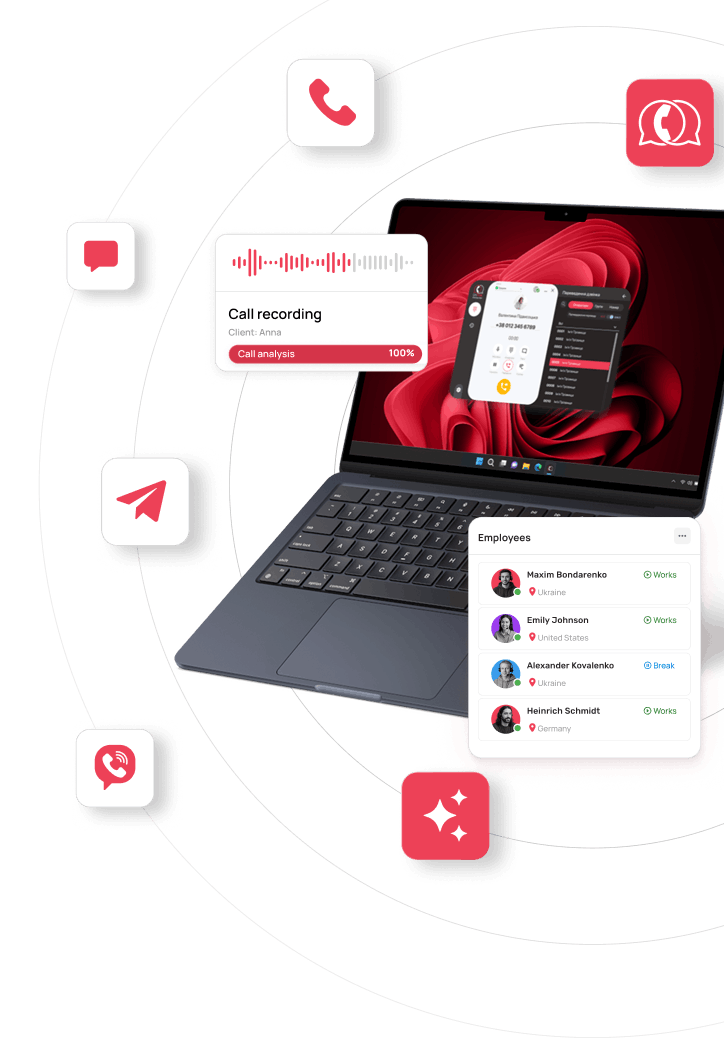
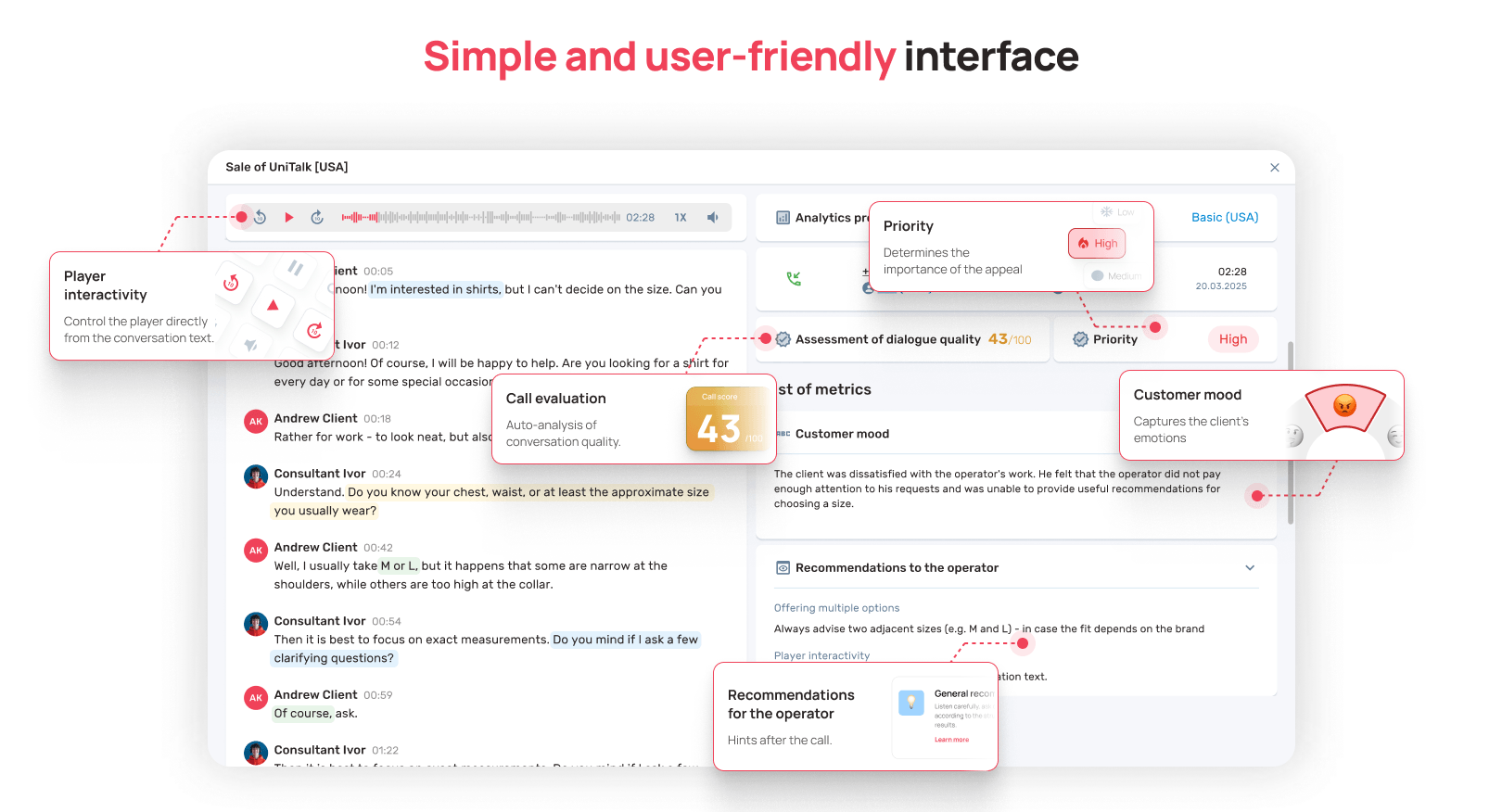
The second layer is AI analytics. It answers the questions “why” and “where exactly is the money being lost.” The system automatically listens to every conversation, converts it to text, and analyzes it against criteria you set yourself. No limits on volume, no risk of missing anything, around the clock. Text channel analytics work the same way: the system tracks the topics of chat inquiries, the quality of manager responses, and problematic dialogues, without anyone having to reread every single message.
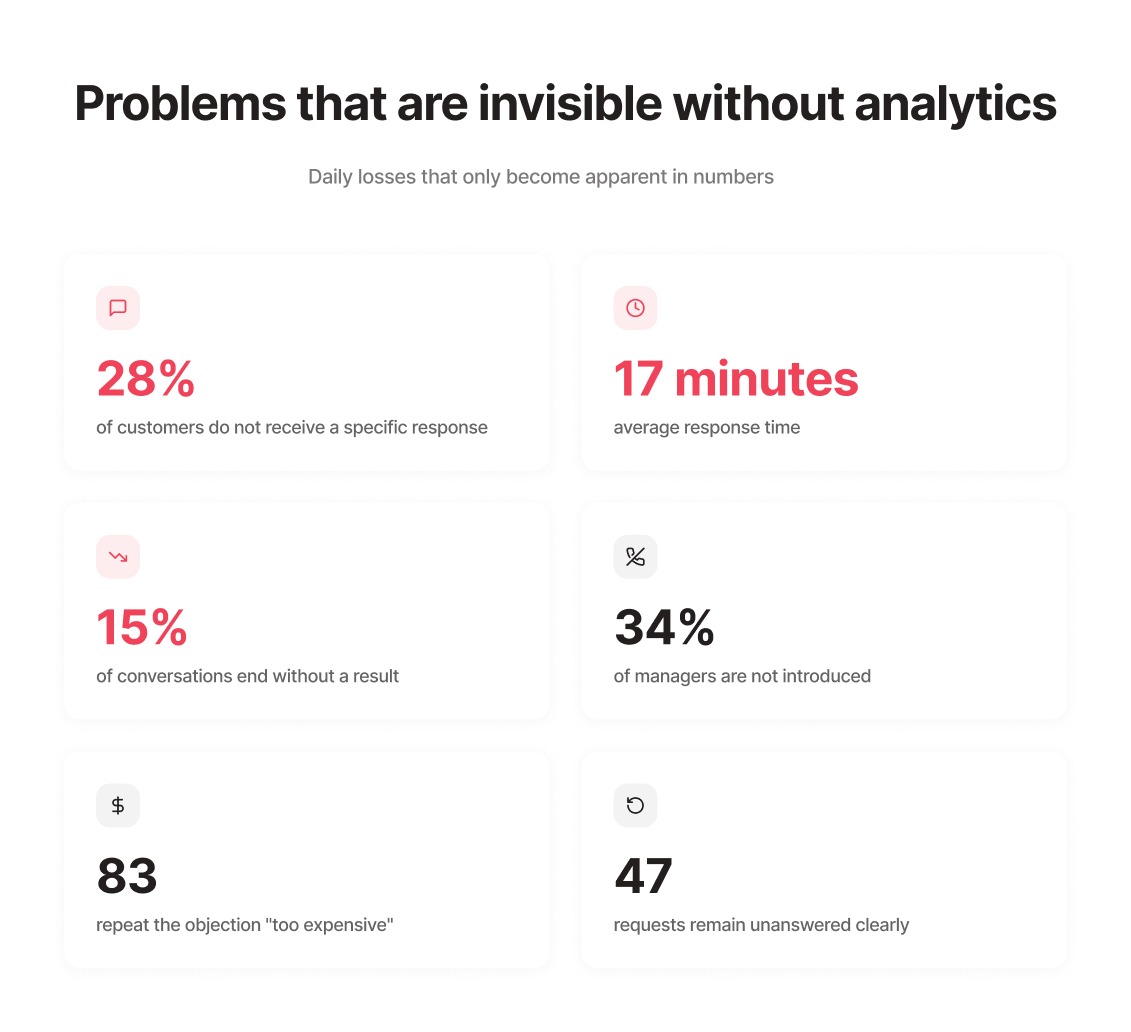
Manager Oleg doesn’t introduce himself at the start of 34% of his calls. Manager Katya skips clarifying the customer’s needs and jumps straight to price. Customers asked about return conditions 47 times in a week, and most of them got a vague answer. The objection “it’s too expensive” came up 83 times, and in 60% of cases the manager simply agreed with the customer and let the conversation drift away.
This isn’t an impression from one call you happened to listen to. It’s a month’s worth of data across your whole team, and you got it without listening to a single call manually.
What this looks like in real businesses
E-commerce. A manager takes orders over the phone. AI analytics reveals that in 28% of calls, the customer asks about the delivery date but gets a vague answer like “about a week.” Those customers don’t come back. The fix is a specific script with a concrete date and analytics to make sure it’s being used.
Online education. A course sales team handles dozens of leads a day. Analytics surfaces the main objection: “I’m not sure I can fit it around my job.” Marketing had no idea and wasn’t addressing it in their ads. After making changes, conversion went up.
Healthcare. A clinic where administrators book patients over the phone. AI analytics shows that 15% of calls end without a booking, even though the patient didn’t say no. The call just cuts off, or the administrator never offers the nearest available slot. An invisible loss that’s easy to fix.
In every one of these cases, the problem had been there for months. Nobody just hadn’t seen it in numbers before.
When conversation data lands in your CRM, everything clicks into place
Without the context of a deal, a dashboard is just statistics. The real value starts when data from calls and chats is automatically sent to the CRM and becomes part of the customer’s profile.
Imagine the full chain: a customer comes in from a Facebook ad → messages on Telegram → a manager calls back → AI call analytics captures the topic and scores the quality → and the result lands in the CRM along with the transcript and the traffic source.
The marketer sees: this campaign brought in 120 inquiries, but 40% of them weren’t the right fit. The sales manager sees: out of those 120 leads, the manager closed only 18 deals, and half the conversations had no clear offer. The COO sees: average handling time is 9 minutes, but the standard is 5.
Everyone gets the data they actually need, with no manual gathering and no subjective reports from managers.
What happens if you leave things as they are
- Some managers deliver results. Others go through the motions. Without analytics, a manager can’t tell them apart. The strong ones may leave because they feel unrecognized. The weak ones keep going and nothing changes because there are no numbers to hold them to.
- Competitors are already using AI call analytics and understanding their customers better: their objections, their fears, their behavior patterns. A company that doesn’t do this isn’t losing in advertising or in its product. It’s losing in communication.
- The business grows, the volume of inquiries increases, and the system buckles. You hire more people, but the chaos grows right alongside them. Without a system in place, scaling becomes expensive survival rather than actual growth.
- And the most painful part: decisions get made on gut feeling. You changed the script, but nobody knows if it made a difference. You launched a new promotion, but nobody knows if customers are even mentioning it. You hired a new manager, but nobody knows if they’re actually selling. Every one of those unknowns has a concrete price tag.
The bottom line
AI analytics for calls and chats, combined with dashboards, is no longer a tech option for big companies. It’s a tool without which a manager simply cannot see what’s happening in their team.
Dashboards give visibility: how many inquiries, how fast, where the gaps are. AI analytics gives depth: what customers are saying, where managers are making mistakes, which objections are killing deals. CRM integration closes the loop from the ad source all the way to the outcome.
In 2026, this isn’t a competitive advantage anymore. It’s a basic management standard. And companies that ignore it pay for that choice every day: in lost leads, underperforming teams, and decisions made without data.
UniTalk OMNI brings calls, chats, AI analytics, and dashboards together in one communication management system. Book a demo and get the full picture of how your team is working within your first week.