“Hang on, let me check”: why agent scripts fail the moment a real conversation starts
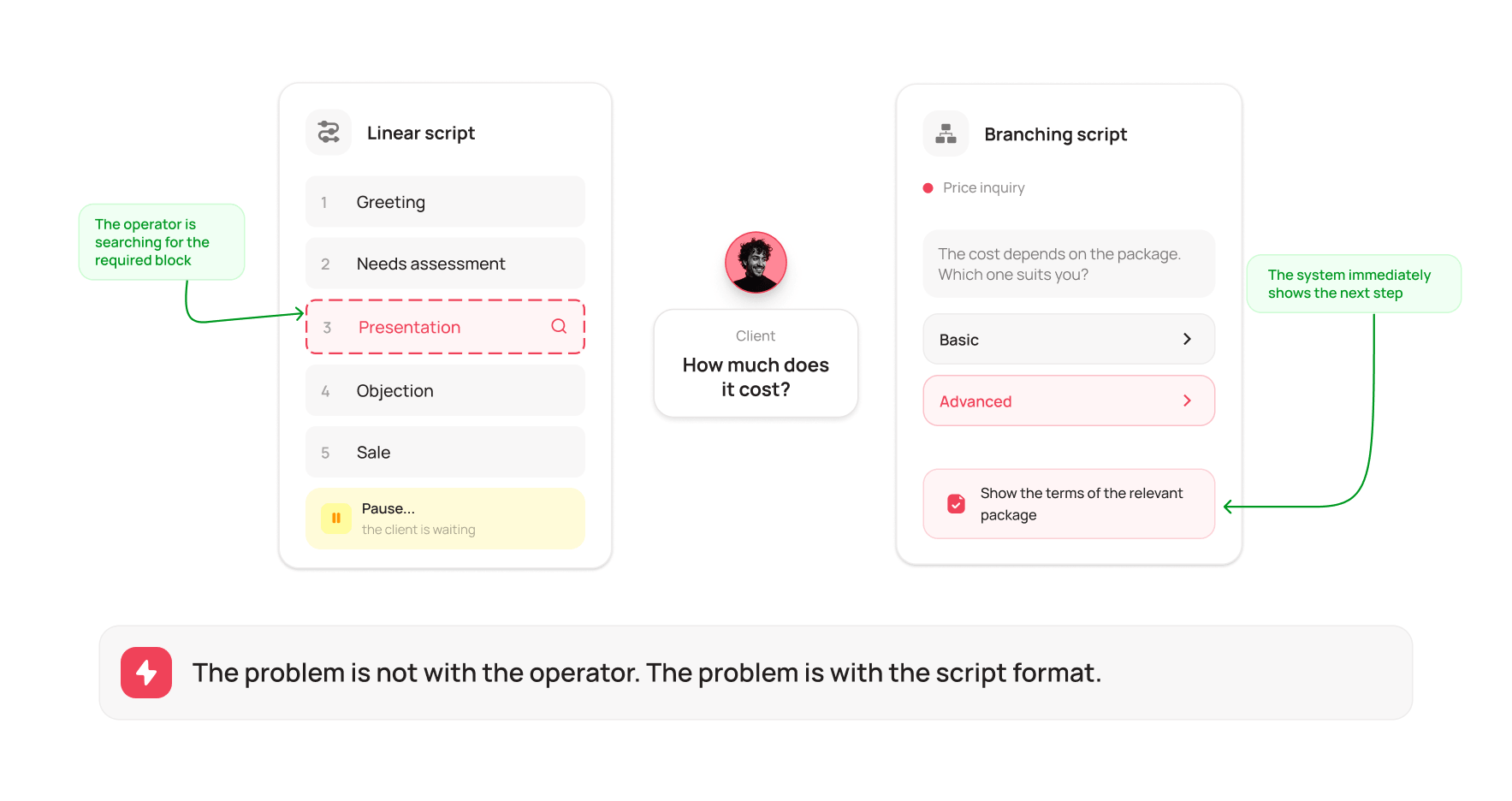
The customer listens to the pitch for less than a minute, then cuts in: “So how much does this cost?” In the script, that question comes much later, somewhere after needs discovery. While the agent hunts for the right block, the conversation stalls.
It’s not about the agent. It’s about the document itself, built as a straight line, when a conversation with a customer is never a straight line.
A conversation with a customer never follows the plan
On paper, a script looks perfectly logical:
- Greeting
- Needs discovery
- Pitch
- Objection handling
- Close
The customer never read that document, and owes it nothing. Here’s what actually happens:
“What if I pay today, when would delivery be?”
The agent opens the script, finds the payment block. There’s a link to delivery terms. While they’re scrolling, the customer is already asking the next question:
“And what if the item is out of stock?”
The conversation has already moved on. The agent is still searching the document.
One question, four different scenarios
The agent asks the customer a simple question:
“Would you like to hear more about the terms?”
And depending on the answer, the conversation splits four ways:
| Customer’s answer | What the agent needs to do next |
|---|---|
| “Yes” | Continue the pitch |
| “No” | Find out why |
| “I’m already using a competitor” | Handle the competitor objection |
| “Call me back tomorrow” | Wrap up politely and agree on a time |
Four routes from a single point. And the agent has to find each one in the same document, instead of the system simply surfacing the right step for whatever the customer just said.
Agents shouldn’t have to hunt for the right answer
It’s easy to say the agent just wasn’t prepared enough. But even a strong agent can’t hold every objection, every promo condition, and every exception in their head. When the right answer has to be searched for mid-call, a pause creeps in, and the customer notices.
Worth noting. This isn’t about skill. A linear document simply can’t support a non-linear conversation, no matter how well the agent knows it.
Agents shouldn’t have to find the logic of the conversation. The logic of the conversation should lead the agent.
The question isn’t whether an agent needs a script at all. It’s whether that script actually helps carry the conversation, or forces the agent to dig through it mid-call.
What this actually sounds like on a call
The exact same customer line can leave an agent in completely different positions, depending on how the script is built.
Linear script
“So, tell me what caught your interest?”
“How much does it cost?”
“One second… let me check.”
“Okay, I’ll wait.”
The answer is in the script somewhere, the agent just has to find it. A few seconds of silence, and the conversation already loses its rhythm.
But what if the conversation could work completely differently: sharper, faster, without that scramble to find the right paragraph?
That’s exactly what a branching script offers. Instead of one continuous document, it breaks the conversation into individual steps and shows the agent only the step that’s needed right now, based on what the customer just said. Not a text to read and memorize, but a logic that carries the conversation forward on its own.
This isn’t just about agent convenience. According to a Software Advice survey, 69% of respondents said their experience improves when an agent doesn’t sound like they’re reading from a script. That confirms something simple: the way an agent carries a conversation shapes how the whole service is perceived.
Branching script
“So, tell me what caught your interest?”
“How much does it cost?”
“It depends on the plan you pick. Are you looking at the basic or the extended package?”
The moment the price question comes up, the script routes the agent straight to the right block. The next step already depends on the answer: “Basic” leads to plan terms, “Extended” leads to the other package’s terms.
The difference isn’t that one agent knows the answer and the other doesn’t. It’s whether that answer has to be searched for mid-call at all.
Three principles of a script that works mid-call
1. The agent sees only the step that matters right now. Not an entire document with dozens of scenarios, just the one block for the customer’s actual answer.
2. Every customer answer leads to its own next scenario. “Yes,” “no,” “too expensive,” “call me back tomorrow” are all separate routes, not exceptions the agent has to dig up somewhere.
3. The scenario is easy to update as things change. A promo changes, delivery terms change, the product changes: the scenario gets updated, not rewritten from scratch.
This isn’t just a sales problem
- In support, customers describe their issue in whatever order makes sense to them, not the order a diagnostic script expects.
- A recruiter gets a counter-question mid-interview that no linear script accounted for.
- In financial services, the customer’s answer immediately determines what comes next: a debt case, an insurance claim, or loan terms.
In every one of these, the conversation can go in different directions depending on what the customer says. It’s just most visible in sales, where hesitation or a long pause can cost an agent the customer’s attention, and sometimes the deal itself.
What this means for a contact center leader
Once a script stops being something to read and starts working differently, several things change at once:
- new agents get up to speed faster, since they don’t have to memorize an entire document upfront;
- call quality depends less on how well any one agent happens to remember the script;
- it’s easier for leaders to standardize conversation logic across the whole team;
- agents spend less time searching for the right block mid-call.
That’s why, for complex scenarios, it makes sense to turn a script from a document into a tool that guides the agent step by step, based on what the customer actually says.