Why Calls Keep Dropping, and What Your Connection Infrastructure Has to Do With It
A call drops in the middle of a conversation. You and your client start talking over each other for a second because the voice arrives with a delay. Then the sound just disappears, right when you need to agree on the details of a deal.
Your client isn’t going to figure out why the connection failed. They’ll simply remember that the call didn’t go well. And the cause might not be your internet or theirs, but how the IP telephony infrastructure you’re using is actually built.
What clients experience as “poor connection”
In practice, call quality comes down to three simple things:
- Sound quality. The voice comes through clearly, without crackling or distortion.
- No dropped calls. The conversation doesn’t cut off mid-sentence.
- Stability under load. A single call goes through fine. But when dozens of lines are active at once, quality should stay the same.
That last point is hard to assess before you sign up. A test call almost always goes perfectly: one channel, a quiet network, zero load.
But your team isn’t the only one using the provider’s infrastructure. During the same hours your managers are calling, so are the managers of hundreds of other companies connected to that same provider. Peak load isn’t created by your twelve lines, it’s created by the system’s total traffic on a Monday at ten in the morning.
So stability under load doesn’t depend on the size of your company, it depends on how much capacity is built into the infrastructure and how that traffic gets distributed. A five-person company will feel the problem just as much as a two-hundred-agent call center.
GSM gateways: what determines call quality
A GSM gateway is a device with a SIM card that converts a mobile signal into a signal for your company’s communication system.
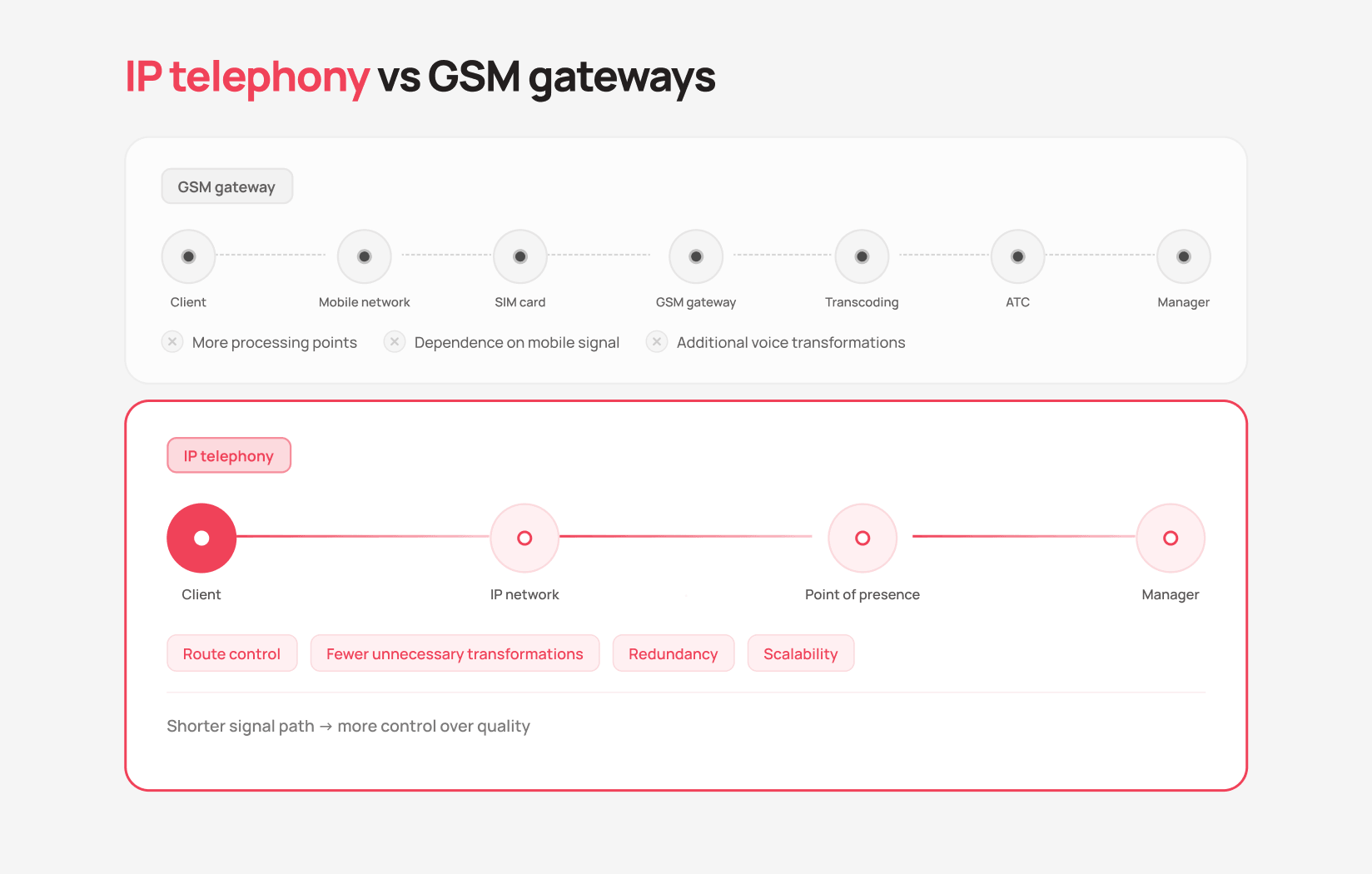
This setup emerged when a stable office internet connection was expensive and unreliable. Conditions changed, but the workaround stuck around. Another participant now stands between you and your client, and your call quality depends on it: the carrier’s mobile network. A good office internet connection can’t compensate for that, because the signal has already passed through a stretch you have no control over.
Sound. Voice over a mobile network travels in a narrow frequency band: high frequencies get cut, sound goes muffled, similar consonants blur together. A last name has to be spelled out letter by letter, an email address gets repeated three times and still comes out wrong. Modern mobile networks can carry a wider band, but the gateway sits at the boundary between the mobile and IP networks and re-encodes the signal. That’s exactly where quality gets lost.
Stability. Call quality depends on the radio signal strength at the physical location of the equipment, usually a server room or utility closet chosen for convenience of installation, not signal strength. Add to that carrier limits on the number of calls from a single number, anti-fraud restrictions on bulk calls, and a limited number of channels on the gateway itself.
How IP telephony differs from GSM gateway solutions
In IP telephony, voice is transmitted over the internet using VoIP (Voice over IP). A separate signaling protocol, SIP (Session Initiation Protocol), handles the call itself: connecting the parties, transferring the conversation to another manager, putting it on hold, and ending it correctly.
For a business, this means the connection isn’t tied to a SIM card or mobile signal quality. Quality instead depends on the IP infrastructure, the signal’s route, and the load on the system, parameters a provider can actually control.
With GSM gateways, the mobile network works however it works. With IP infrastructure, a provider can directly manage the voice path: optimize routing, use multiple points of presence, and add redundancy to individual components. UniTalk runs on this model: distributed IP infrastructure with direct carrier connections and no unnecessary intermediaries along the call route.
There’s still a condition on the user’s side: a stable connection over Wi-Fi, home internet, or mobile data. The difference is that you can measure the quality of that connection and change how you connect if needed. You can’t do the same with a SIM card’s signal strength inside a GSM gateway.
Simply supporting IP telephony doesn’t guarantee anything on its own. What matters is how the provider actually built their infrastructure.
Why distance affects the quality of international calls
A call travels a physical path from one speaker to the other. The closer to the user the point handling the call is located, the shorter that path.
This matters especially for companies with clients in other countries or a distributed team. A longer route can increase latency, which is what makes people start talking over each other or asking one another to repeat themselves.
That’s why, for international calls, where the infrastructure carrying the voice is physically located matters.
What’s happening under the hood
Call quality isn’t shaped by a single factor. What matters is the voice transmission technology, the codecs, latency, connection stability, and how the provider built its infrastructure.
Codecs and transcoding: what happens to your voice during a call
Before transmission, a voice signal is compressed and encoded using a codec. Different codecs affect sound quality and bandwidth requirements differently. So the choice of codec directly affects how clear the voice will sound.
A separate issue is transcoding: converting voice from one codec to another.
If the signal gets re-encoded multiple times along the call’s path, each conversion becomes an extra point where sound quality can degrade or additional latency can creep in.
That’s why, in IP infrastructure, it matters how many of these conversions the voice goes through on its way to the other person.
Why quality can drop under load
When many calls happen at once, what matters isn’t just internet speed, it’s also latency and jitter.
Latency is the time it takes a signal to travel from one speaker to the other. The longer the route and the more intermediate nodes along the way, the higher the latency. In conversation, this shows up as a pause that makes people start talking over each other.
Jitter is the unevenness in how voice packets arrive. It can make the voice sound choppy, distorted, or broken up.
Quality needs to stay stable even when many managers are on calls at the same time.
Points of presence and redundancy
Two things matter especially for infrastructure stability: points of presence and redundancy.
A point of presence is a physical location where a provider has equipment for receiving and processing calls. Several independent points across different regions help shorten the signal’s route and reduce dependency on any single point in the infrastructure.
Failover is the automatic switch to a backup resource when the primary one becomes unavailable. It reduces the risk of a single component failure taking down the entire phone system.
As a result, an individual failure doesn’t have to mean the whole system stops. Load can be shifted to another resource, and the phone system keeps running.
Another metric worth checking is uptime, the percentage of time a service runs without interruption. UniTalk’s uptime is 99.98%, meaning the service runs with virtually no downtime. It’s a measurable, verifiable figure, not a marketing line.
What to ask a provider before signing up
Call quality depends on infrastructure, so before connecting, it’s worth asking your provider exactly how theirs is built.
- What technology is used to transmit voice: GSM gateways or IP telephony?
- How is the call route built, and where are the points of presence located?
- Are there direct connections to carriers?
- What happens if an individual infrastructure component becomes unavailable?
- How does the system perform under peak load?
- What is the service’s actual uptime over a given period?
These questions will help you evaluate not just the phone system itself, but the infrastructure behind its call quality.
Call quality: the foundation, not the whole system
A stable voice connection is a basic requirement for any system a business uses to talk with clients. If a conversation keeps dropping or the parties can’t hear each other well, nothing that happens afterward matters much.
But a stable connection on its own isn’t enough either. Once a client has called, a business needs to see the interaction history, work with its CRM, analyze conversation quality, unify channels, and understand what to do with each inquiry next.
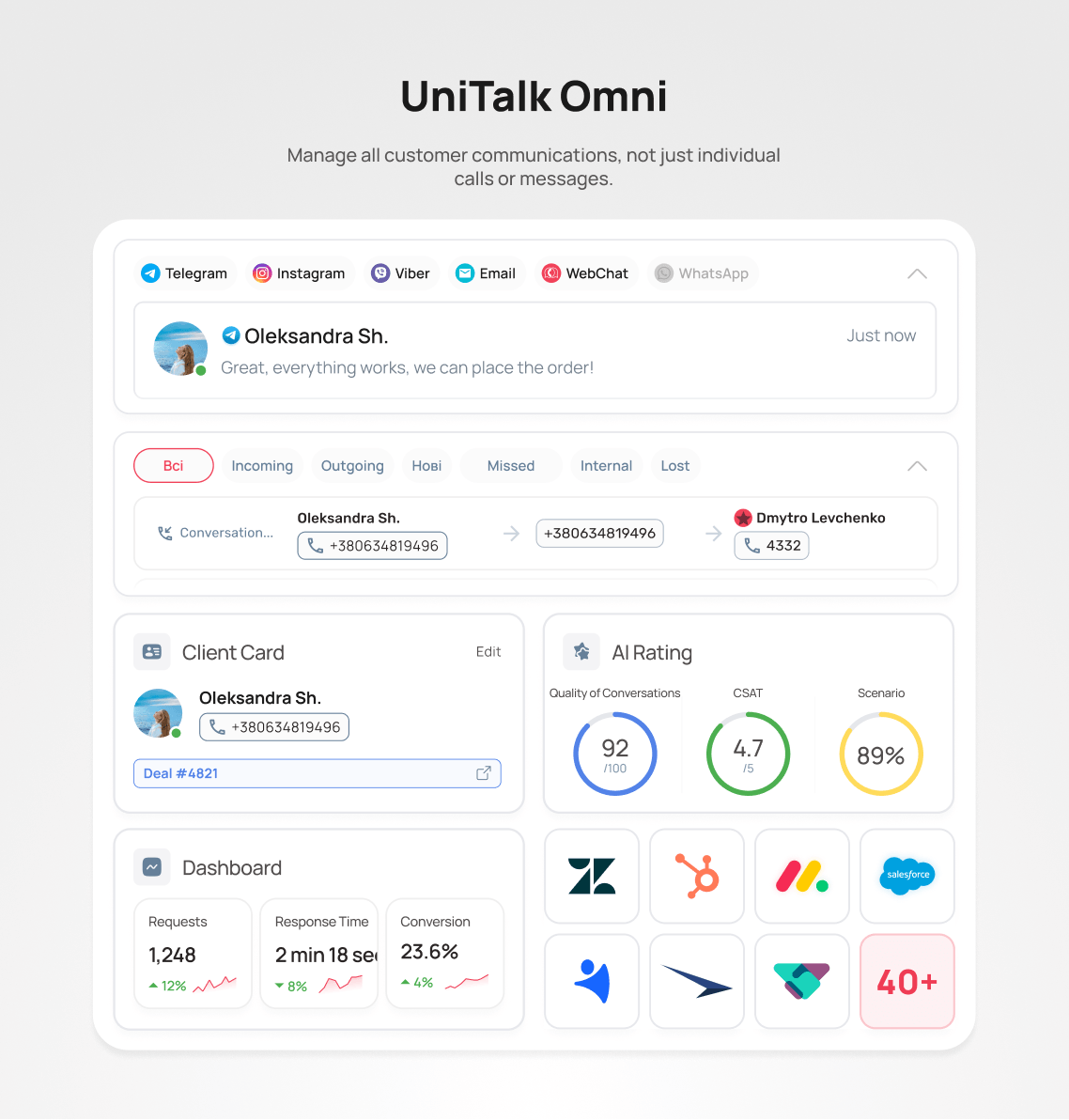
UniTalk Omni brings voice calls, chats, messengers, broadcasts, AI analytics, and CRM integration together in one system. So your team gets more than just a channel for calls, it gets an environment for managing the entire customer conversation.