Does a Good Operator Need to Know Everything by Heart? Contact Center Myth #3
Picture an ordinary day at a contact center. The operator knows the product, the rates, the current promotions, the escalation rules, the exceptions, and dozens of internal procedures.
Then the company changes one condition of a promotion.
And suddenly it turns out some operators are already working under the new rules, others are still using the old ones, and a few read the update but didn’t retain every detail.
The problem here isn’t any individual’s memory. The problem is that the process depends far too heavily on it.
Let’s look at why an operator’s skill isn’t measured by how much information they can hold in their head, and what the process needs to look like so the operator can focus on the customer instead.
Why knowing the product well enough isn’t enough anymore
The old logic seemed simple: learn the product, memorize the basic rules, and you’re ready to talk to customers.
But the more complex the business, the less that’s actually true.
During a single interaction, an operator may need to account for:
- the rate plan and the product’s specific conditions;
- the current promotion and its exceptions;
- mandatory questions to ask;
- the internal procedure for that type of request;
- escalation rules;
- the nuances of handling different customer segments;
- the information that needs to be logged after the call.
And this list never stays still. Conditions change, new products launch, promotions get updated, internal processes shift.
So the problem isn’t that the operator “didn’t study the material well enough.” You simply can’t keep expanding the amount of information a person has to carry in their head and expect that to deliver consistent quality.
Knowing more doesn’t mean serving better
A good operator isn’t someone who can recite the entire knowledge base without a prompt.
What matters far more is what they do during an actual conversation:
- listening closely to the customer;
- understanding what they actually need;
- asking the right follow-up questions;
- reading the situation correctly;
- finding a solution instead of just quoting a rule;
- not skipping any critical step in the process.
In that moment, the operator isn’t just processing information. They’re listening, analyzing, responding, asking questions, and tracking what comes next, all at once.
If on top of that they also have to recall dozens of rules and dig through memory for the right version of the terms, some of that attention stops going to the customer.
So the system’s job isn’t to help the operator memorize even more.
It’s to take off their plate the things they never needed to memorize in the first place.
When service quality depends on who happens to answer
Picture three operators.
- The first has been with the company for five years and remembers almost every nuance.
- The second joined two months ago and hasn’t run into some of the edge cases yet.
- The third read the update about the latest changes but didn’t retain every detail.
A customer asks the exact same question. The answer they get can be different each time.
Not because one of the three is a bad operator, but because the process depends on personal experience, memory, and whatever each person happened to absorb.
For a contact center manager, that creates another problem: as the team grows, it gets harder and harder to keep quality consistent.
That’s where the need for standardization comes in.
But standardization doesn’t mean every operator has to say the exact same words to every customer.
Its point is that the customer gets the right outcome, no matter who picks up.
The more there is to memorize, the longer onboarding takes
This problem shows up most clearly during onboarding.
A new operator has to learn the product, the processes, the rates, the scripts, the exceptions, the escalation rules, and a long list of other details. Until they’re confident they know it all, it’s hard to let them handle calls on their own.
That creates a paradox: to start working, a new hire first has to know almost as much as someone with real experience.
The more information there is to learn before that first independent call, the longer training takes, and the more the new hire depends on a trainer or supervisor.
But an operator doesn’t have to turn into a walking knowledge base before they can start.
Some of that information can be delivered to them right as they work. Training still matters, but its goal shifts: the operator learns how to talk to customers and understand the process, instead of trying to hold the company’s entire documentation in memory.
One change to a promotion shouldn’t turn into a memory test for 50 operators
Take a simple scenario.
The company launches a new promotion with several conditions and exceptions.
Option 1
The terms get sent to operators in a work chat or dropped into a document.
Now everyone has to read the message, understand the new rules, and not mix them up with the old ones. If a doubt comes up mid-call, they also have to go dig up the right information.
Option 2
The current terms are already built into the operator’s live script, and they show up exactly when they’re needed.
Whoever owns the process updates the information centrally, and the operator is automatically working with the latest version.
The difference is clear.
In the first scenario, the company is largely counting on 50 people having read, understood, and remembered the change.
In the second, part of that responsibility moves out of individual memory and into the process itself.
That’s exactly what makes it possible to scale operations without constantly increasing how much information an operator has to carry around.
What the system should prompt the operator with, instead of memory
The logical conclusion from all of this: the job of a modern contact center isn’t to make the operator hold more in their head. It’s to make sure the right information and the next step show up exactly when they’re needed.
During a call, it helps the operator to see:
- the script for that specific case;
- prompts on what to ask or offer next;
- current information without hunting through other tabs;
- mandatory steps that can’t be skipped;
- fields where the outcome gets logged right away.
This takes the load off the operator’s memory and, at the same time, helps standardize the process regardless of who’s actually answering.
What this changes for the contact center
When part of the process logic moves out of the operator’s head and into the system, it changes more than just their day-to-day work.
Dependence on specific people goes down.
New hires find it easier to get up to speed.
Managers find it easier to maintain one consistent standard across the team.
And process changes no longer have to turn into a “learn it and remember it” task every single time.
This matters especially for contact centers where the team is growing, processes are multiplying, and information keeps changing.
That’s why it makes sense to think of a contact center not just as a team of operators, but as a system for handling customer interactions, one where you need to manage not only the calls but the entire process behind them. That’s in line with how UniTalk Contact Center is positioned today.
How this works in UniTalk Contact Center
In UniTalk Contact Center, operators can work with Scripts and Forms directly, right in the middle of a conversation with a customer.
The Script prompts the next step
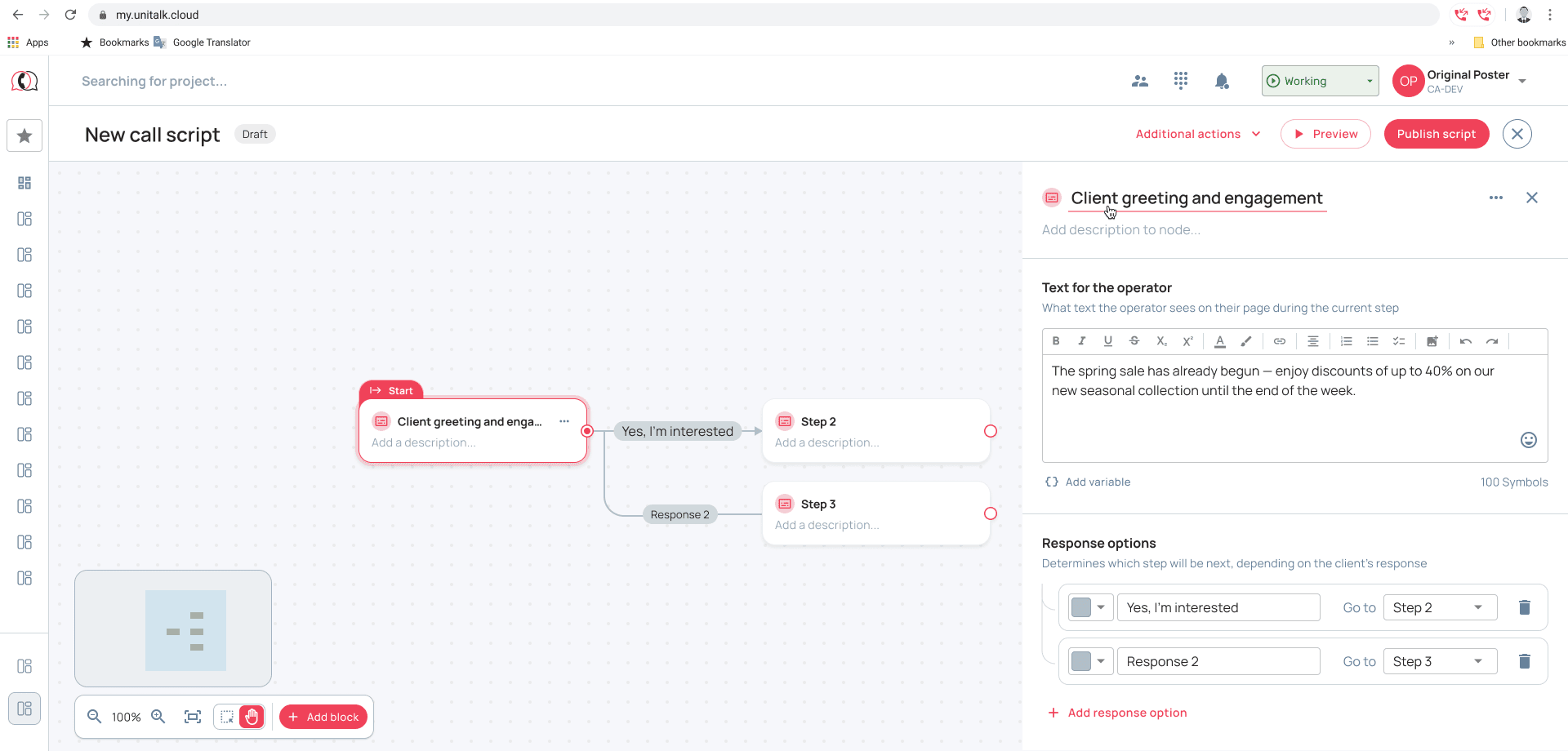
A ready-made script helps the operator move through the right process without having to hold its entire logic in memory.
What matters here isn’t that the operator is “reading a script.” What matters is that the necessary steps are already built into the process, and the operator works through them as the conversation unfolds.
We covered how branching scripts work in detail in a separate piece on branching scripts in UniTalk Contact Center, so we won’t repeat that mechanic here.
The Form captures the outcome of the conversation
While the call is happening, the operator fills in the relevant fields right away: the outcome of the request, key details, or any other fields the process calls for.
That means less information to remember “for later,” and less risk that an important detail gets lost once the call ends.
As a result, the technology solves several problems at once: it reduces dependence on any one person’s memory, cuts down on missed steps, and makes the process more stable as the team grows.
A good operator doesn’t have to remember everything
An operator’s skill isn’t measured by how many pages of instructions they can recite without help.
A good operator listens to the customer, understands what they need, steers the conversation well, and knows what to do next.
And it’s the contact center’s job to give them the conditions to do that.
That’s why a mature process runs on a simple principle:
less dependence on any one person’s memory → fewer missed steps → a more stable outcome → more attention for the customer.
And that’s how technology stops being a substitute for a good operator, and becomes the thing that backs them up.